




Description
Collector's Note – Why This Issue Matters
Carl Jung on the cover of Time Magazine on February 14, 1955 documents one of the most significant figures in the history of psychology at a precise and consequential moment in his life and legacy. Jung was seventy-nine years old when this issue appeared — he would die in June 1961 — and the mid-1950s represented the period when his ideas were achieving their broadest mainstream American cultural penetration. Analytical psychology, the collective unconscious, archetypes, introversion and extraversion, the shadow, the anima and animus — concepts that Jung had developed over decades of clinical practice and theoretical writing were entering the general cultural vocabulary in a way they had not previously, driven partly by the postwar American appetite for psychological frameworks and partly by Jung's own late-career writings, which had grown increasingly accessible and spiritually oriented. Time's decision to put him on the cover in February 1955 reflects the magazine's recognition that Jungian psychology had become a genuine phenomenon of American intellectual life, not merely a specialized academic matter. For collectors exploring the Time magazine archive from the mid-1950s, this cover sits alongside the Claire McCardell and Ernest Hemingway covers from the same year as one of the most culturally significant profiles the magazine published in 1955.
The cover date — February 14, Valentine's Day — carries a certain unintentional aptness for a psychologist whose work was so deeply concerned with the inner life, with the relationship between the conscious and unconscious mind, and with the psychological dimensions of love, creativity, and spiritual experience. Jung's influence by 1955 extended well beyond clinical psychology into literature, art, anthropology, and religious studies, and the breadth of that influence is precisely what made him a Time cover subject rather than a purely academic one. His disagreement and eventual break with Sigmund Freud, which had occurred decades earlier, had by the mid-1950s settled into the kind of historical perspective that allowed Time to engage with Jung on his own terms rather than primarily in relation to Freud. The issue functions as a primary document of how American mainstream journalism understood Jungian psychology at the moment of its widest cultural influence. For collectors building a documentary archive of mid-1950s American intellectual culture, this is an essential entry.
Jung's subsequent reputation has only grown more complex and more widely debated, with ongoing scholarly engagement with both his theoretical contributions and the more controversial aspects of his biography and wartime conduct. But in February 1955, Time's framing of him was one of serious intellectual achievement and enduring influence — a portrait of a thinker whose ideas had proven durable and generative across multiple fields of human inquiry. The cover is a primary document of that specific moment of cultural reception, before the full complexity of his legacy had been subjected to the scrutiny that later decades would bring.
About the Publication
Time was founded in 1923 by Henry Luce and Briton Hadden as the first American weekly news magazine. By 1955 it was one of the most widely read publications in the United States, reaching millions of Americans weekly with its signature format of opinionated news summaries organized across departments — National, Foreign, Business, Science, Medicine, Arts — anchored each week by a cover story on the figure or event the editors judged most significant. Its Science and Medicine coverage in the mid-1950s regularly engaged with major figures in psychology, psychiatry, and the emerging behavioral sciences, reflecting the postwar American cultural investment in psychological frameworks as tools for understanding both individual and social life.
Key Highlights Inside
- Carl Jung cover feature — The cover story examines Jung and his analytical psychology at the moment of their broadest American cultural penetration, when concepts like the collective unconscious, archetypes, and psychological types had entered general intellectual discourse far beyond the clinical psychology community.
- Jung at seventy-nine — late career documentation — The issue captures Jung in his final decade, when his theoretical framework was fully developed and his late writings were emphasizing the spiritual and mythological dimensions of the psyche that had become central to his work and his popular appeal.
- Mid-1950s American psychology in mainstream culture — Published during the postwar period of intense American interest in psychological frameworks, the issue documents the mainstream cultural reception of Jungian ideas at the precise moment they were most widely discussed outside academic and clinical contexts.
- Primary source for intellectual history research — As a contemporaneous account of Jung's standing and influence in American intellectual life, the issue provides research value for historians of psychology, cultural history, and the postwar American engagement with European intellectual traditions.
Condition & Rarity
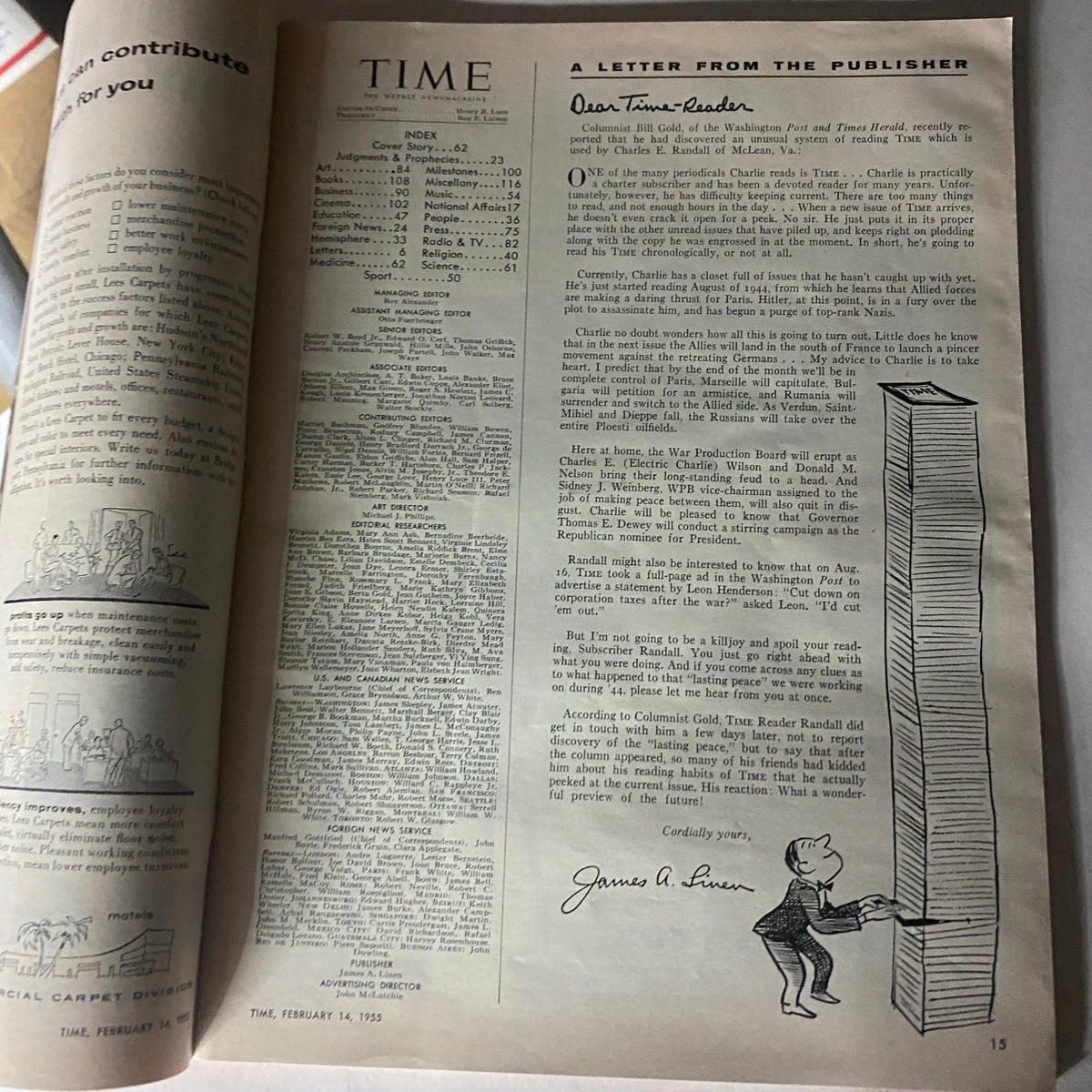
Time issues from February 1955 are now seventy years old, and the condition notes for this surviving copy are specific and consequential: creases on the front cover and pages, marks, potential tears, and water damage. These are among the more serious condition issues a vintage periodical can present, and collectors should assess them carefully in available photographs before drawing any conclusions about display or research suitability. Water damage in particular varies enormously in its actual impact — light tide lines on margins affect a copy's grade far less than warping, staining across the cover portrait, or damage to the central pages of the cover story. Cover creasing directly affects the visual integrity of Jung's portrait, which is the primary display element for this issue. Protective plastic covering indicates deliberate preservation storage, though it does not reverse damage that predated enclosure. For research and reference purposes, copies with condition imperfections of this nature retain documentary value; for display-quality collectors, careful examination of the cover surface and the extent of water damage is essential before any evaluation. Handling any seventy-year-old magazine with water damage requires particular care given the increased brittleness that moisture damage accelerates in acidic paper stock.
Looking for More Issues Like This?
Time covers devoted to major figures in psychology and intellectual history are among the rarer entries in the magazine's archive, and a Jung cover from the mid-1950s — when his cultural influence was at its American peak — is a genuinely specific find for collectors of intellectual history documentation. The full Time magazine archive at OriginalMagazines.com is the best place to explore other landmark covers from the magazine's mid-century run, including other significant profiles from the magazine's Science, Medicine, and Arts coverage during its most intellectually ambitious period. For collectors focused on the specific cultural moment this issue inhabits, the 1955 magazine collection gathers contemporaneous material from one of the most culturally rich years of the postwar decade.