

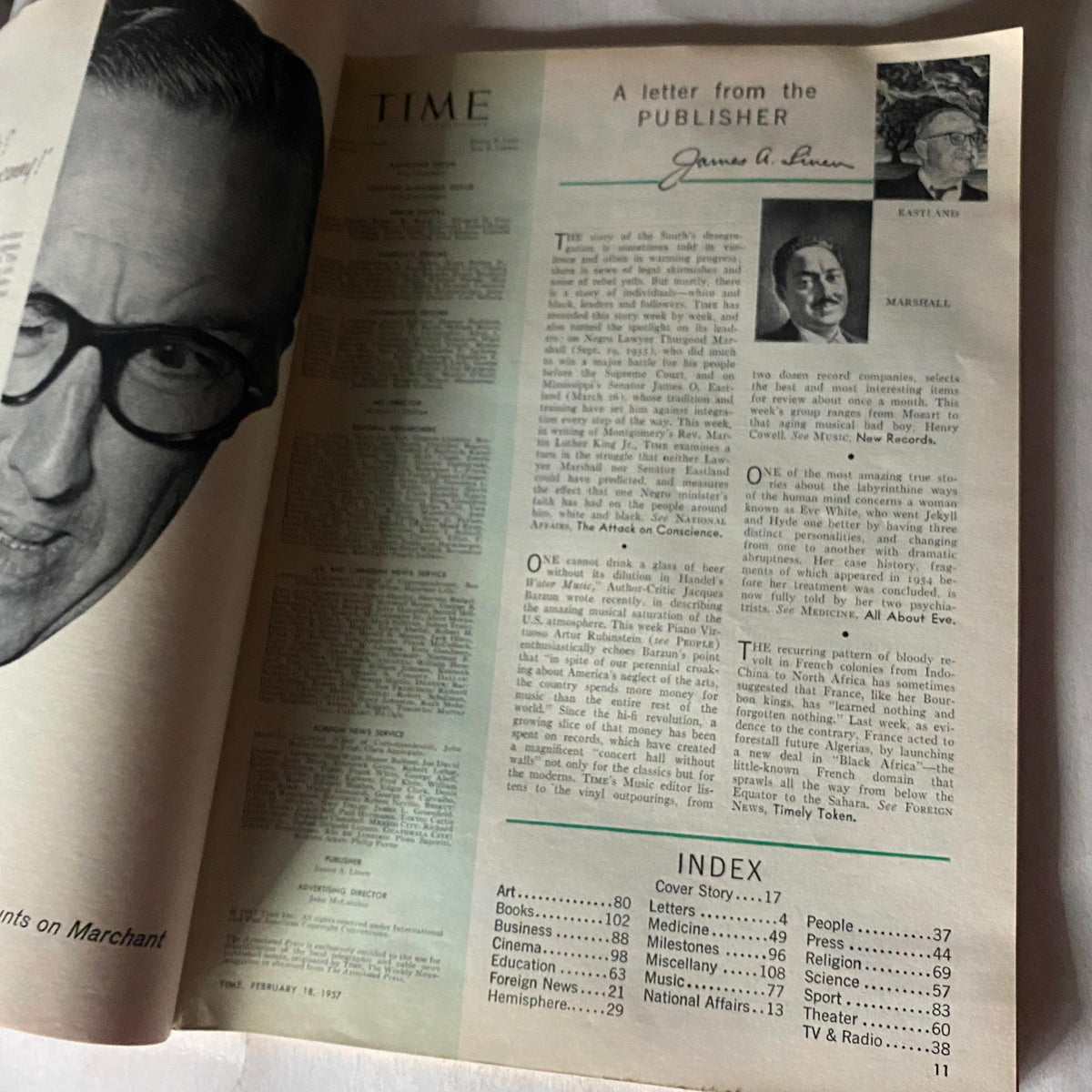


Description
Collector's Note – Why This Issue Matters
February 18, 1957 marks one of the most consequential moments of recognition in the history of the American civil rights movement. The Montgomery Bus Boycott had concluded just two months earlier, on December 20, 1956, when the Supreme Court's ruling in Browder v. Gayle desegregated Montgomery's city bus system after 381 days of sustained, nonviolent economic pressure. Martin Luther King Jr. had emerged from that campaign as the most visible leader of a movement that the national press was only beginning to fully comprehend. A Time cover in February 1957 was the mainstream American media's most authoritative signal that King had become a figure of national — not merely regional — significance. For a twenty-eight-year-old minister from Atlanta to appear on the cover of the country's dominant newsweekly just weeks after the boycott's conclusion is a measure of how rapidly the civil rights struggle had moved to the center of American public life.
For collectors focused on Martin Luther King Jr. magazine coverage, this February 1957 Time issue is the foundational document — the earliest major mainstream press recognition of King's national significance, predating his later and better-known appearances across a decade of mounting civil rights victories. The cover portrait and accompanying feature represent the press's first sustained attempt to explain King to a national readership that had followed the Montgomery story but had not yet been given a full account of who he was, where he came from, and what his philosophy of nonviolent resistance actually meant. That explanatory function gives this issue a different quality than the later coverage: it is introduction rather than confirmation, and the difference matters for understanding how King's public image was constructed.
The broader context of Time magazine in February 1957 reflects an America in the early stages of grappling with the civil rights challenge to its self-image as a free society. The year ahead would bring the Little Rock Crisis, the Civil Rights Act of 1957, and the founding of the Southern Christian Leadership Conference — all developments in which King would play a central role. This issue arrived just as that arc was beginning to accelerate, making it a document of the movement's early national emergence rather than its later celebrated milestones. For collectors building an archive of magazines from 1957 that document the civil rights era, this cover is among the year's most historically significant.
About the Publication
Time magazine, founded in 1923 by Henry Luce and Briton Hadden, was by February 1957 in its thirty-fourth year of publication and firmly established as the dominant weekly news magazine in the United States. Volume 69, Number 7 places this issue well into the magazine's postwar period of maximum circulation and cultural influence. Time's cover subject selection was a reliable and closely watched indicator of who the American press considered most significant in any given week, and a cover devoted to a young Black minister from the South in 1957 was a genuine editorial statement — one that not all of the magazine's readership would have received with equal enthusiasm in that moment. Henry Luce's editorial voice, shaped by his missionary upbringing and his conviction that America had a providential role in world history, gave Time's coverage of the civil rights movement a particular moral framing that distinguished it from more neutral news reporting.
Key Highlights Inside
- Cover feature on Reverend Martin Luther King Jr., published just two months after the successful conclusion of the Montgomery Bus Boycott — the first major national press profile of King as a figure of broad American significance rather than a regional civil rights story.
- Documentation of the philosophy and strategic vision of nonviolent resistance that King had developed and demonstrated through the Montgomery campaign, introducing these ideas to a national readership in extended form for the first time in a major American newsweekly.
- Historical context for the emerging civil rights movement as understood by the American mainstream press in early 1957 — a perspective that captures the movement at its moment of national emergence, before the subsequent decade of legislative battles and iconic confrontations had further shaped both the struggle and its public narrative.
- News department coverage consistent with Time's weekly format for February 1957; specific article titles beyond the King cover story are unconfirmed from the listing.
Condition & Rarity
The listing directs collectors to the provided photographs as the primary condition reference, without specifying a formal grade beyond the general representation of the item. For a weekly newsmagazine now nearly 70 years old, the expected condition range includes cover wear, page toning, and the handling marks consistent with a publication that was actively read at a moment of intense public interest. The most consequential condition factor for this specific issue is the integrity of the King cover portrait — color retention, absence of significant creasing across the cover image, and the presence or absence of a subscriber label on the front cover are the attributes that most directly affect display and collector value. The protective plastic sleeve provides ongoing stabilization. Given the historical significance of this cover and the overlap between civil rights history collectors and vintage magazine enthusiasts, surviving copies attract sustained collector attention across a broad range of condition grades.
Looking for More Issues Like This?
Time's February 1957 Martin Luther King Jr. cover is widely regarded as one of the most historically significant issues in the magazine's archive — a document of the civil rights movement's national emergence that predates the better-known coverage of the decade's later milestones. If this issue has already been claimed, the Martin Luther King Jr. magazine collection at OriginalMagazines.com is the best place to explore other available covers and features from across his public career. The Time magazine collection and the 1957 magazine archive are both worth browsing for collectors building a broader record of this pivotal year in American civil rights and political history.