

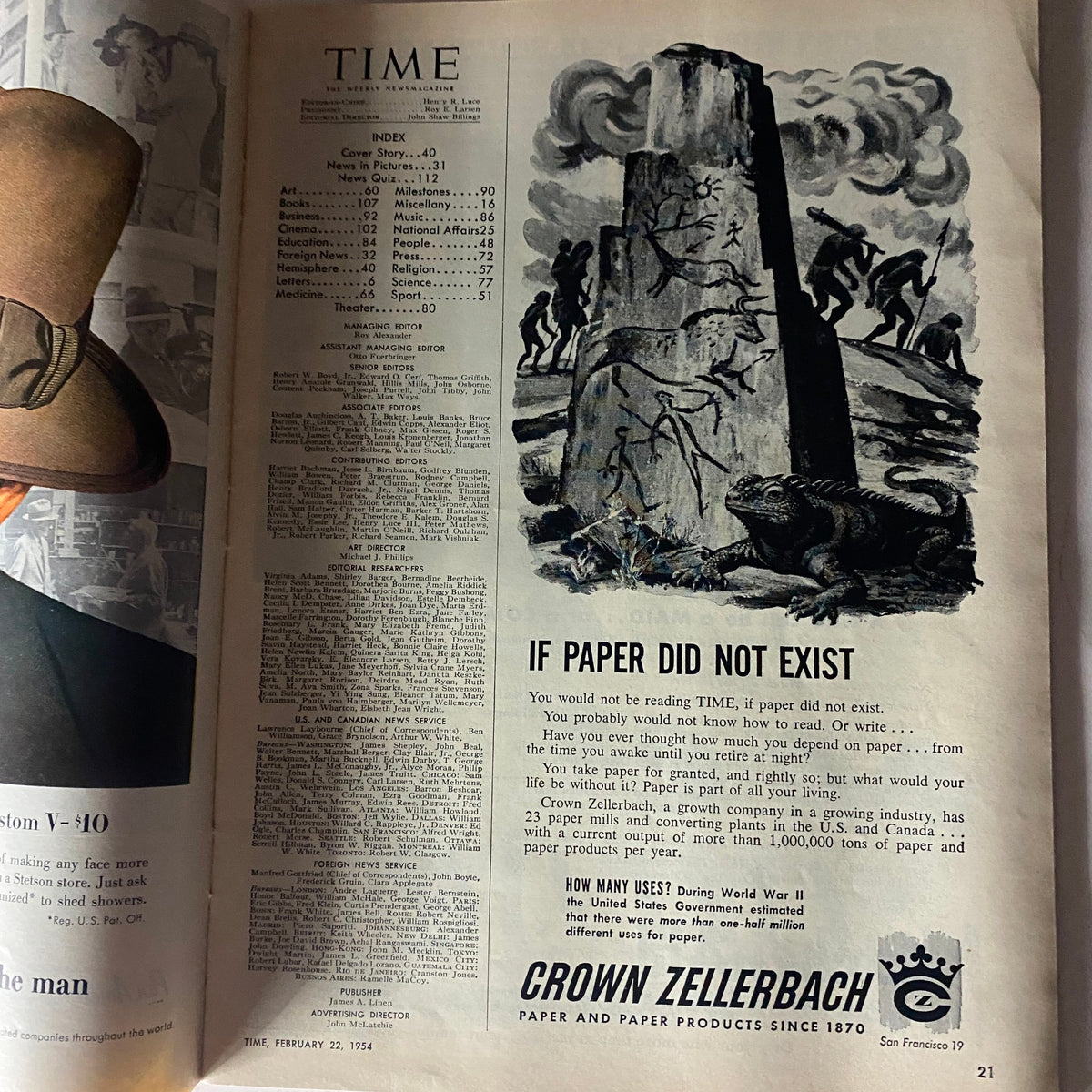


Description
Collector's Note – Why This Issue Matters
The February 22, 1954 issue of Time magazine — Volume 63, Number 8 — featuring Haitian President Paul Magloire on the cover is a primary document of a specific and historically instructive phase in the history of Haiti, American Caribbean policy, and the broader Cold War framework within which both were being understood in the early 1950s. Paul Magloire had come to power through a military coup in 1950, had subsequently held a presidential election that he won with overwhelming — and widely questioned — majorities, and had established a government that the Eisenhower administration and its predecessors regarded with considerable favor as a stable, anti-communist presence in the Caribbean. By February 1954, Magloire was approaching the most consequential test of his presidency: Hurricane Hazel, which would devastate Haiti in October 1954 and produce the economic crisis that would contribute to his eventual overthrow in December 1956. But in February 1954, he was still at the height of his international profile — having recently completed a successful state visit to the United States — and a Time cover represented the American establishment press's acknowledgment that his specific combination of political stability, pro-American alignment, and personal charisma made him one of the more significant Caribbean leaders in American foreign policy. A Time cover on a Haitian president in 1954 was itself a historically uncommon event, and the specific moment of the Magloire cover — its post-state-visit timing and its Cold War Caribbean context — gives it a documentary significance that extends beyond its immediate subject. Collectors building a focused archive of Cold War-era American press documentation of the Caribbean and Latin America will find the Time magazine collection at OriginalMagazines.com the most comprehensive resource for issues from this period.
The Cold War context of a February 1954 Time cover on a Caribbean head of government deserves explicit appreciation. The early 1950s were the years when the United States was most actively engaged in defining and defending its hemispheric sphere of influence against communist penetration — the Guatemalan coup supported by the CIA was just four months away in June 1954, the overthrow of Arbenz designed to prevent what the Eisenhower administration characterized as communist infiltration of a Western Hemisphere government. In this atmosphere, a Haitian president who maintained stable, pro-American governance and who had recently visited Washington was exactly the kind of Caribbean leader that American foreign policy wanted to celebrate and support, and a Time cover was one of the most public forms that celebration could take. The magazine's engagement with Magloire in February 1954 was therefore not merely a profile of a foreign head of government but a document of the specific American foreign policy priorities that were shaping the Caribbean basin in the years before the Guatemalan coup and the Cuban Revolution that would make the region the Cold War's most contested American hemisphere theater. The 1954 magazines collection at OriginalMagazines.com gathers publications from a year that was consequential across American foreign policy and domestic political history.
Paul Magloire's specific historical significance as a subject also deserves appreciation for what his subsequent trajectory reveals about the limits of the American Cold War alliance-building strategy he embodied. Despite the American support his government enjoyed and despite the personal diplomatic success of his Washington visit, his government collapsed within three years of this cover — undone by the hurricane's economic devastation, accusations of corruption, and the growing political opposition that the elections of December 1956 brought to crisis. His fall opened the political space that François "Papa Doc" Duvalier would exploit to seize power in 1957, beginning one of the most brutal and most durable dictatorships in Caribbean history. The Time cover of February 1954 therefore documents Magloire at the peak of his apparent success, in the last year before the forces that would destroy his government began their final acceleration — a primary source for understanding both the specific character of his regime and the specific failures of the American Caribbean policy that supported it.
About the Publication
Time was founded in 1923 by Henry Luce and Briton Hadden as the first American weekly news magazine, built on the premise that educated readers needed a single authoritative source synthesizing the week's events across politics, business, science, culture, and international affairs. By February 1954, the magazine had been operating for thirty-one years and was the most widely read newsweekly in the world, with a domestic and international readership spanning every level of educated professional life. Its international coverage in the early Cold War period was shaped by Henry Luce's personal conviction that the United States had both the right and the responsibility to lead the non-communist world, and a Magloire cover in this context reflected the magazine's broader engagement with American hemispheric policy and with the specific leaders whose alignment with American interests was being promoted and celebrated.
Key Highlights Inside
- Paul Magloire cover — Haiti's president post-Washington state visit — a major profile of the Haitian president at the height of his international profile, appearing in the aftermath of his successful state visit to the United States and representing one of the more historically unusual Time cover appearances by a Haitian head of government, documenting the specific moment of his regime's maximum American approval and diplomatic engagement.
- Cold War Caribbean policy documented — a cover appearing four months before the CIA-backed Guatemalan coup and three years before the Duvalier seizure of power in Haiti, this issue documents American Caribbean foreign policy at the specific moment when the Eisenhower administration's anti-communist hemispheric strategy was most actively being implemented and when pro-American leaders like Magloire were most valued as regional anchors of stability.
- Pre-Hurricane Hazel Haiti documented — published eight months before the October 1954 hurricane that would devastate Haiti and contribute to Magloire's eventual overthrow, this cover documents the country's political leadership at the last moment before the natural disaster that would begin the terminal phase of his regime, giving it a specific retrospective poignancy as documentation of a government on the eve of its most consequential crisis.
- Volume 63, Number 8 — thirty-first year of publication — this issue belongs to the mature phase of a publication that had spent three decades establishing the editorial format and international coverage infrastructure that made its Cold War-era documentation the most authoritative available to American readers.
- Note on additional interior content: Specific additional features, columns, and department coverage beyond the Magloire cover story are unconfirmed from available sourcing for this individual issue. The highlights above reflect what is verifiable from the cover subject, volume and issue number, publication date, and Time's thoroughly documented editorial format and priorities for the period.
Condition & Rarity
The listing describes this issue as carefully preserved and protected with a plastic covering, directing collectors to the accompanying photographs for specific condition assessment. For a seventy-two-year-old weekly newsweekly, the plastic protective covering indicates deliberate preservation effort and more careful storage than an unprotected copy would have received across seven decades. The most consequential condition factors for display and collector purposes are the integrity of the Magloire cover portrait and the completeness and readability of the cover story content. The listing does not specify the presence or absence of a subscriber address label — a meaningful display condition variable — and this should be verified against the accompanying photographs, as labeled subscriber copies are the majority of what survives from any given Time issue of this era. For a cover of this specific historical significance — a Haitian president in February 1954, at the intersection of Cold War Caribbean policy and the specific historical arc that would lead to the Duvalier years — collector and historical relevance extends across a wide condition range.
Looking for More Issues Like This?
Time covers from the early Cold War era documenting the leaders of American-aligned Caribbean and Latin American governments — and the February 22, 1954 Paul Magloire issue, appearing at the specific intersection of American hemispheric policy, Haitian political history, and the Cold War alliance-building strategy whose failures the subsequent decade would make visible, is among the more historically instructive examples — are consistently sought by collectors of Cold War political history and Caribbean regional history research. If you're building a collection of the magazine's most historically resonant mid-century international covers, the Time magazine collection at OriginalMagazines.com is the most comprehensive place to browse what's currently available. The 1954 magazines collection offers essential context from a year whose Cold War foreign policy decisions — Guatemala, Haiti, the hydrogen bomb — had consequences that shaped the hemisphere for decades.