
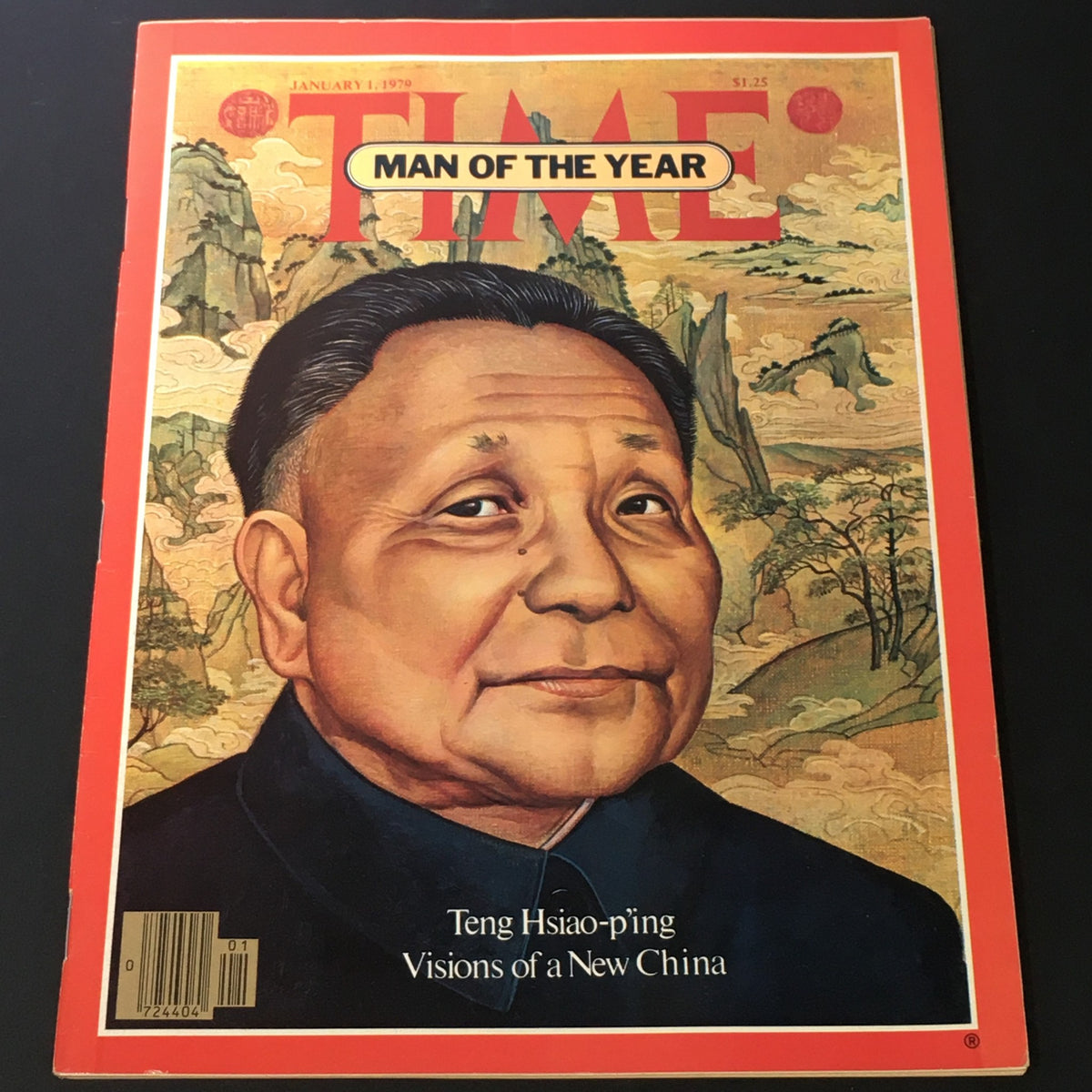

Description
Collector's Note – Why This Issue Matters
The January 1, 1979 issue of Time — the annual Man of the Year issue — names Teng Hsiao-p'ing (Deng Xiaoping in the now-standard romanization) as its honoree, and the choice stands as one of the most historically vindicated selections the magazine ever made. Deng had consolidated power in China through late 1978, outmaneuvering rivals in the post-Mao leadership struggle and launching what would become the most consequential economic transformation of the twentieth century. The Third Plenum of the 11th Central Committee, held in December 1978 — just weeks before this issue's publication — is now recognized as the formal starting point of China's Reform and Opening Up policy. Time's editors were identifying, in real time, the beginning of a process that would lift hundreds of millions out of poverty and fundamentally alter the global economic order.
The geopolitical backdrop makes the timing even more striking. The United States and the People's Republic of China formally normalized diplomatic relations on January 1, 1979 — the exact cover date of this issue. That coincidence is not incidental; the normalization of relations and Deng's domestic reform agenda were intertwined, and Time's Man of the Year selection acknowledged both dimensions simultaneously. For collectors building around vintage Time magazine issues that document genuinely world-altering moments, this is among the handful of Man of the Year covers that history has most thoroughly validated.
Deng's selection also sits within a remarkable run of consequential Time Man of the Year choices from the late Cold War period, when the magazine's annual honor carried genuine cultural weight as a marker of who had most shaped global events. The late 1970s were a period of extraordinary geopolitical flux — the Iranian Revolution, the Soviet invasion of Afghanistan, the normalization of U.S.-China relations — and this issue captures the pivot point of one of those stories at its very inception. Among surviving magazines from 1979, few carry the same combination of historical precision and long-term significance.
About the Publication
Time, founded in 1923 by Henry Luce and Briton Hadden, had by 1979 been publishing its annual Man of the Year issue — selecting the individual who had most influenced news events in the preceding twelve months — since 1927. The tradition had become a cultural institution, and the January 1 issue was reliably one of the most widely read of the year. The magazine's editorial format combined interpretive news coverage with long-form profiles, and its international affairs reporting in particular carried significant authority during the Cold War decades. Its readership was broad, educated, and engaged with both domestic and global events — and the Man of the Year issue reliably reached beyond the regular subscriber base to newsstands and general readers tracking the year's dominant story.
Key Highlights Inside
- The Man of the Year feature on Teng Hsiao-p'ing, examining his consolidation of power in post-Mao China and the early contours of his reform agenda — written at the precise moment those reforms were being announced to the world.
- Coverage of the normalization of diplomatic relations between the United States and the People's Republic of China, which took effect on the cover date of this issue.
- Standard Time year-in-review and forward-looking editorial content typical of the annual January 1 Man of the Year issue format.
- Note: Specific interior article titles and additional features beyond the Man of the Year cover package are unconfirmed for this issue. The Teng Hsiao-p'ing profile is the documented editorial centerpiece.
Condition & Rarity
Newsstand origin with no address label is the most desirable configuration for a collectible Time issue, and it is meaningfully less common than subscriber copies for this era — the majority of Time's 1979 circulation was subscription-based, meaning labeled copies significantly outnumber clean newsstand survivors in the market. Excellent condition with minimal edge wear represents a strong grade for a forty-plus-year-old staple-bound newsweekly; Time used relatively lightweight coated stock in this period that is prone to tanning and edge brittleness with age, making well-preserved copies genuinely notable. A plastic protective sleeve indicates deliberate long-term storage. When evaluating any surviving copy of this issue, the priority attributes are the color and surface integrity of the Teng Hsiao-p'ing cover portrait, the flatness and completeness of the spine, and the absence of tanning or moisture damage in the interior pages.
Looking for More Issues Like This?
The Teng Hsiao-p'ing Man of the Year cover is one of the most historically significant Time covers of the Cold War era, and clean newsstand copies are not easy to find. If this issue is no longer available, the Time magazine collection at OriginalMagazines.com covers decades of Man of the Year and major world-events issues worth exploring. For collectors focused on the late 1970s specifically, the 1979 magazine collection is a rich place to browse — it was a year of extraordinary global events, and the coverage reflects that across multiple titles.