
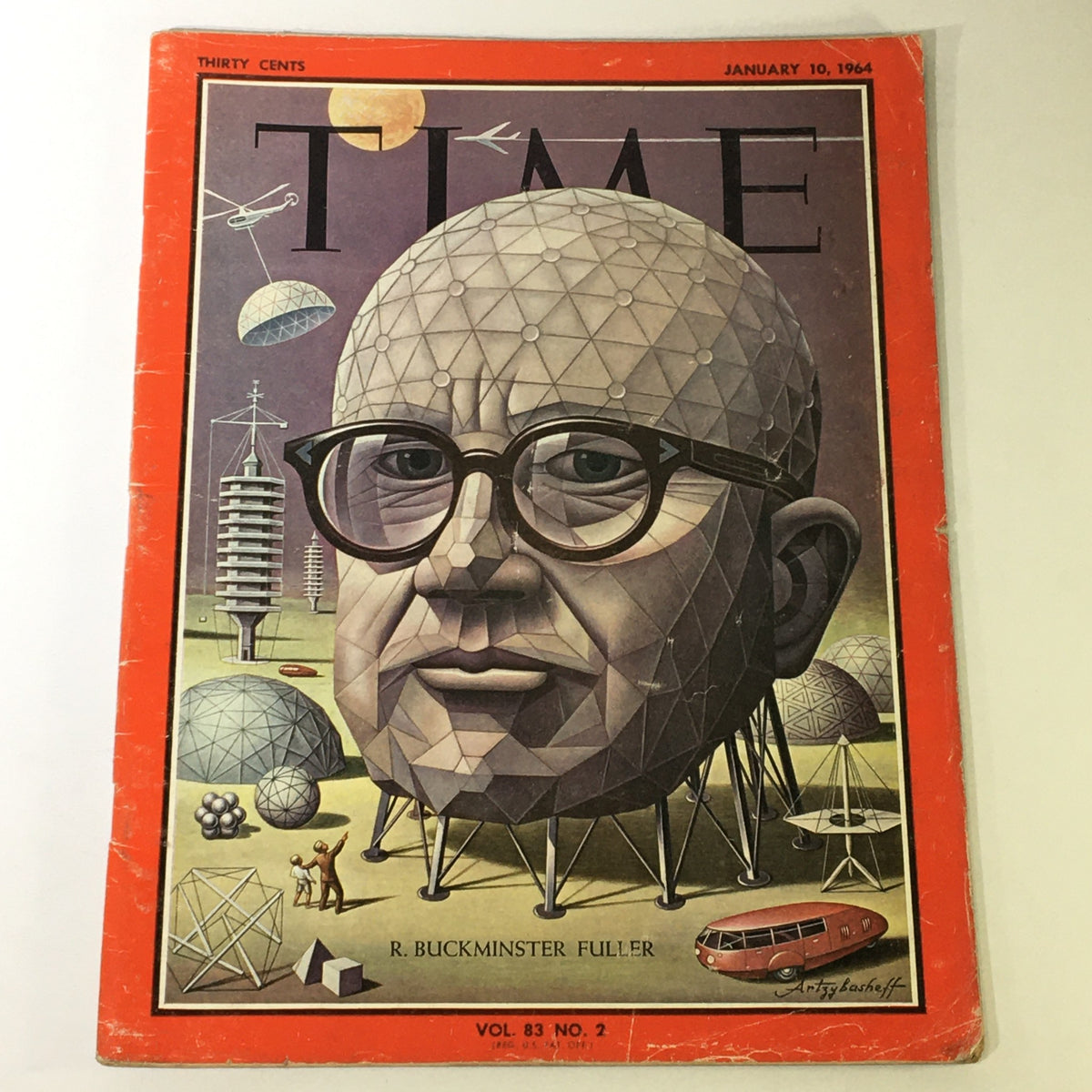

Description
Collector's Note – Why This Issue Matters
Richard Buckminster Fuller on the cover of Time in January 1964 was a cultural event as much as a journalistic one. Fuller was sixty-eight years old and at the absolute apex of his public visibility — the geodesic dome he had spent decades developing had proliferated to the point where thousands of examples existed worldwide, the United States pavilion at the 1967 Montreal Expo would soon make the structure globally iconic, and his ideas about systems thinking, resource efficiency, and what he called "doing more with less" had captured the imagination of a generation of architects, engineers, designers, and counterculture thinkers simultaneously. A Time cover in January 1964 was the mainstream confirmation of a reputation that had been building for decades in more specialized circles. For the general American reader who encountered Fuller through this issue, it was an introduction to one of the most genuinely original minds the twentieth century produced. For the architectural and design communities, it was the moment their field's most radical thinker was handed the largest platform in American journalism. Collectors building a focused archive through the Time magazine run of the 1960s will find this cover among the decade's most intellectually significant.
The January 1964 date also places this issue in a specific and charged historical moment. John F. Kennedy had been assassinated six weeks earlier, on November 22, 1963, and the country was navigating the early weeks of Lyndon Johnson's presidency in a state of collective grief and uncertainty. The decision to place Fuller — a visionary, optimistic, forward-looking figure whose entire intellectual project was about solving humanity's problems through design intelligence — on the cover in January 1964 reads, in retrospect, as a kind of editorial act of faith: a gesture toward the future at a moment when the present was almost unbearably heavy. Fuller's message, that human ingenuity could solve any material problem the species faced, was exactly the kind of thinking a traumatized country needed to encounter. For anyone researching the cultural and intellectual climate of early 1964, this issue is a document of how American public discourse was attempting to reorient itself toward the future in the immediate aftermath of catastrophic loss.
Fuller's legacy has only grown in the decades since this issue was published. His influence on sustainable design, systems thinking, architecture, and the philosophy of technology is now widely recognized across multiple disciplines, and the 1964 Time cover is regularly reproduced in retrospective accounts of his career. That means this issue functions not only as a historical document of its own moment but as a primary source cited in Fuller scholarship, design history, and architectural biography. Serious collectors and researchers across several fields actively seek it out, which gives the January 10, 1964 Time a sustained relevance that goes well beyond its age.
About the Publication
Time magazine, founded in 1923 by Henry Luce and Briton Hadden, was by 1964 the dominant general-interest newsweekly in the United States, with a global circulation that made its cover one of the most significant endorsements in American journalism. Its format combined reported news summaries across politics, business, science, culture, and international affairs with a signature essay-driven cover story that attempted to define the week's most important figure or event. The editorial voice was authoritative and confident, and the cover selection process was treated internally and externally as a statement of cultural significance. A Time cover in January 1964 carried the full weight of the publication's thirty-year institutional authority, and its choice of Fuller as the first cover of the new year reflected a genuine editorial conviction about his importance.
Key Highlights Inside
- Cover story on Richard Buckminster Fuller — architect, systems theorist, inventor of the geodesic dome, and one of the most original and wide-ranging thinkers of the twentieth century, profiled at the peak of his public reputation and cultural influence.
- Editorial content consistent with Time's January 1964 context: the first issue of a new year published in the immediate aftermath of the Kennedy assassination, with the Johnson administration newly established and the country in active psychological transition.
- Newsstand copy without subscriber label — the preferred state for display-oriented collectors, preserving the full visual impact of the Fuller cover portrait without address label interruption.
- Period news summaries, advertising, and editorial sections throughout, offering a complete cross-section of American public life and commercial culture in the first weeks of 1964.
- Note: Specific interior article titles, additional features, and the full table of contents beyond the confirmed Fuller cover story have not been independently verified from the listing. Interior details should be confirmed against a physical copy for comprehensive research purposes.
Condition & Rarity
Surviving copies of this issue present the condition profile expected of a sixty-plus-year-old weekly magazine that has passed through active use before entering a collection. Minor edge wear with some rips and marks is an honest assessment for a publication of this age; these characteristics are consistent with a copy that was read and handled rather than archived immediately, and they are accepted as authentic evidence of the object's history in the collector market. A newsstand copy without subscriber label is the preferred state for display, as the Fuller cover portrait — one of the more artistically striking Time covers of the 1960s — presents without interruption. A plastic protective sleeve indicates deliberate preservation effort by a previous owner. For collectors evaluating any surviving copy of this issue, the primary criteria are cover integrity and the legibility of the interior content; the marks noted in the listing should be assessed against the provided photographs to determine their placement relative to the cover image and key interior pages. Fuller cover issues of Time are consistently sought by architecture and design history collectors, making this a cross-community collectible with sustained demand.
Looking for More Issues Like This?
The January 10, 1964 Fuller cover is one of the more intellectually significant and actively researched issues in the Time magazine archive, sought by architecture historians, design collectors, and Fuller scholars alongside general Time completists. If this issue has already found a home, the full Time magazine collection at OriginalMagazines.com is the right place to continue exploring across the publication's decades of significant covers and historical documentation. The complete 1964 magazines collection is also worth a careful look for anyone building a broader archive of American intellectual and cultural life from this pivotal year.