
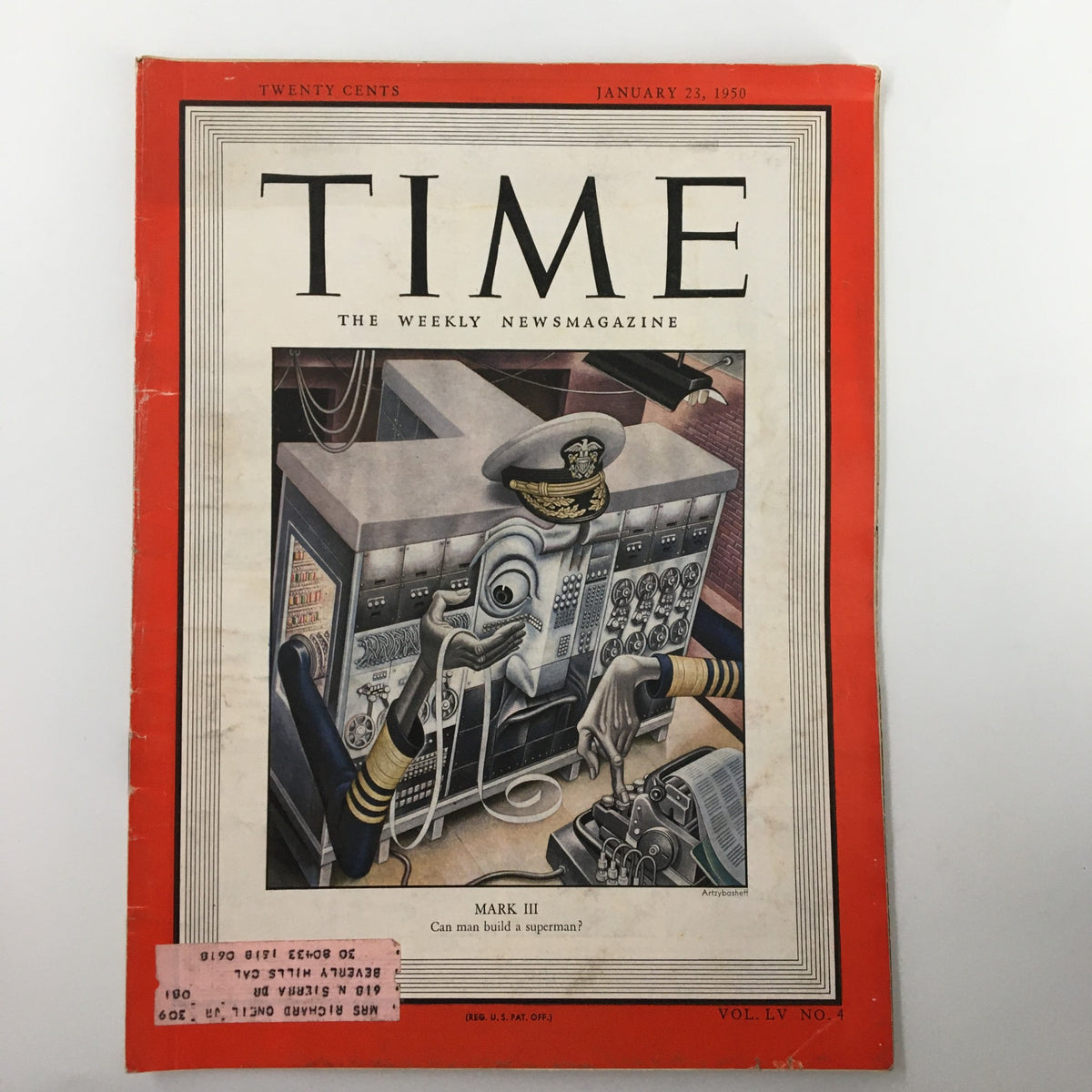


Description
Collector's Note – Why This Issue Matters
The January 23, 1950 issue of Time Magazine — Volume 55, Number 4 — carries a cover story titled "Mark III: Can Man Build Superman?" that places it at one of the most consequential and anxiety-laden moments in the history of human thinking about technology, intelligence, and the future of the species. The "Mark III" referenced in the cover line almost certainly refers to one of the early electronic computing machines being developed in American universities and research institutions in the late 1940s — machines that were, in early 1950, beginning to attract serious public attention as something more than laboratory curiosities. The question "Can Man Build Superman?" is not merely rhetorical; it reflects the genuine and widespread uncertainty of the postwar period about what these machines might eventually become, what they might be capable of, and what their existence meant for the relationship between human intelligence and the machines it was creating.
The early 1950 timing is historically precise and significant. Alan Turing had published his foundational paper on computing machinery and intelligence — the paper that introduced what became known as the Turing Test — in October 1950, just nine months after this issue appeared. Norbert Wiener's Cybernetics, which had introduced the concept of feedback systems and machine intelligence to a broad audience, had been published in 1948. The American public in January 1950 was encountering the idea of thinking machines not as science fiction but as a real and developing technology, and the cultural anxiety and fascination that accompanied that encounter was one of the defining intellectual currents of the early Cold War era. A Time cover story framing the question in terms of "Superman" — a being of superior capability — captures exactly the utopian and dystopian ambivalence that surrounded early computing in the popular imagination. For collectors who follow Time's long history of covering the intersection of science, technology, and society, the Time Magazine archive at OriginalMagazines.com documents the publication's engagement with these themes across many decades.
The January 1950 date also places this issue at a broader historical inflection point. The Cold War was fully established, the Soviet Union had successfully tested its first atomic bomb in August 1949, and American anxieties about technological competition, military capability, and the future of human civilization were running at levels that gave any discussion of superhuman machine capability an edge of genuine urgency. The question of whether man could build a "Superman" — whether technology could be used to transcend the limitations of the human — was not merely a philosophical curiosity in January 1950; it was a question with direct implications for national security, military strategy, and the survival of democratic civilization in an era of existential technological competition. For collectors building a comprehensive picture of early Cold War America and its technological imagination, the complete 1950 magazine archive at OriginalMagazines.com provides essential surrounding context from this pivotal year.
About the Publication
Time Magazine was founded in 1923 by Henry Luce and Briton Hadden as the first American weekly news magazine, and by 1950 it had been the dominant publication of its kind for more than two decades, reaching a readership that spanned virtually every level of educated American society. Under Luce's editorial vision, Time treated its cover as the most significant editorial statement in weekly American journalism, and its choices of cover subjects and cover stories across the early Cold War years reflect both the genuine complexity of the technological and political challenges facing American society and the publication's editorial responsibility to frame those challenges for a mass audience. Its science and technology coverage during this period was particularly significant — Time was one of the primary vehicles through which educated Americans first encountered the implications of nuclear power, computing, and the broader technological revolution that the war had accelerated, and its willingness to ask large, uncomfortable questions about human capability and technological destiny gave its early-1950s issues a philosophical depth that distinguished them from purely news-driven coverage.
Key Highlights Inside
- Cover story "Mark III: Can Man Build Superman?" — an early mainstream American media engagement with the possibilities and implications of electronic computing machines, published at the precise historical moment when the concept of machine intelligence was transitioning from laboratory speculation to genuine public conversation, just months before Turing's foundational paper on computing and intelligence appeared.
- Editorial framing of early computing technology through the lens of human potential and technological ambition — the specific cultural register of early Cold War America, in which questions about what machines could do were inseparable from questions about what nations could achieve and what the future of human civilization might hold.
- Coverage reflecting the broader scientific and technological landscape of early 1950 — a moment defined by the aftermath of the Manhattan Project, the early development of the hydrogen bomb, and the rapid expansion of American research institutions that were laying the foundations for the technological revolution of the second half of the twentieth century.
- Editorial content across Time's standard departmental format reflecting the news landscape of late January 1950 — the first year of the Korean War era's approach, the early Truman administration's second term, and an America navigating the dual anxieties of atomic competition and domestic anti-communist politics that defined the period.
- Period advertising throughout, capturing the consumer culture and commercial landscape of early 1950s America in the secondary documentary layer that serious Time collectors consistently find as historically revealing as the editorial content itself.
- Note: Specific interior article titles, contributing writers, and full feature details beyond the Mark III cover story are unconfirmed for this issue. The above reflects what can be responsibly attributed based on the cover subject, publication format, date, and Time's well-documented editorial practices of the era.
Condition & Rarity
Surviving copies of this issue are described as carrying a label on the front cover, in good condition with minor wear throughout and some marks visible in photographs — an honest and common condition profile for Time issues from this era, given the magazine's enormous subscription base in the early 1950s. The label's presence affects the visual presentation of the cover and is a relevant factor in collector grade assessment; label-free newsstand copies of this specific issue would represent a more desirable configuration for collectors to whom cover integrity is a primary consideration, though they are harder to locate for issues of this vintage. The overall condition — good, with minor wear and marks — indicates structural soundness and readability without claiming pristine preservation, which is the appropriate standard for a publication now seventy-five years old. The addition of a protective plastic covering reflects deliberate archival care, helping to prevent further deterioration of both the cover and interior pages. When evaluating any surviving copy of this issue, collectors should assess the extent of label adhesion and associated surface damage, the nature and placement of any marks on the cover, the integrity of the spine and binding, and the completeness of all interior pages — the combination of factors that determines where a given copy falls within the collectible range for a historically significant early Cold War Time issue.
Looking for More Issues Like This?
A Time cover story asking whether man can build a superman — published in January 1950, at the precise dawn of the computing age — is one of the more philosophically resonant and historically prescient issues in the magazine's early Cold War run, and clean surviving copies with minimal label damage are worth pursuing seriously. If this issue has already found its home, the Time Magazine archive at OriginalMagazines.com is the most comprehensive place to continue searching across the publication's decades of science, technology, and cultural coverage. For collectors whose focus is the specific texture of early Cold War America and its technological imagination, the 1950 magazines collection brings together material from across the American press during one of the more consequential opening years of the postwar decade.