

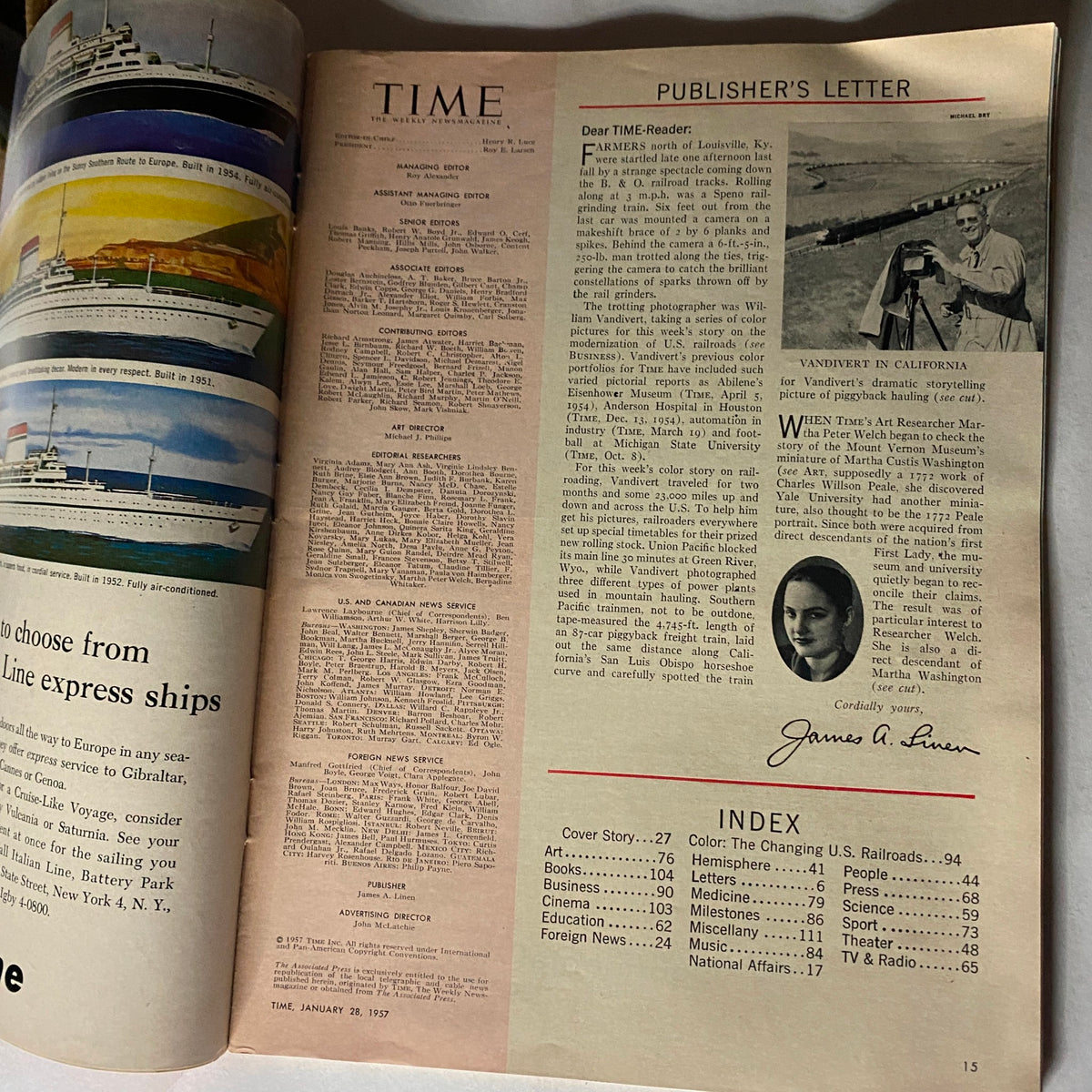


Description
Collector's Note – Why This Issue Matters
The January 28, 1957, issue of Time magazine — Volume 69, Number 4 — places Saudi Arabia's King Saud on the cover at one of the most consequential moments in the modern history of the Middle East and American foreign policy. King Saud bin Abdulaziz had ascended to the throne in November 1953 following the death of his father, the kingdom's founder Ibn Saud, and by January 1957 he was navigating a geopolitical landscape of extraordinary complexity. The Suez Crisis had concluded just weeks earlier, in late 1956, fundamentally reshaping the balance of power in the Arab world and accelerating the decline of British and French influence across the region. President Eisenhower had responded with the Eisenhower Doctrine, announced to Congress on January 5, 1957 — just three weeks before this issue's cover date — pledging American military and economic support to Middle Eastern nations threatened by communist influence. King Saud's appearance on Time's cover in this precise week was not coincidental: he was visiting Washington at that moment, meeting with Eisenhower in discussions that centered on American access to the Dhahran air base, military aid to Saudi Arabia, and the broader question of which direction the Arab world would tilt in the Cold War contest between Washington and Moscow. For collectors of vintage Time magazine issues focused on Cold War diplomacy and Middle Eastern history, this cover documents a pivotal week in the postwar international order.
The King Saud visit of January 1957 represented the high point of his personal diplomacy with the United States, and the Time cover placement reflected the genuine strategic importance Washington attached to the relationship at that moment. Saudi Arabia's oil reserves were already understood to be among the world's largest, and the kingdom's geographic position made it a critical consideration in any serious assessment of American interests in the region. The Eisenhower administration was actively constructing the framework of relationships that would define American engagement with the Arabian Peninsula for decades, and King Saud was a central figure in that construction. Time's decision to put him on the cover the week of his Washington visit was a reflection of that strategic significance — the magazine was signaling to its millions of readers that this was a relationship worth understanding. Among the broader collection of magazines from 1957, this issue stands as one of the most geopolitically specific and historically traceable covers of the year.
The longer arc of King Saud's reign adds additional historical texture to this issue. His relationship with the United States would become more complicated as the decade progressed, and he would eventually be displaced as the kingdom's effective ruler by his brother Faisal in 1964. The January 1957 Time cover captures him at the apex of his international visibility and American favor — a moment that looks very different in retrospect than it did to readers who encountered it fresh on newsstands during that cold January week. That gap between the original context and the historical perspective available today is precisely what makes primary source documents like this issue worth collecting and studying.
About the Publication
Time was founded in 1923 by Henry Luce and Briton Hadden as the first weekly news magazine in the United States, and by 1957 it had achieved a circulation in the millions and a global readership that made it one of the most influential periodicals in the world. Its format combined concise, editorially opinionated reporting across politics, international affairs, science, business, and culture with a single dominant cover story each week. Luce's own deep interest in American global engagement — he was a committed internationalist and a strong advocate for American leadership in the postwar world — shaped the magazine's consistent attention to foreign policy and international figures throughout his editorial tenure. The decision to feature a Middle Eastern head of state on the cover in January 1957 reflected both the genuine news value of the moment and the magazine's broader commitment to explaining the world beyond America's borders to its domestic readership.
Key Highlights Inside
- Cover story on Saudi Arabia's King Saud, published during his January 1957 visit to Washington for meetings with President Eisenhower — documenting one of the most strategically significant diplomatic encounters in the early history of the American-Saudi relationship.
- Coverage situated in the immediate aftermath of the Suez Crisis and the announcement of the Eisenhower Doctrine, providing readers with context for understanding Saudi Arabia's position within the rapidly shifting geopolitical landscape of the mid-1950s Middle East.
- Editorial content consistent with Time's format in early 1957, covering the full range of domestic and international news from a period when Cold War tensions were reshaping alliances and alignments across multiple continents simultaneously.
- Specific additional articles and features beyond the cover story are unconfirmed for this issue; interior content details should be verified against the physical copy.
Condition & Rarity
The listing describes this issue as in excellent condition with a plastic protective sleeve, without specifying individual condition variables such as label presence or absence, spine integrity, or page tanning. Those details should be assessed against the accompanying photographs before drawing specific conclusions about grade. The protective sleeve indicates collector-conscious storage. On a nearly 70-year-old weekly newsmagazine, excellent condition implies intact pages, strong cover gloss retention, and a structurally sound binding — characteristics that place a surviving example in the upper range of the grade spectrum for a publication of this age. Time covers featuring Middle Eastern political figures from the 1950s occupy a specialized but consistent collecting niche, sought by Cold War historians, Middle East studies researchers, and general Time cover collectors simultaneously. The specific diplomatic timing of this cover — tied to a documented and historically significant visit — makes it a more traceable and contextually grounded piece than covers featuring subjects without such a clear historical anchor point.
Looking for More Issues Like This?
Cold War-era Time covers featuring international political figures are among the more historically substantive pieces in the magazine's mid-century archive, and the King Saud issue is particularly well-anchored to a specific and documented moment in diplomatic history. The full Time magazine archive at OriginalMagazines.com is the most comprehensive resource for exploring other landmark covers across the magazine's long editorial run. For collectors building a documentary record of the mid-1950s international landscape, the 1957 magazine collection spans multiple titles from a year dense with geopolitical significance — the aftermath of Suez, the early space race, and the ongoing realignment of postwar global power all playing out simultaneously across the American press.