



Description
Collector's Note – Why This Issue Matters
This January 30, 1956 issue of Time Magazine arrives at a pivotal and often underappreciated moment in early Cold War history, one defined less by the atomic bomb itself than by the emerging technology built to deliver it: the long-range guided missile. The issue's cover story opens with a striking hypothetical scenario, imagining a fictional 1962 in which the Soviet Union has successfully tested an intercontinental ballistic missile while the United States still lags behind in the race to develop its own equivalent weapon. That framing device, presenting a chillingly plausible future scenario rather than a straightforward news report, reflects how genuinely uncertain the missile race appeared to American observers in early 1956, at a time when the outcome of that competition remained very much in doubt. The cover itself, painted by artist Boris Artzybasheff, depicts an anthropomorphic "smart missile," rendered with human-like features and internal components in a style the artist had previously used for earlier Time covers exploring emerging military and computing technology. That distinctive visual approach, treating a machine of war as a kind of mechanical organism, captures the genuine unease with which the missile age was being processed by American culture at this early stage of its development. This issue stands as a document of that unease, published years before the eventual launch of Sputnik would make the missile and space race a matter of undeniable public urgency. It captures a moment when the stakes of this technological competition were already clearly understood by informed observers, even as the broader American public had not yet fully grasped their significance.
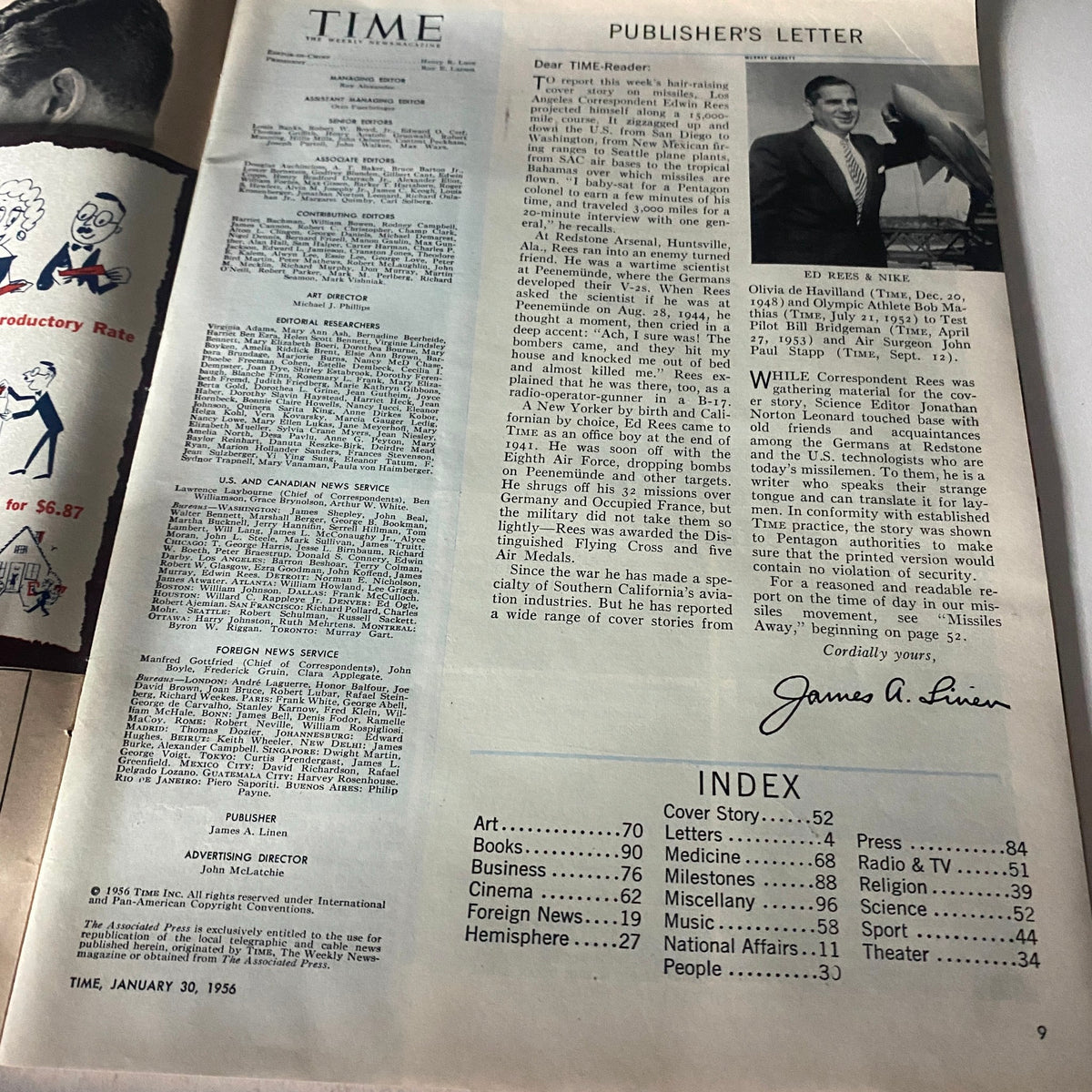
The issue's reporting drew on genuinely significant, well-documented figures within the early American missile program, including Trevor Gardner, who served as Assistant Secretary of the Air Force for Research and Development, and mathematician John von Neumann, who was serving as an Atomic Energy Commissioner at the time and had been consulted as part of Gardner's broader survey of the American missile program's status. That survey, completed in early 1954, had reportedly been shaped significantly by a carefully reasoned forecast from nuclear physicists regarding the feasibility of pairing thermonuclear warheads with long-range missile delivery systems, a combination that would define the strategic landscape of the Cold War for decades to come. The article traced the missile's military significance back to the German V-2 rocket program of the Second World War, correctly noting that guided missiles were not themselves a novel technology, but that their potential pairing with atomic and thermonuclear warheads represented an entirely new and far more consequential dimension of warfare. That historical framing, connecting the wartime V-2 program to the emerging intercontinental ballistic missile race, offers readers a genuinely substantive account of how quickly missile technology had escalated in destructive potential within just over a decade. This issue's engagement with these specific figures and technical developments reflects a level of informed, detailed reporting that distinguishes it from more superficial contemporary coverage of Cold War anxieties.
Beyond its cover feature, this issue also included coverage of significant international political developments, including reporting connected to Juscelino Kubitschek, around the time of his rise to the Brazilian presidency, and coverage touching on Luo Ruiqing, a senior Chinese military and security official during this period. That combination of missile-age technological reporting alongside coverage of significant international political figures reflects Time's characteristic breadth during the 1950s, weaving together military technology, international politics, and global affairs within a single issue. Readers encountering this issue in early 1956 would have received a genuinely comprehensive picture of the shifting global landscape at a critical juncture of the Cold War, spanning both the emerging technological arms race and the broader political developments unfolding across multiple continents. That range of coverage, delivered through Time's distinctive narrative style and highlighted by Artzybasheff's striking cover art, exemplifies the magazine's approach to documenting a complex and rapidly changing geopolitical moment for its broad national readership. This issue's combination of technological anxiety and international political reporting offers collectors and researchers a genuinely rich cross-section of mid-1950s Cold War concerns within a single publication.
For collectors of Cold War history and vintage news journalism specifically, this issue offers a well-documented and visually striking artifact from a genuinely formative period in the development of nuclear missile technology, predating the more widely remembered missile-race anxieties that would follow later in the decade. Boris Artzybasheff's distinctive cover art has itself become a recognized artifact of mid-century American visual culture, cited by historians of the nuclear era as one of the more memorable and unsettling examples of how Time chose to depict emerging military technology during this period. The issue's substantive engagement with figures like Trevor Gardner and John von Neumann gives it genuine documentary value beyond its striking visual presentation alone. This issue captures a specific and consequential moment in Cold War history, when the shape of the coming missile age was becoming clear to informed observers even as the broader public reckoning with that reality remained years away. It stands as a significant primary source for anyone researching the early technological and political dimensions of the nuclear arms race.
About the Publication
Time Magazine was founded in 1923 and grew into one of the most influential news and current affairs publications in American history, known for its weekly coverage of politics, business, culture, and international affairs. The magazine's cover feature became one of its most recognizable editorial conventions, regularly spotlighting major figures, technologies, and developments across politics, science, and world affairs, often accompanied by a substantial reported feature examining the subject's broader significance. Time's audience was broad and national, reaching a readership across the country interested in comprehensive, digestible coverage of current events and emerging global developments. The magazine's cover art during this period was frequently produced through original illustration and painting, commissioning artists to create custom artwork rather than relying solely on photography, a practice that gave Time's covers a distinctive artistic identity throughout the mid-20th century. Boris Artzybasheff, the artist responsible for this issue's missile cover, was among the magazine's most prolific and recognized cover artists during this era, known for his distinctive anthropomorphic renderings of machines and technology across numerous Time covers throughout the 1940s and 1950s. Advertising within the magazine during this period reflected products aimed at a broad, educated, and professionally engaged national readership. Time's willingness to devote substantial cover attention to emerging military technology, alongside its more frequent political and business coverage, reflected the magazine's broad editorial ambition to document the full scope of developments shaping American and global life during the Cold War. That editorial range is precisely what allowed a subject as technically complex as guided missile development to receive the same substantial cover treatment typically reserved for political leaders and major public figures. This issue exemplifies that editorial breadth clearly, connecting emerging military technology to the broader currents of Cold War international politics within a single publication.
Key Highlights Inside
- A cover feature titled "The Missile," examining the emerging American guided missile program during a critical period of Cold War development. The piece opens with a hypothetical 1962 scenario imagining a Soviet intercontinental missile test. This framing reflects genuine contemporary anxiety about the pace of American missile development relative to the Soviet Union.
- Cover artwork by Boris Artzybasheff, depicting an anthropomorphic "smart missile." Artzybasheff was known for distinctive machine-as-organism illustrations across numerous Time covers of this era. This cover remains a recognized artifact of mid-century Cold War visual culture.
- Reporting connected to Trevor Gardner, Assistant Secretary of the Air Force for Research and Development, and mathematician John von Neumann. Gardner's 1954 survey of the American missile program significantly shaped early Cold War missile strategy. Von Neumann was consulted as part of that broader assessment while serving as an Atomic Energy Commissioner.
- Historical context tracing missile technology back to Germany's World War II-era V-2 rocket program. The piece connects that wartime technology to the emerging intercontinental ballistic missile race of the 1950s. This framing situates the issue's central subject within a broader arc of 20th-century military technology.
- Additional international political coverage, including reporting connected to Brazilian president-elect Juscelino Kubitschek and senior Chinese official Luo Ruiqing. This content reflects Time's standard practice of covering multiple significant global developments within a single issue. Specific details of this coverage beyond the noted names are not reproduced here.
- Additional news, political, and cultural coverage consistent with Time's standard weekly issue structure. Issues typically combined multiple substantial features per edition. Specific additional article titles for this issue beyond those noted here are not detailed in available records.
Condition & Rarity
This issue is described as being in excellent condition, exhibiting the kind of strong preservation collectors generally hope for from a periodical of this age. At this grade, collectors can typically expect minimal handling marks, strong cover integrity, and good overall structural preservation, an outcome that is notably less common among widely circulated 1950s newsweeklies than among more specialized or limited-run publications. Time Magazine issues from this period were produced in large volumes and read broadly across the country, meaning surviving copies in excellent condition represent a smaller proportion of original print runs than the sheer circulation numbers might suggest. Cover feature issues addressing significant Cold War subjects, particularly those with visually striking illustrated cover art like this one's anthropomorphic missile design, often draw additional collector interest beyond the magazine's general publishing history, since these covers tend to have specialized and lasting appeal among collectors of Cold War history and vintage illustration alike. A plastic protective covering, when present, functions as a stabilizing measure intended to preserve a copy's current condition rather than a factor that changes its underlying grade. Collectors evaluating any surviving copy of this issue should examine the spine and cover gloss closely, since these are the attributes most likely to distinguish a genuinely excellent-grade copy from one merely described as such. The combination of this issue's substantive Cold War missile coverage and its recognized Artzybasheff cover artwork adds a layer of collector interest beyond condition and general publishing history alone. Overall, an excellent-grade copy of this issue represents a well-preserved and historically significant example of Time's mid-century Cold War cover journalism.
Looking for More Issues Like This?
Well-preserved issues of Time Magazine featuring significant Cold War subject matter, particularly one connected to recognized cover artist Boris Artzybasheff's distinctive body of work, are a genuinely appealing category for collectors spanning both magazine history and the broader history of the nuclear and missile age. This issue's substantive coverage of early American missile development, alongside its striking anthropomorphic cover illustration, gives it particular appeal among collectors of Cold War history and mid-century editorial illustration alike. For those drawn to this particular issue, our Time Magazine collection is an excellent place to continue browsing, since it gathers other surviving issues from across the publication's long history of political, technological, and cultural cover journalism. That collection offers a broader look at how Time's cover choices documented the shifting concerns of the Cold War across different years and developments. Collectors with a specific interest in nuclear and missile history, Cold War journalism, or Boris Artzybasheff's body of cover artwork for Time may find related material of interest scattered throughout that same collection. Beyond the publication itself, our 1956 magazines collection offers useful context for the broader publishing landscape of the same year, spanning titles well outside news journalism. Browsing by year can be especially valuable for researchers interested in a specific historical moment rather than a single magazine title. Given how appealing Cold War-themed cover issues like this one tend to be to collectors once discovered, we'd encourage anyone interested in this period to browse both collections at their own pace. There is always more of this history available than a single issue can represent on its own. We hope these collections help round out whatever corner of Cold War and mid-century news journalism history you're most drawn to.