




Description
Collector’s Note – Why This Issue Matters
TIME Magazine’s July 11, 1955 issue, Volume LXVI, Number 2, features August Anheuser Busch Jr., widely known as Gussie Busch, in a symbolic painted portrait by Ernest Hamlin Baker. The cover caption identifies him as “Budweiser’s Busch,” connecting his public identity directly with the beer brand and the family-controlled brewing company he led. A large glass of beer appears beside his portrait, while red cardinals, a baseball bat, and a baseball refer to his additional role as president and owner of the St. Louis Cardinals. This combination makes the cover an unusual representation of American business, advertising, professional sports, and regional civic identity within a single composition. Busch was not presented merely as an executive responsible for brewery operations, but as a highly visible promoter whose personality had become closely associated with the company’s national image. His energetic approach to sales, spectacle, packaging, and brand promotion helped make him an important figure in postwar American consumer culture. The issue therefore belongs within the history of both the brewing industry and the expanding relationship between major corporations, mass entertainment, and professional athletics.
The principal business feature, “The Baron of Beer,” examines Busch and Anheuser-Busch during a period of intense competition among large American breweries. TIME reported that Busch had personally taken a more direct role in the company’s sales effort while supporting a major advertising campaign intended to strengthen its position in the national beer market. The article also discussed new bottle sizes and the test marketing of a lower-priced product called Busch Lager alongside the established Budweiser brand. These details illustrate how packaging, price, advertising, and product differentiation were becoming increasingly important components of mid-century corporate strategy. The feature did not portray Busch’s record as one of uninterrupted success, since it also considered a price increase that had contributed to lost sales and stronger competition from less expensive local beers. This combination of celebration and criticism makes the article more useful as a business document than a purely promotional company profile. Within an archive of historical TIME Magazine issues, the July 11 edition demonstrates how the publication transformed an executive and his company into a larger story about branding, competition, personality, and American consumption.
Busch’s association with the St. Louis Cardinals gives the cover an additional historical dimension beyond brewing. Anheuser-Busch acquired the baseball club in 1953, and Busch became a conspicuous symbol of the connection between the team, the brewery, and the city of St. Louis. The cardinals and baseball equipment incorporated into Baker’s artwork make that relationship immediately visible without requiring a separate headline. Inside, the magazine ranges far beyond beer through reporting on President Dwight D. Eisenhower, the approaching Geneva conference, Congress, foreign relations, labor, science, medicine, religion, education, sports, music, radio, television, art, cinema, and books. The issue consequently preserves both a focused corporate profile and a broad weekly record of public affairs during the summer of 1955. Its contents reflect a country balancing Cold War diplomacy, domestic political debate, scientific development, health concerns, expanding consumer markets, and popular entertainment. Considered alongside other magazines published in 1955, it offers a revealing picture of how business leadership and everyday consumer products could share editorial space with matters of international consequence.
About the Publication
TIME was founded by Henry R. Luce and Briton Hadden, with its first issue appearing in 1923. The publication was designed as a concise weekly guide to major events for readers seeking an organized overview of national and international developments. Its recurring departments covered government, foreign affairs, business, science, medicine, religion, education, sports, books, theater, cinema, radio, television, and the arts. TIME became known for compressed narrative writing, memorable characterization, wordplay, and an editorial voice that frequently interpreted personalities as symbols of larger historical forces. By the 1950s, it had become one of the most influential American news magazines and a major visual record of political, commercial, scientific, and cultural leadership. Its red-bordered covers were especially important because they elevated one person, organization, event, or idea as the defining subject of the week. Painted portraits remained common during this period and often incorporated background objects that explained the subject’s profession or significance. Ernest Hamlin Baker was among the artists whose work helped establish this symbolic approach to cover design. The Gussie Busch image uses brewing and baseball references to communicate two distinct parts of his public identity within a single visual arrangement. This method allowed TIME to introduce a business figure to general readers without reducing the cover to a conventional corporate portrait. Surviving issues now provide primary-source evidence of journalism, illustration, advertising, political language, consumer behavior, and the changing reputations of influential twentieth-century figures.
Key Highlights Inside
- The principal business feature, “The Baron of Beer,” profiles Gussie Busch and the competitive position of Anheuser-Busch in the American brewing market. It discusses his personal involvement in sales, the company’s large advertising effort, new package sizes, and the testing of the lower-priced Busch Lager brand. The article also acknowledges pricing and market-share challenges, giving the profile a more analytical character than a simple celebration of corporate success.
- The cover artwork by Ernest Hamlin Baker combines Busch’s portrait with a tall glass of beer, a row of red cardinals, a baseball bat, and a baseball. These elements connect Budweiser and Anheuser-Busch with Busch’s leadership of the St. Louis Cardinals. The composition provides a compact visual summary of how commerce, sport, civic identity, and executive personality had become intertwined around him.
- “A War for Peace” appears in the presidency section and examines the Eisenhower administration during a period of active Cold War diplomacy. Additional national reports address Congress, foreign relations, federal administration, the armed forces, investigations, political organizations, Utah, and labor. Together, these features preserve TIME’s interpretation of American government and political conflict during the summer of 1955.
- “Ready for the Climb” considers preparations for the approaching Big Four summit involving the United States, the Soviet Union, Great Britain, and France. The international section also reports on Yugoslavia, Israel, Portugal, West Germany, Italy, Pakistan, South Africa, Indonesia, China, Argentina, Canada, Guatemala, and other regions. This broad coverage places the Busch profile within a world shaped by alliance politics, decolonization, regional unrest, and efforts to reduce Cold War tension.
- The medical department includes “The First Deep Breath,” “The Lung Cancer Epidemic,” and “Indian Health,” along with shorter capsule reports. These articles reflect contemporary concern with respiratory disease, public health, medical access, and changing scientific knowledge. The lung-cancer feature is particularly notable as evidence of the growing attention being given to a major health problem during the 1950s.
- Religion coverage includes “Contest Controversy,” “Deadline from God,” “Is Communism Christian?,” and “Words & Works.” The explicitly political religious question demonstrates how Cold War ideology entered discussions of theology and institutional belief. These reports show that TIME treated religion not only as private faith but also as a public force connected with education, politics, culture, and international conflict.
- Sports coverage includes “Road to the Pros,” “Red Blisters,” “Baseball’s Big Ten,” and the magazine’s weekly scoreboard. Baseball’s appearance inside the issue reinforces the sporting imagery used on the Gussie Busch cover. The section preserves contemporary rankings, personalities, and professional pathways during a period when baseball remained central to American popular culture.
- The education department presents “Of One Blood,” “The Learned One,” and a recurring report-card feature. These articles place questions of schooling, knowledge, institutional leadership, and social responsibility within the magazine’s weekly record. Their inclusion demonstrates how education was treated as a national subject alongside government, industry, science, religion, and foreign affairs.
- Arts and entertainment coverage includes reports on music, new records, radio biography, coast-to-coast broadcasting, television programming, art, cinema, and books. Individual features address subjects ranging from opera and the visual arts to current motion pictures and historical writing. This range supplies a cultural counterpoint to the issue’s concentration on business competition, national politics, diplomacy, and public health.
Condition & Rarity
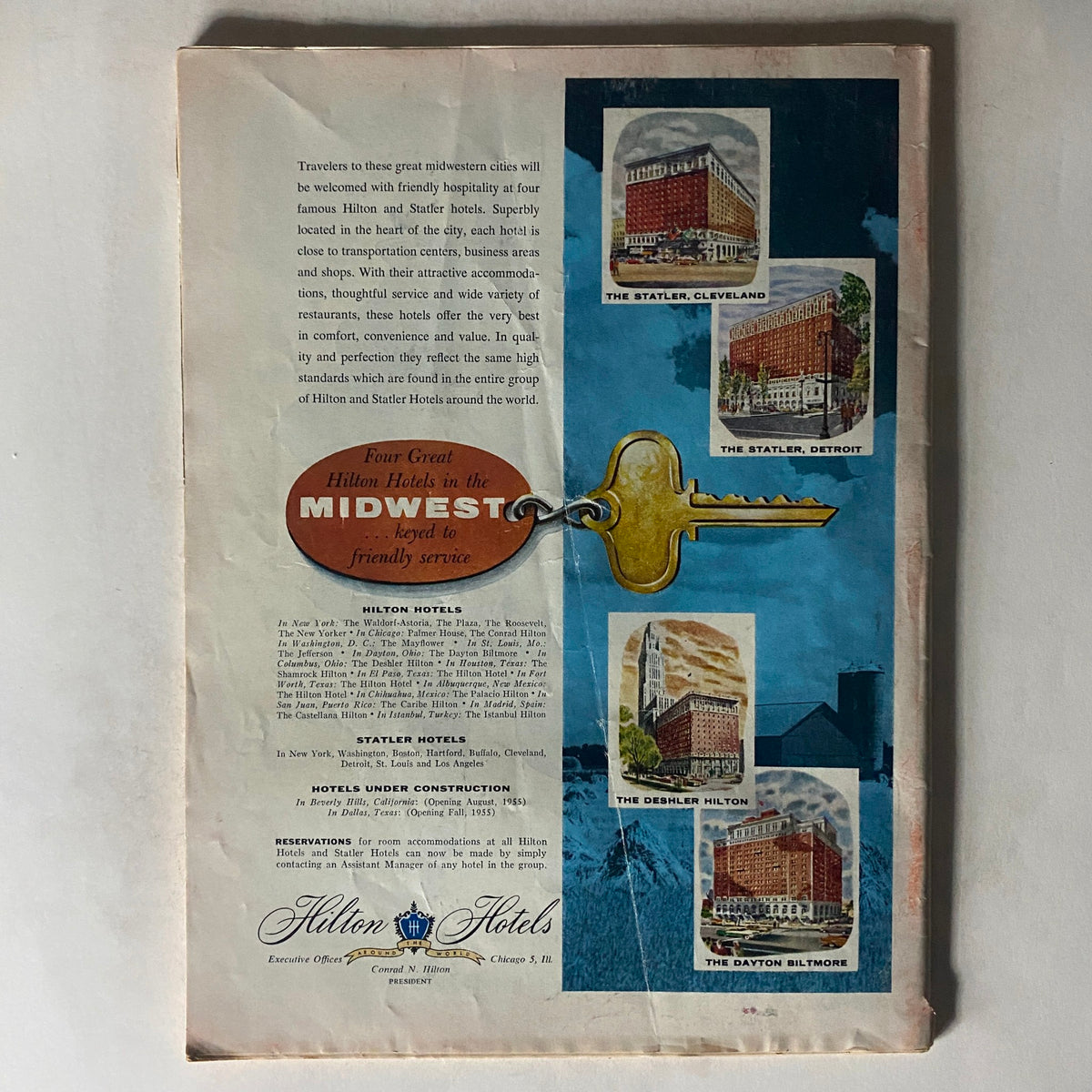
The supplied description characterizes this July 11, 1955 issue as being in Good condition for its age. No standardized numerical grade has been assigned, so the term should be understood as a general descriptive assessment rather than a professionally certified evaluation. The accompanying photographs are identified as the primary evidence for examining the magazine’s visible physical condition. The pictured issue is described as the same example represented by the original listing rather than a generic photograph of the date. No detailed written inventory has been provided for creases, rubbing, edge wear, corner wear, spine stress, discoloration, or interior marks. The presence or absence of a mailing label is also not confirmed in the supplied condition notes. Similarly, there is no definite statement concerning clipping, missing pages, detached leaves, staining, writing, tape, repairs, or restoration. Those characteristics should remain unverified unless they can be established through the photographs or direct physical inspection. A plastic protective covering is reported to accompany the magazine and can reduce exposure to dust and unnecessary handling. That covering is a later storage accessory rather than an original component of the July 1955 publication. Preservation of the front cover is especially relevant because Baker’s portrait and the combined beer-and-baseball imagery give the issue much of its visual and historical identity. TIME was produced for broad weekly circulation, so interest in this date is best connected with the Busch subject, documented cover story, distinctive artwork, complete contents, and actual condition rather than with an unsupported claim of exceptional rarity.
Looking for More Issues Like This?
Additional executive portraits, political covers, and weekly historical records can be examined through the TIME Magazine collection. Comparing nearby editions can show how the publication represented corporate leaders alongside presidents, diplomats, military officials, scientists, entertainers, athletes, and cultural figures. It can also reveal how artists used symbolic objects to communicate a cover subject’s profession, authority, and public reputation. The Busch issue is especially useful for studying the overlap between business promotion and professional baseball during the postwar period. Related TIME editions may provide broader context for the growth of national brands, television advertising, packaged consumer goods, and executive celebrity. Readers researching the period can also consult the 1955 magazine archive. Publications from that year document Cold War diplomacy, the Eisenhower presidency, expanding consumer culture, public-health debates, scientific ambition, television growth, sports, and changing entertainment. Comparing different magazine categories can show how a business story was interpreted differently by newsweeklies, financial publications, trade journals, and general-interest magazines. The July 11 TIME issue brings many of these themes together through its treatment of Busch as brewer, salesman, team owner, and public personality. Its interior coverage adds international diplomacy, medicine, religion, education, science, and the arts to that corporate narrative. Together, the cover and contents preserve a layered record of American business culture and public life during the middle of the 1950s.