


Description
Collector's Note – Why This Issue Matters
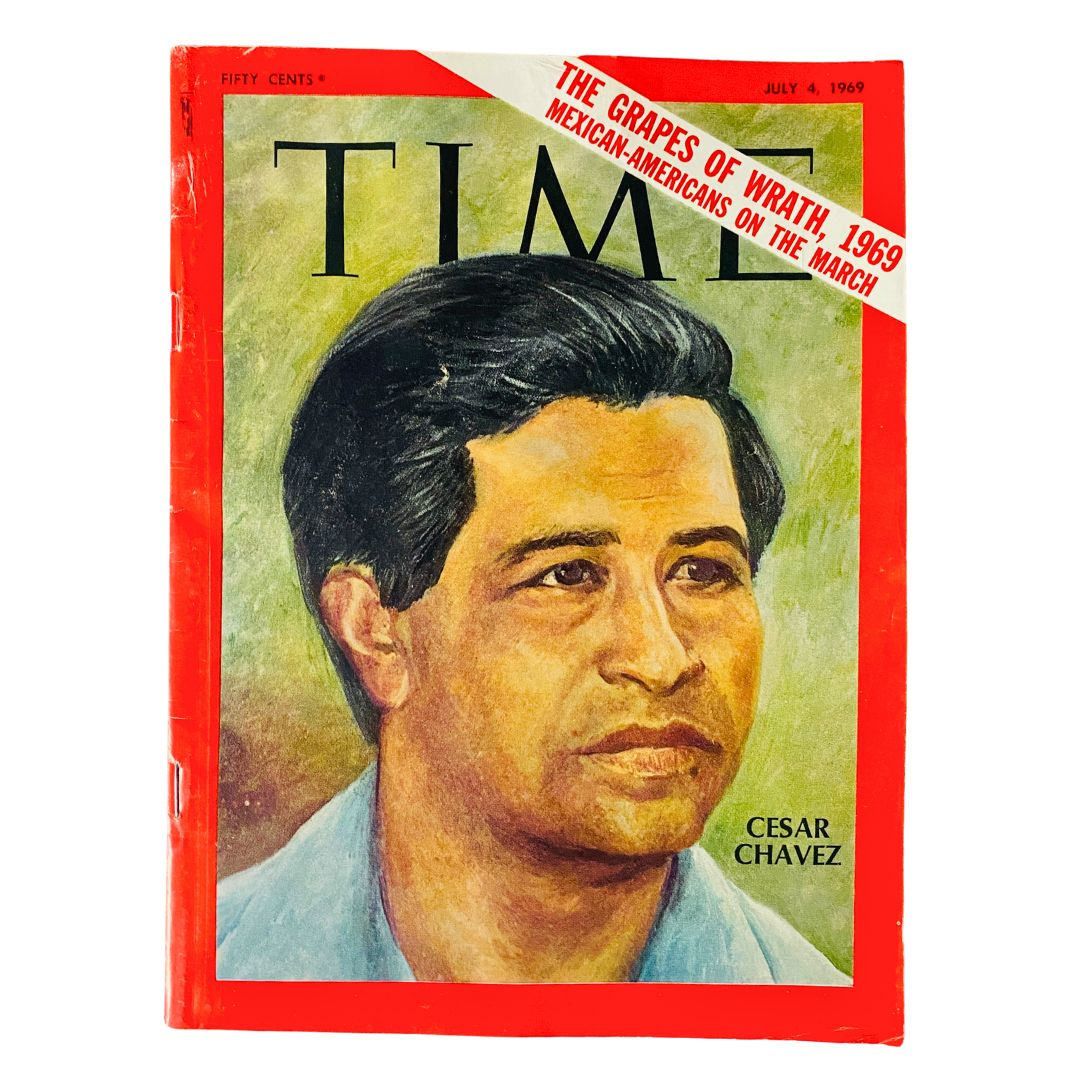
The July 4, 1969 issue of Time — its cover date deliberately chosen as the nation's Independence Day — features César Chávez at one of the most consequential moments of his career and of the American labor movement's postwar history. By the summer of 1969, the United Farm Workers' grape boycott had been underway for nearly three years and had become one of the most effective consumer solidarity campaigns in American labor history. Millions of Americans had stopped buying table grapes in support of the largely Latino and Filipino farmworker communities of California's Central Valley, and the boycott was generating real economic pressure on the growers who had resisted union recognition. A Time cover on the Fourth of July was a specific editorial choice — placing Chávez and the farmworker struggle within the broader narrative of American democratic ideals at a moment when the country was simultaneously grappling with Vietnam, urban unrest, and the ongoing civil rights movement.
The cover's reference to "The Grapes of Wrath" is deliberate and layered. John Steinbeck's 1939 novel had made the exploitation of migrant agricultural workers a touchstone of American social conscience, and invoking it in connection with Chávez in 1969 was a way of placing the UFW struggle within a longer historical arc — connecting the Depression-era Dust Bowl migrants with the contemporary Chicano and Filipino farmworkers who were, three decades later, still fighting for basic labor protections. For collectors who follow vintage César Chávez magazine appearances, this Time cover is among the most historically significant in the public record — a national mainstream magazine using its most prestigious cover slot on Independence Day to make an explicit argument about whose struggle belonged in the American story.
The broader context of July 1969 is equally charged. The nation was eight months into the Nixon administration, the counterculture was at its peak, and the question of what America owed its most exploited workers was being actively contested in the streets, the courts, and the supermarkets where the grape boycott played out. A Time cover featuring Chávez in this moment was not a neutral journalistic act — it was a recognition that the farmworker movement had achieved sufficient national significance to command the magazine's attention on its most symbolically resonant publication date of the year. Collectors building focused archives around magazines from 1969 will find no single issue more precisely positioned at the intersection of labor history, civil rights history, and the cultural politics of that extraordinary year.
About the Publication
Time magazine was founded by Briton Hadden and Henry Luce in 1923 and had by 1969 been the dominant American weekly news magazine for nearly five decades. Its cover selections were understood as editorial statements about what mattered most in American and world affairs, and the deliberate placement of significant stories on symbolically resonant dates — like July 4th — reflected the magazine's consistent self-awareness as a chronicle of American life rather than merely a news summary. By 1969 Time was operating in an environment of intense social upheaval that tested its editorial instincts at every issue, and its willingness to put a labor organizer on its Independence Day cover reflected a genuine engagement with the full range of that upheaval.
Key Highlights Inside
- Cover story on César Chávez and the United Farm Workers' grape boycott, published on the Fourth of July 1969 — an editorial framing that explicitly connected the farmworker struggle to the ideals of American democracy.
- The "Grapes of Wrath" reference in the cover treatment positions the UFW movement within the longer American history of agricultural labor exploitation, connecting the 1969 boycott to the Depression-era migrant worker crisis documented by Steinbeck thirty years earlier.
- Publication date places this issue at the height of the grape boycott's effectiveness, nearly three years into the campaign and at the point of maximum economic pressure on California table grape growers.
- No address label confirmed, indicating newsstand rather than subscription origin — preserving the cover art and its Fourth of July symbolic framing without the permanent marking of subscription delivery.
- Specific interior articles and additional features beyond the Chávez cover story are unconfirmed from the listing; the full editorial content would reflect Time's characteristic range of national and international news coverage for early July 1969.
Condition & Rarity
The listing confirms no address label and protective plastic sleeving but does not specify a formal condition grade beyond the general descriptions provided. For any surviving copy of this issue, the standard evaluation points for a fifty-five-year-old weekly newsmagazine apply: spine integrity, cover surface preservation including the Chávez portrait and cover text, and the state of interior pages for toning and brittleness. The absence of a label is a genuine positive — newsstand copies of Time from this era are less common in the surviving pool than subscription copies, which were addressed directly on the cover and are far more frequently encountered. The protective sleeving reflects deliberate preservation effort. The July 4th cover date and the significance of the Chávez subject matter made this a more commonly kept issue than average weekly Time editions from the same period, which somewhat improves the odds of finding surviving copies in sound condition relative to less culturally charged issues from the same year.
Looking for More Issues Like This?
The July 4, 1969 Time with César Chávez on the cover is one of the most historically purposeful issues in the magazine's late-1960s run, and label-free copies are consistently sought by labor history collectors, Chicano history researchers, and anyone building a serious archive of the era's social movements. If this issue is no longer available, the César Chávez vintage magazine collection is the best starting point for other appearances documenting his public profile across publications and years. The full vintage Time magazine archive spans the publication's complete run, and the 1969 magazine collection covers the full year across multiple titles for collectors focused on one of the most turbulent and consequential years in American history.