
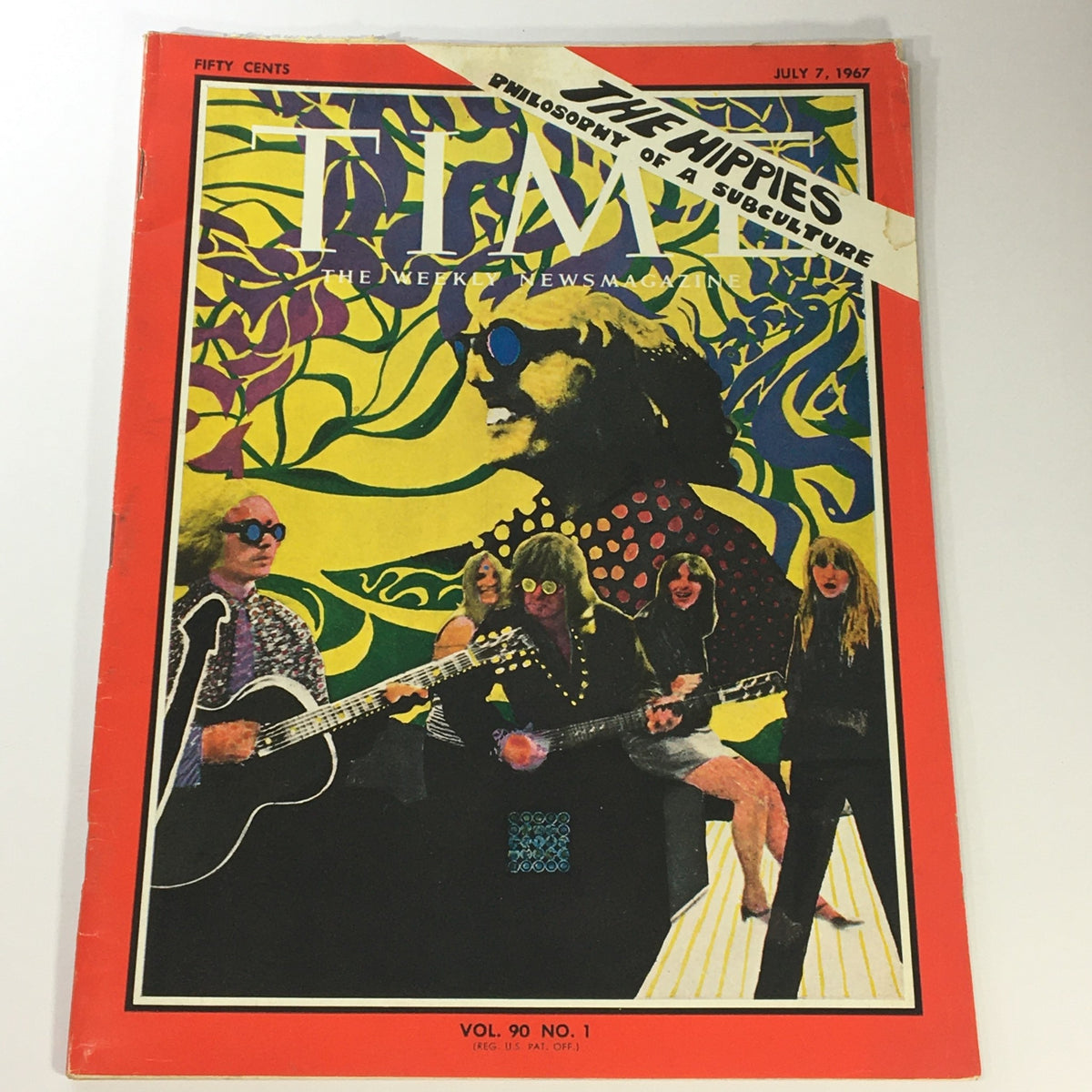


Description
Collector's Note – Why This Issue Matters
The July 7, 1967 issue of Time Magazine — Vol. 90, No. 1 — with its cover story on "The Hippies" and the counterculture subculture is one of the most historically significant single issues in the publication's 1960s run and one of the most consequential acts of mainstream press documentation of the counterculture in American publishing history. The publication date is precise and historically extraordinary: July 1967 was the opening month of what would become known as the "Summer of Love," the period of maximum concentration of countercultural activity in San Francisco's Haight-Ashbury district that had been building since the Human Be-In in January. By the time this issue reached newsstands in the first week of July, an estimated 100,000 young people had migrated to San Francisco, and the Haight had become the most discussed neighborhood in America. A Time cover on the hippie subculture in this specific week is not a retrospective cultural analysis — it is contemporaneous documentation at the moment of the phenomenon's maximum media visibility and maximum cultural energy, produced for the mainstream American readership that the counterculture was simultaneously addressing and rejecting. The specific framing as "subculture" reflects Time's analytical distance from its subject — an attempt to understand and categorize a phenomenon that was actively challenging the values of the publication's core readership. For collectors and researchers building a documentary record of the counterculture through the mainstream press, this issue is a primary source of the first order. The Time Magazine archive at OriginalMagazines.com provides essential context for the magazine's engagement with 1960s cultural transformation across the decade.
The broader context of July 1967 in American social and cultural history makes this issue extraordinarily dense with significance. The Newark riots would begin on July 12th, five days after this issue's publication, and the Detroit riots on July 23rd — the Summer of Love and the long hot summer of urban rebellion were occurring simultaneously, in a cultural juxtaposition that defined the specific character of 1967 as a year of radical polarization. The Vietnam War was escalating — the year's troop commitments were at their highest levels, antiwar sentiment was intensifying, and the connection between the counterculture and antiwar activism was actively being mapped by the press. The Beatles' Sgt. Pepper's Lonely Hearts Club Band had been released in June, just weeks before this issue; Jimi Hendrix had performed at Monterey Pop in June; the entire cultural infrastructure of what would be called the sixties revolution was at its point of maximum creative and social energy. A Time cover that attempts to explain the hippie subculture to mainstream America in this specific July documents the mainstream press's engagement with that energy at its most intense and most formative moment. Those researching the counterculture, the Summer of Love, and the cultural landscape of 1967 will find the 1967 magazines collection at OriginalMagazines.com a valuable resource across publications from this pivotal year.
The Vol. 90, No. 1 designation is worth noting: this was the first issue of Time's ninetieth volume, a publication marker that coincided with one of the most culturally significant stories the magazine had ever attempted to document. The no-label newsstand status preserves the hippie subculture cover in its original, unobstructed state — the preferred configuration for a cover whose imagery and framing constitute a primary document of how the mainstream American press visualized and categorized the counterculture at its Summer of Love peak.
About the Publication
Time Magazine was founded in 1923 by Henry Luce and Briton Hadden as the first American weekly news magazine, and by July 1967 had been the dominant publication of its format for more than four decades. Its editorial model synthesized the week's news across politics, science, culture, and international affairs into a single authoritative weekly package anchored by a cover story that served as the publication's declaration of the moment's most significant subject. A cover story on the hippie subculture in July 1967 reflects the magazine's recognition that the counterculture had crossed the threshold from marginal phenomenon to mainstream American concern — a recognition that the cover itself helped to accelerate by distributing images and analysis of the counterculture to millions of American households simultaneously.
Key Highlights Inside
- "The Hippies: The Philosophy of a Subculture" cover story — published during the opening weeks of the Summer of Love in July 1967, at the moment of maximum media concentration on the Haight-Ashbury counterculture and its national significance, documenting the mainstream press's attempt to categorize and explain a phenomenon that was actively challenging the values of its readership.
- Vol. 90, No. 1, dated July 7, 1967 — the opening issue of the magazine's ninetieth volume, coinciding with one of the most historically significant cultural moments of the decade and published five days before the Newark riots began.
- Newsstand edition with no label — preserving the hippie subculture cover in its original unobstructed state, the most significant positive condition attribute for an issue whose cover image is both the primary display consideration and a primary document of mainstream press engagement with the counterculture.
- Note: Specific article titles, bylines, and interior content details beyond the confirmed hippie subculture cover story have not been independently verified for this issue. The highlights above reflect confirmed cover content and well-documented historical context for the Summer of Love, the publication, and the period.
Condition & Rarity
The noted condition describes a good newsstand copy with minor edge wear and possible rips or marks, no label, and a plastic protective sleeve. The no-label newsstand status is the most significant positive condition attribute, preserving the cover imagery without adhesion damage — particularly important for a cover whose visual documentation of the counterculture aesthetic is a primary historical and display consideration. Minor edge wear and marks on a weekly newsmagazine now nearly sixty years old are entirely expected and do not typically affect the cover's visual integrity or the interior content's legibility. The plastic sleeve confirms deliberate protective storage. Summer of Love-era Time covers are among the most actively sought configurations in 1960s counterculture press collecting, sought by cultural historians, counterculture researchers, and collectors of 1960s American social history documentation simultaneously.
Looking for More Issues Like This?
Summer of Love-era Time covers from July 1967 are among the most historically specific and culturally resonant finds in vintage American press collecting, and the Vol. 90, No. 1 hippie subculture issue — published at the counterculture's moment of maximum national visibility — holds an irreplaceable position in the documentary record of mainstream America's engagement with the 1960s cultural revolution. If this issue has already been claimed, the full Time Magazine collection at OriginalMagazines.com is the best place to search for other landmark cultural and social covers from the magazine's extraordinary 1960s run. Collectors building a complete picture of 1967 — one of the most culturally and historically charged years of the postwar period — will find the 1967 magazines collection an essential resource for period publications from across this pivotal year.