

Description
Collector's Note – Why This Issue Matters
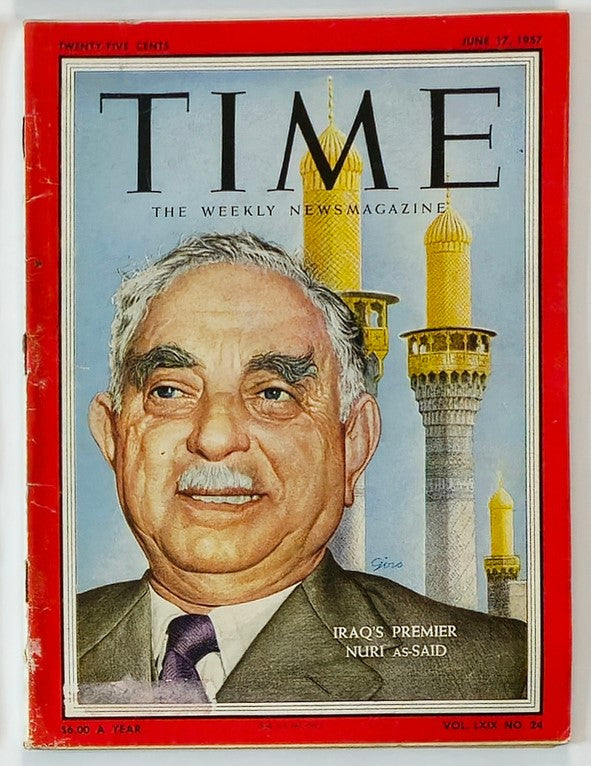
The June 17, 1957 issue of Time magazine — Volume 69, Number 24 — featuring Iraq's Prime Minister Nuri as-Said on its cover is one of the most historically charged Middle East covers the publication produced in the decade before the regional transformations of the late fifties and early sixties made that part of the world the center of sustained American strategic anxiety. Understanding the full weight of this cover requires understanding both who Nuri as-Said was and what was about to happen to him. By June 1957 Nuri as-Said was the most dominant political figure in Iraq — a veteran of the Arab Revolt against the Ottomans during the First World War, a founding figure of the Iraqi state, and a man who had served as Prime Minister on multiple occasions across three decades of Iraqi political life, wielding power through a combination of genuine political skill, British backing, and a willingness to suppress opposition with considerable ruthlessness. He was a pillar of the pro-Western regional order, a key supporter of the Baghdad Pact — the American-backed collective security arrangement that was the Middle Eastern equivalent of NATO — and one of the most reliable allies of both the United States and Britain in a region where reliable allies were becoming increasingly scarce as Arab nationalism gathered force. A Time cover in June 1957 treating Nuri as-Said as the man worth profiling in the Middle East reflects exactly how the Western press and Western foreign policy establishment viewed him at this moment: as a stabilizing figure, a partner, a man who could be counted on. For collectors building a serious archive of Time magazine covers from the Cold War era and the history of the Middle East, this issue carries a particular retrospective weight.
That retrospective weight derives from what happened just over a year after this cover was published. On July 14, 1958 — the date known in Iraq as the July 14 Revolution — a military coup organized by the Free Officers movement overthrew the Hashemite monarchy, assassinated King Faisal II and Crown Prince Abd al-Ilah, and hunted down Nuri as-Said, who was killed the following day while attempting to escape Baghdad disguised as a woman. The revolution ended the Hashemite kingdom that Britain had helped establish in 1921 and destroyed the pro-Western political order that Nuri as-Said had spent his career building and defending. The Baghdad Pact was effectively finished as a regional security architecture. The June 1957 Time cover therefore documents Nuri as-Said at the absolute apex of his power and influence — the last full year of his dominance — in a portrait that the events of July 1958 would transform into something considerably more poignant than a standard political profile. It is a photograph of a man who did not know that his world had less than thirteen months left. That quality — of journalism that documents the moment before catastrophe without being able to see it coming — gives this cover a historical resonance that purely retrospective accounts of the same events cannot quite replicate.
The broader context of June 1957 in American Middle East policy adds further historical layers that make this issue valuable to researchers and collectors working across multiple areas of Cold War and regional history. By mid-1957 the Eisenhower Doctrine — the administration's policy of extending American support to Middle Eastern countries threatened by international communism — had just been announced, and the United States was actively trying to shore up pro-Western governments across the region against the rising tide of Nasserist Arab nationalism that Egypt's Gamal Abdel Nasser was personifying and spreading. Nuri as-Said and the Iraqi monarchy represented the Western position in the Arab world in its most concentrated and most vulnerable form, and their relationship with the United States and Britain was one of the defining strategic partnerships of the period. A Time cover profile of the Iraqi Prime Minister in this specific geopolitical context was therefore not merely a foreign affairs feature but a primary document of American strategic thinking in the Middle East at a genuinely consequential moment. Those assembling a comprehensive archive of 1957 magazines as primary documents of the Cold War's Middle Eastern dimension will find this issue one of the most historically specific and retrospectively significant pieces in that collection.
About the Publication
Time magazine, co-founded by Henry Luce and Briton Hadden in 1923, had established itself by the mid-fifties as the definitive American weekly newsmagazine and one of the most widely read and editorially influential periodicals in the world, reaching millions of subscribers at the height of its postwar cultural authority. Its editorial format combined concise, opinionated reporting on the week's major domestic and international news with longer analytical features, cultural coverage, and regular departments that gave it a comprehensive weekly survey quality making it genuinely indispensable to the educated American reader. The magazine's cover, selected each week by editors who treated the decision as the most consequential editorial choice of the publishing cycle, had by the mid-fifties become one of the most powerful and recognized cultural declarations in American journalism — to appear on the cover of Time was to be designated, by the most authoritative mainstream newsmagazine in the country, as the person or subject that mattered most to the world that week. Henry Luce's personal engagement with international affairs, and the magazine's consistent commitment to treating foreign policy and geopolitics as central rather than peripheral editorial concerns, gave its international covers — including the June 1957 Nuri as-Said profile — a depth and seriousness that made them primary sources for the history of American engagement with the world during the Cold War's most consequential decades.
Key Highlights Inside
- The cover features Nuri as-Said — Iraq's most dominant political figure and the central pillar of the pro-Western Hashemite order — published in June 1957, just thirteen months before the July 14, 1958 revolution that would overthrow the Iraqi monarchy, kill the royal family, and result in Nuri as-Said's own death, making this a primary document of the man and the political order he represented at the final peak of their power and Western backing.
- The issue is precisely identified as Volume 69, Number 24, published June 17, 1957 — placing it in the specific geopolitical atmosphere of the post-Suez Crisis Middle East, when the Eisenhower Doctrine had just been announced, Arab nationalism was in the full force of its regional ascendancy, and the United States and Britain were actively working to sustain the pro-Western governments that Nuri as-Said's Iraq most clearly represented.
- The in-depth analysis and profile content confirmed in the listing would have engaged with Nuri as-Said's extraordinary political biography — his participation in the Arab Revolt, his decades of Iraqi political dominance, his relationship with Britain and the United States, and his role in the Baghdad Pact collective security architecture — providing American readers with one of the most substantive mainstream press treatments of Iraqi politics and Middle Eastern geopolitics available in any publication of the era.
- A Time cover devoted to the Iraqi Prime Minister in June 1957 reflects the specific and historically significant way in which Western journalism and Western foreign policy understood the Middle Eastern strategic landscape at this moment — a framing that the events of July 1958 would devastatingly overturn, giving this cover the particular retrospective quality of journalism produced on the eve of catastrophe without the knowledge that catastrophe was coming.
- As a mid-June 1957 issue, the magazine would have carried Time's comprehensive coverage of the full range of domestic and international events of that week — including the Eisenhower administration's management of the Cold War, the civil rights movement's ongoing confrontations, and the broader sweep of a world in which the postwar order was being challenged and renegotiated simultaneously on multiple fronts — making it a rich documentary cross-section of a specific and historically consequential week.
- Note: Specific article titles, interior features, and secondary editorial content beyond the confirmed cover subject and the general profile described in the listing have not been independently verified for this issue. The above reflects what is documented from the cover, volume and issue identification, and the well-established historical record surrounding Nuri as-Said, Iraq's Hashemite monarchy, and the Middle Eastern geopolitical landscape of June 1957.
Condition & Rarity
Surviving copies of the June 17, 1957 Time in collectible condition present the characteristic aging profile of a nearly seventy-year-old weekly newsmagazine that has passed through multiple decades of varied storage and ownership. Time of this era was printed on a combination of coated stock for photographic and cover pages and lighter text-weight paper for its news and editorial sections — more resilient than pure newsprint but not engineered for archival longevity across seven decades — and the characteristic aging patterns of mid-fifties issues are well established among serious collectors: some tanning and possible brittleness to outermost pages, spine softening from decades of storage in variable conditions, and the handling marks and edge wear that accumulate over nearly seventy years of ownership transitions. The listing directs collectors to the provided photographs as the primary condition reference and acknowledges some visible marks on the magazine — an honest approach that places visual documentation at the center of the evaluation process and reflects the reality that individual surviving copies of nearly seventy-year-old weekly magazines present specific and individual condition profiles best assessed from direct visual inspection. Collectors evaluating any surviving copy of this issue should examine the cover stock condition and the legibility of the Nuri as-Said cover portrait — the primary historical and visual asset of an issue whose significance derives substantially from the specific person depicted and the historically specific moment that depiction documents — alongside the standard structural assessments of spine integrity and page completeness. Protective plastic sleeve storage is the appropriate preservation standard for coated-stock newsmagazines of this type and period.
Looking for More Issues Like This?
The June 17, 1957 Time Nuri as-Said cover is one of the more historically specific and retrospectively significant Middle East covers the magazine produced in its Cold War run — a primary document of a political figure and a regional order at their final peak of Western confidence, published just over a year before the revolution that destroyed both — and copies in any collectible condition are sought by Middle East historians, Cold War researchers, and serious Time magazine archivists who understand the particular historical weight this specific edition carries. The Time magazine collection at OriginalMagazines.com spans a wide and carefully assembled range of issues from across the publication's remarkable run, and is the essential starting point for anyone building a serious archive of mid-century American newsmagazine journalism and its engagement with the Cold War's most consequential geopolitical developments. For collectors drawn to the full landscape of 1957 — a year of extraordinary consequence in both American domestic politics and Cold War foreign policy — the 1957 magazine collection offers a rich cross-section of that pivotal year across multiple titles and perspectives.