


Description
Collector's Note – Why This Issue Matters
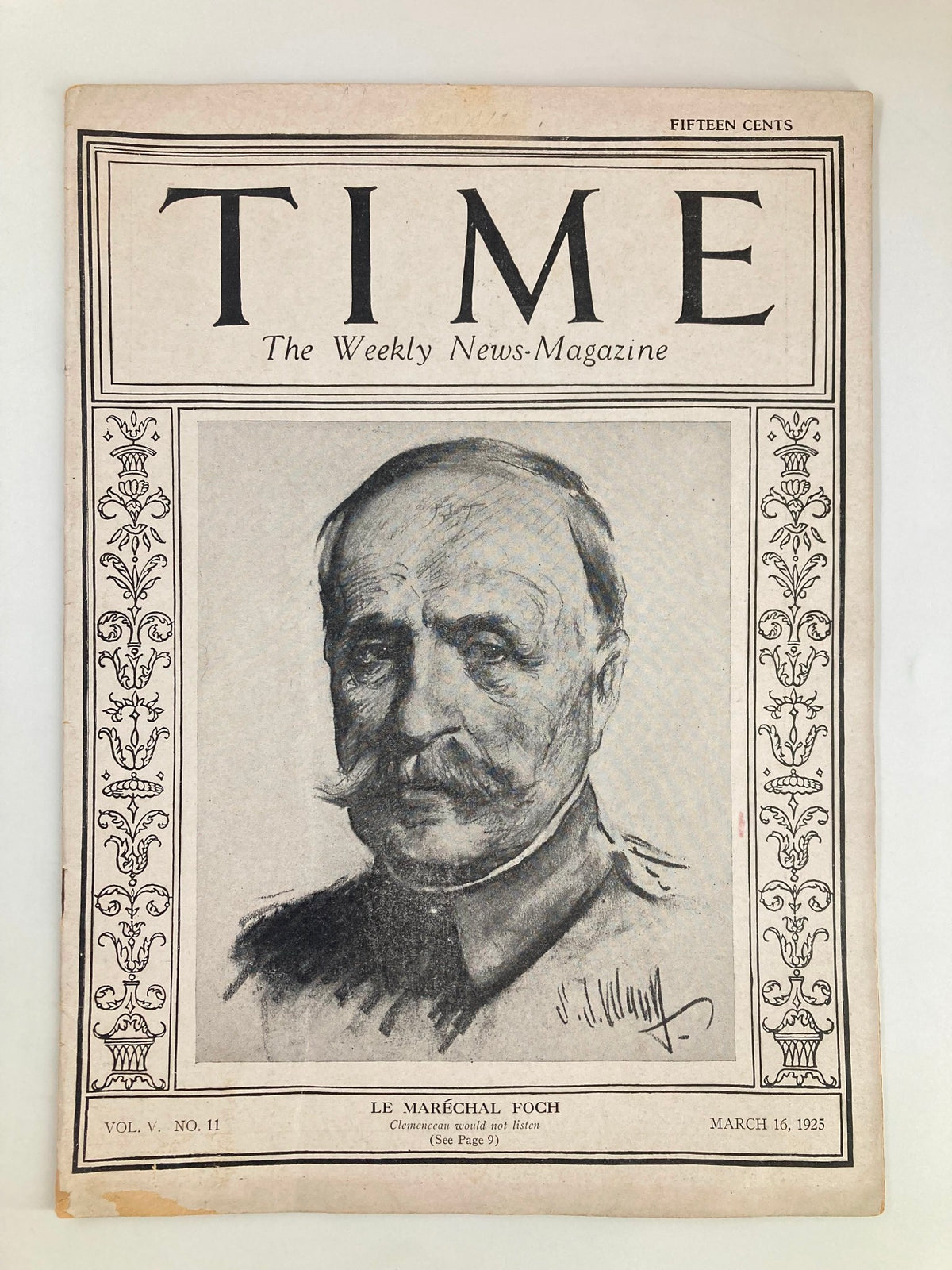
The March 16, 1925 issue of Time magazine — Volume V, Number 11 — featuring Marshal Ferdinand Foch on the cover is a primary document of one of the most historically consequential figures of the twentieth century at the specific moment of his final public visibility, and one of the most historically charged single issues in the publication's first two years of existence. Ferdinand Foch was the Supreme Allied Commander who had led the Allied forces to victory in the First World War, the architect of the November 11, 1918 armistice, and the man who upon signing the armistice had famously declared — with extraordinary prescience — that it was not a peace but merely a twenty-year ceasefire. Marshal Foch died on March 20, 1926 — the March 16, 1925 Time cover appeared approximately one year before his death — capturing him at the specific final phase of his life when his status as the most celebrated military commander in French history and the living embodiment of Allied victory in the Great War was at its fullest public expression. A Time cover featuring Foch in March 1925 is primary documentation of how the American mainstream press was engaging with the war's most celebrated military figure six and a half years after the armistice, in the specific cultural atmosphere of the mid-1920s when the memory of the war was being most actively processed and most formally commemorated by the Allied nations. For collectors building a serious archive of Time magazine's earliest publishing history and First World War-era primary source journalism, the Time magazine collection at OriginalMagazines.com provides essential depth, with Volume V issues from 1925 representing the publication in its second year of operation at a historically significant early phase of its development.
The broader historical significance of March 16, 1925 as a specific publication date gives this issue additional primary source value for researchers studying the interwar period's specific cultural and political atmosphere. The mid-1920s were the specific phase of the interwar period when the First World War's legacy was being most actively institutionalized — war memorials were being erected across Europe and America, the unknown soldier tombs were being established, the formal commemorative culture of the war was taking its permanent shape — and Marshal Foch's continued public presence as the war's most celebrated surviving Allied commander gave him a specific cultural role as the living embodiment of that legacy. The March 16, 1925 Time cover featuring Foch is therefore primary American mainstream journalism documentation of that specific interwar commemorative culture and its relationship to the war's most celebrated surviving military figure, published in the specific cultural atmosphere of the mid-1920s when both the relief of the war's conclusion and the first intimations of the European political instability that would eventually prove Foch's twenty-year ceasefire prophecy correct were simultaneously present in the international atmosphere. The full range of 1925 magazines and publications from this year documents American culture at the mid-decade height of the jazz age and the specific interwar prosperity that preceded the Depression's catastrophic arrival four years later.
The specific institutional significance of a Volume V, Number 11 Time issue from March 1925 extends beyond its cover subject to encompass the publication's own historical position. Time had been founded in March 1923 by Henry Luce and Briton Hadden, and Volume V, Number 11 represents the publication in its second year of operation — a period when its specific editorial identity, its voice, and its institutional character were still being actively developed. A 1925 Time issue is therefore simultaneously a primary document of Ferdinand Foch's legacy and a primary artifact of the American newsweekly's own foundational development, making it a historically significant primary source for both the war's commemorative history and the history of American journalism.
About the Publication
Time magazine was founded in March 1923 by Henry Luce and Briton Hadden as the first American weekly news summary publication, its specific editorial format — the weekly digest of national and international news organized by subject category and written in the specific brisk, opinionated prose that Hadden had pioneered — establishing a new genre in American journalism that would prove extraordinarily influential. By March 16, 1925, the publication was in its second year of operation, its editorial identity and its specific journalistic voice still being developed and refined, and its cover subjects were being chosen from the international figures that its editors judged most significant to the week's most important news. Marshal Foch's March 1925 cover represents one of the publication's early engagements with the First World War's continuing legacy and its most celebrated surviving military figures.
Key Highlights Inside
- Marshal Ferdinand Foch cover — Allied Supreme Commander and armistice architect documented in second-year Time — The confirmed Foch cover is primary Time documentation of the First World War's most celebrated surviving Allied military commander — the Supreme Allied Commander who led the Allied forces to victory and signed the November 11, 1918 armistice — published in the specific mid-1920s interwar phase when his status as the living embodiment of Allied victory was at its fullest public expression, one year before his March 1926 death.
- No-label newsstand edition — full March 1925 cover preserved in complete presentation — The confirmed no-label newsstand origin preserves the full visual integrity of the March 1925 cover without subscription label disruption, representing a meaningful positive for a publication whose 1925 examples are now a century old and whose label-free newsstand examples are considerably less common than the labeled subscription majority of surviving copies from this era.
- Volume V, Number 11 — second-year Time foundational period documented — The confirmed Volume V, Number 11 designation places this issue in the publication's second year of operation, during the specific foundational period when its editorial identity, journalistic voice, and institutional character were being most actively developed, making it simultaneously a primary document of Foch's legacy and a primary artifact of American newsweekly journalism's own foundational history.
- March 16, 1925 — mid-1920s interwar commemorative culture documented — The confirmed March 1925 date places this issue in the specific mid-decade interwar cultural atmosphere when the First World War's commemorative culture was being most actively institutionalized — war memorials, unknown soldier ceremonies, formal commemorative traditions — and when Foch's continued public presence as the war's most celebrated surviving Allied commander was most directly connected to that specific cultural project.
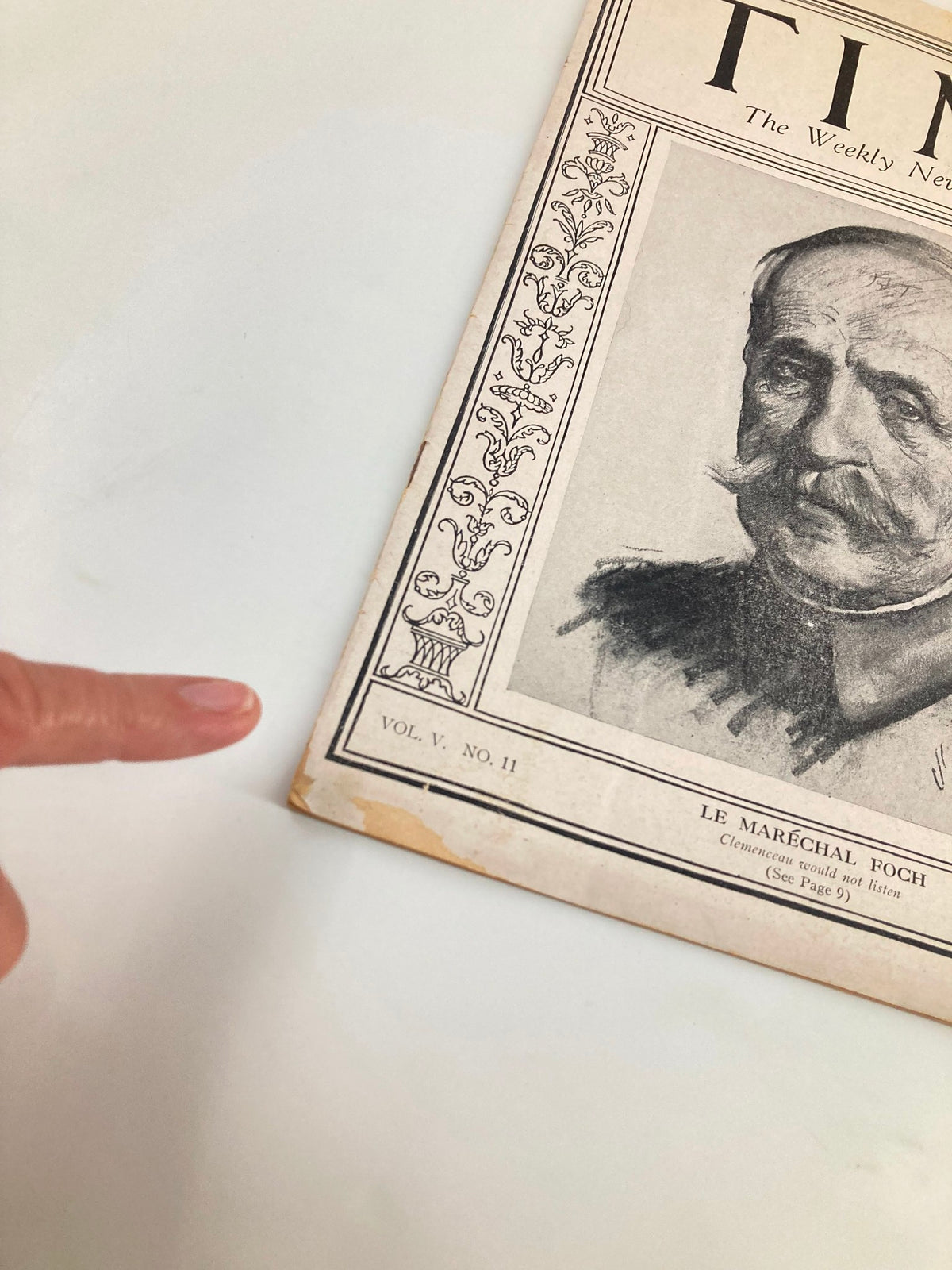
- Note: Specific article titles, the complete editorial contents beyond the confirmed Foch cover, and other features of this issue have not been independently verified beyond the listing description. Some marks are noted and should be assessed from the accompanying photographs. The highlights above reflect what is documentable from the listing and the well-established historical context of Marshal Foch and Time's March 1925 publication.
Condition & Rarity
This issue is described as being in good condition with minor wear throughout, some marks, no label, and a plastic protective covering — a condition profile that is honest and meaningful for a publication now one hundred years old that was produced for active reading use rather than archival preservation. Good condition with minor wear for a weekly newsstand publication from 1925 represents a genuinely significant preservation achievement: the vast majority of weekly publications from this era did not survive a century of storage in any condition, and the structural integrity implied by a good condition designation for a 1925 Time is meaningfully positive. The marks should be assessed from the accompanying photographs relative to the Foch cover and primary content pages. The no-label newsstand status preserves the cover in complete presentation. The plastic protective covering indicates deliberate preservation care. Time magazine issues from Volume V of 1925 — the publication's second year of operation — are among the most historically foundational entries in the publication's full archive, sought by Time completionists, First World War history researchers, interwar European political history specialists, and American journalism historians who recognize these second-year issues as primary artifacts of both the publication's institutional development and the specific historical figures it was documenting at the height of the mid-1920s interwar period.
Looking for More Issues Like This?
The March 16, 1925 Time Marshal Foch cover is a primary artifact of both the First World War's most celebrated surviving Allied commander and the American newsweekly's own foundational second year — a publication now a full century old that documents the specific mid-1920s interwar commemorative culture through the institutional lens of American journalism at its most historically significant early development phase. If this issue is no longer available, the Time magazine collection at OriginalMagazines.com is the most comprehensive resource for exploring what else has surfaced from the publication's earliest years and its extraordinary archive of twentieth century history documentation. For collectors building a broader documentary record of American journalism and international affairs during the jazz age's mid-decade prosperity, the 1925 magazines collection brings together a wide range of primary source material from that pivotal interwar year.