


Description
Collector's Note – Why This Issue Matters
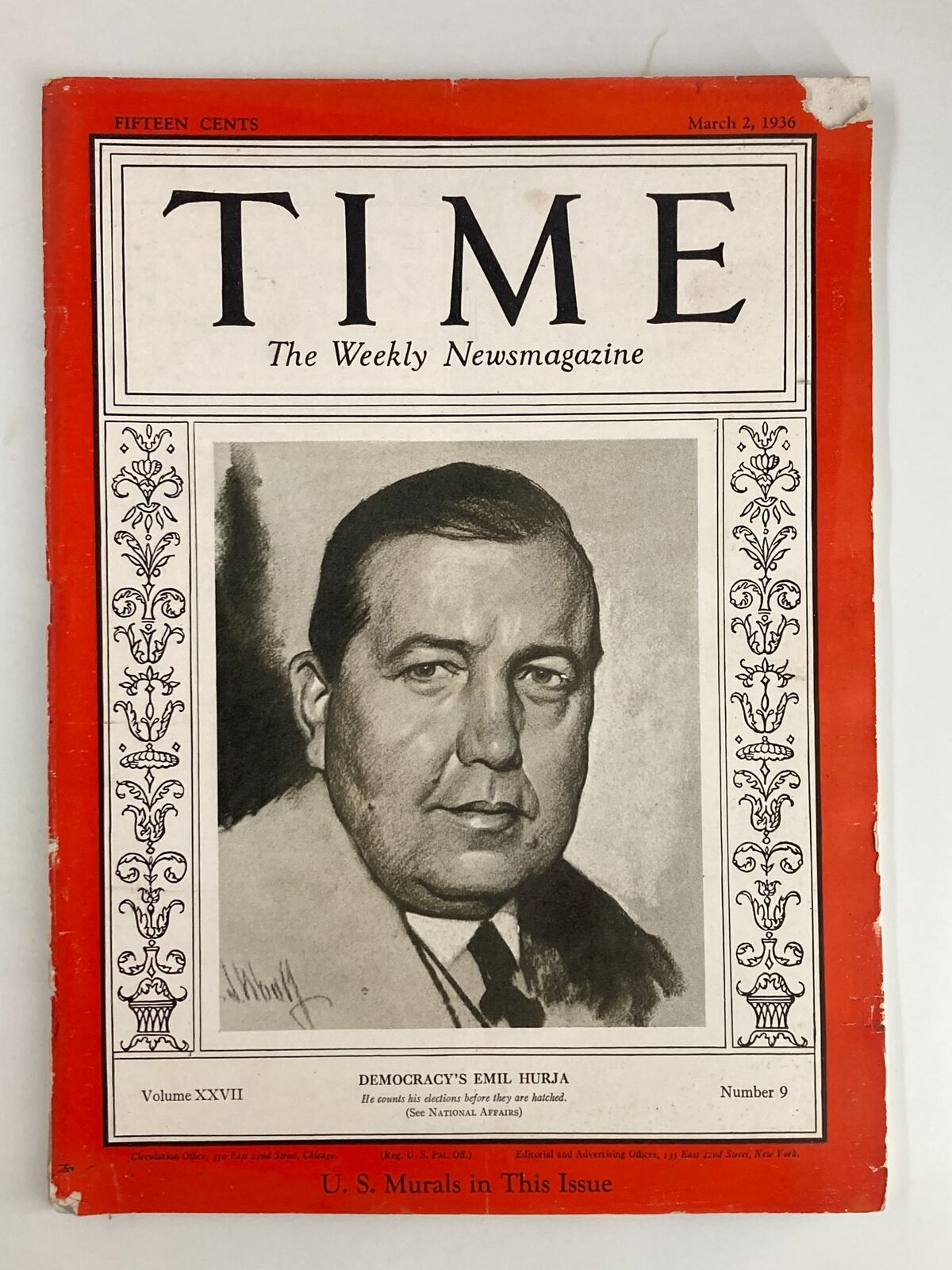
The March 2, 1936 issue of Time featuring Emil Hurja under the headline "Democracy's Emil Hurja" documents one of the most influential and least celebrated figures in the history of American political data analytics — a man whose work in the early 1930s effectively invented the modern political polling operation. Hurja was the chief analyst and statistician for the Democratic National Committee under Franklin Roosevelt, and his systematic use of polling, demographic analysis, and precinct-level data to guide campaign strategy in the 1932 and 1934 elections had produced results so consistently accurate that he was widely credited as a decisive factor in the Democrats' electoral dominance during Roosevelt's first term. His methods were genuinely novel: in an era when political strategy was still largely driven by patronage networks, gut instinct, and newspaper editorial opinion, Hurja was building quantitative models of the American electorate that anticipated by decades the data-driven campaigning that now defines modern politics. A Time cover profile in March 1936 — the year of Roosevelt's landslide re-election campaign — acknowledged Hurja's significance at the precise moment his methods were being deployed for what would prove to be the most decisive presidential victory of the twentieth century. The Time magazine archive at OriginalMagazines.com spans the publication's full run, and this 1936 issue represents the magazine engaging a figure whose historical importance has only been fully appreciated in retrospect.
The broader context of March 1936 is essential to understanding the weight of a Hurja cover story. Roosevelt had just delivered his State of the Union address in January and was preparing for a re-election campaign against a Republican Party still searching for its footing after the devastating 1932 and 1934 cycles. The New Deal was at peak controversy — the Supreme Court had been striking down major components of the program, and the political battle over the role of government in the economy was being fought with an intensity that has few parallels in American history. The Democratic Party's political operation, of which Hurja was the analytical backbone, had transformed itself from the fragmented coalition that had struggled through the 1920s into a formidable national electoral machine. A Time profile titled "Democracy's Emil Hurja" in this specific pre-election year was a mainstream acknowledgment that the science of winning elections was being transformed, and that the transformation was happening inside the Roosevelt coalition. The 1936 magazines collection at OriginalMagazines.com offers related titles for collectors building a broader picture of this pivotal election year.
About the Publication
Time magazine was founded by Henry Luce and Briton Hadden in 1923 and by March 1936 had been the dominant American news weekly for over a decade. Its cover — reserved each week for the single figure or subject the editors considered most consequential — was the most widely recognized editorial designation in American journalism. In the mid-1930s, Time's coverage of the New Deal, the Roosevelt administration, and the transformation of American politics and economics was among its most sustained and significant editorial commitments, and its profiles of the figures who were actually operating the Democratic political machine gave its readership access to inside accounts of how American electoral politics worked that daily newspaper coverage could not provide.
Key Highlights Inside
- Emil Hurja cover profile — "Democracy's Emil Hurja": A major feature on the Democratic National Committee's chief statistical analyst — effectively the inventor of data-driven American political campaigning — published in the year of Franklin Roosevelt's historic 1936 re-election landslide, at the moment Hurja's methods were being deployed for their most consequential test.
- Vol. 27, No. 9 — specific archival identification: The confirmed volume and issue number allows precise placement within Time's publication history, useful for completionist collectors and researchers documenting the magazine's mid-1930s political coverage.
- Pre-1936 election political context: As a March 1936 issue, the broader coverage would have reflected Time's full engagement with the New Deal political landscape — the Supreme Court battles, the Republican opposition's search for a viable candidate, and the Roosevelt administration's preparation for what would prove the most decisive presidential campaign of the century.
- Label on back cover: The address label is on the back cover rather than the front — a condition note worth specifying, as this leaves the front cover with the Hurja portrait and headline unobscured.
Note: Specific additional interior article titles and features beyond those verifiable from the cover and listing details have not been inventoried for this issue and are not detailed here.
Condition & Rarity
A ninety-year-old issue of Time presenting in good condition with its overall integrity intact represents a meaningful preservation outcome for a weekly periodical from the Depression era — a period when most magazine copies were read, shared, and eventually discarded rather than archived. Minor wear throughout, binding wear, visible marks, and minor rips are standard and accepted condition attributes at this age, reflecting authentic circulation history. The label's placement on the back cover rather than the front is a positive attribute for this specific issue, as it leaves the Hurja cover portrait and headline fully visible and undistorted. Plastic protective covering indicates deliberate preservation and generally correlates with better interior page condition — reduced brittleness, legible text, and intact binding across nearly nine decades. For a 1930s Time cover profile of a figure whose significance in American political history has grown considerably as data-driven campaigning has become the norm, collector interest spans political historians, New Deal era researchers, and serious Time run archivists.
Looking for More Issues Like This?
A March 1936 Time with Emil Hurja on the cover — profiling the man who invented data-driven American political campaigning in the year of Roosevelt's historic landslide — is a historically specific find that sits at the intersection of New Deal political history, electoral analytics history, and serious mid-1930s periodical collecting. If this issue is currently unavailable, the Time magazine archive at OriginalMagazines.com is the most comprehensive place to explore what other political and historical covers from the magazine's Depression-era run are currently available. The 1936 magazines collection is worth browsing as well for collectors building a broader picture of this pivotal election year in American political history.