



Description
Collector's Note – Why This Issue Matters
The March 21, 1955 issue of Time Magazine, identified as Volume 65, Number 12, features American Federation of Labor president George Meany on a painted cover by Boris Chaliapin. The cover identifies him as “A.F.L.’s George Meany” and surrounds his portrait with scenes representing several forms of manual labor. A large wrench crosses the lower portion of the composition, referring both to organized labor and to Meany’s own background as a plumber. His ever-present cigar reinforces the plainspoken and forceful public image associated with him during much of his career. The corresponding article is titled “Head of the House,” presenting Meany as the dominant leader of the A.F.L. at a decisive moment in American labor history. He had become federation president following William Green’s death in 1952 and had worked rapidly to strengthen its central leadership. The issue therefore records Meany immediately before the achievement that would define his national reputation: the unification of the A.F.L. and the Congress of Industrial Organizations.
When the magazine appeared, the proposed A.F.L.–C.I.O. merger had been negotiated but was not yet formally completed. The two federations had separated during the 1930s amid disagreement over craft-based organization and the effort to unionize entire industries such as steel and automobile manufacturing. By the early 1950s, competition between them had produced expensive jurisdictional disputes and campaigns to recruit workers already represented by another union. Meany revived negotiations for unity and worked with C.I.O. president Walter Reuther and other senior labor officials to develop an agreement acceptable to both organizations. Time’s profile discusses the no-raiding arrangements intended to reduce internal conflict and redirect organizing efforts toward millions of workers who remained outside unions. The article also addresses concerns about corruption, Communist influence, organizational discipline, political action, and the proper authority of a national labor federation. Because the merger was still prospective in March 1955, Meany should be described here as A.F.L. president and prospective leader of a reunited labor movement rather than as an established AFL-CIO president.
Meany’s personal history gave the feature an additional connection to the working people whose organizations he represented. He grew up in a New York union household, entered the plumbing trade as a teenager, and became a journeyman and union member before moving into full-time labor administration. His career led from a local plumbers’ union to the New York State Federation of Labor and eventually to national A.F.L. leadership. The profile presents him as a practical negotiator who relied upon detailed knowledge, institutional memory, and direct argument rather than ideological theory. It also reflects the political position of mainstream American organized labor during the Cold War, including support for democratic trade unions and opposition to Communist control. Later in 1955, the A.F.L. and C.I.O. formally united, and Meany became the first president of the combined federation. Related labor, political, and economic reporting can be examined through other vintage issues of Time Magazine and through additional magazines published in 1955.
About the Publication
Time Magazine was founded by Henry R. Luce and Briton Hadden, with its first issue published in March 1923. The weekly publication was designed to organize major national and international developments into a concise and recognizable news format. Its departments covered government, diplomacy, armed conflict, business, labor, science, medicine, religion, education, sports, books, theater, cinema, music, radio, and visual art. Articles were generally brief and arranged so that readers could move through a broad survey of the week’s events. Time became especially associated with cover portraits of political leaders, military commanders, scientists, executives, writers, performers, clergy members, athletes, and institutional figures. During the middle decades of the twentieth century, many of these covers were commissioned paintings rather than conventional news photographs. Artists such as Boris Chaliapin combined recognizable likenesses with symbolic tools, buildings, maps, machinery, clothing, and surrounding figures. The magazine’s red border became one of the most familiar design elements in American periodical publishing. Its writing frequently blended factual reporting with strong interpretation, compressed character descriptions, and a distinctive editorial voice. Labor coverage treated union leadership, strikes, wages, industrial relations, legislation, political influence, and workplace organization as major national subjects. Surviving editions now document both the events being reported and the editorial assumptions through which contemporary readers were encouraged to understand them.
Key Highlights Inside
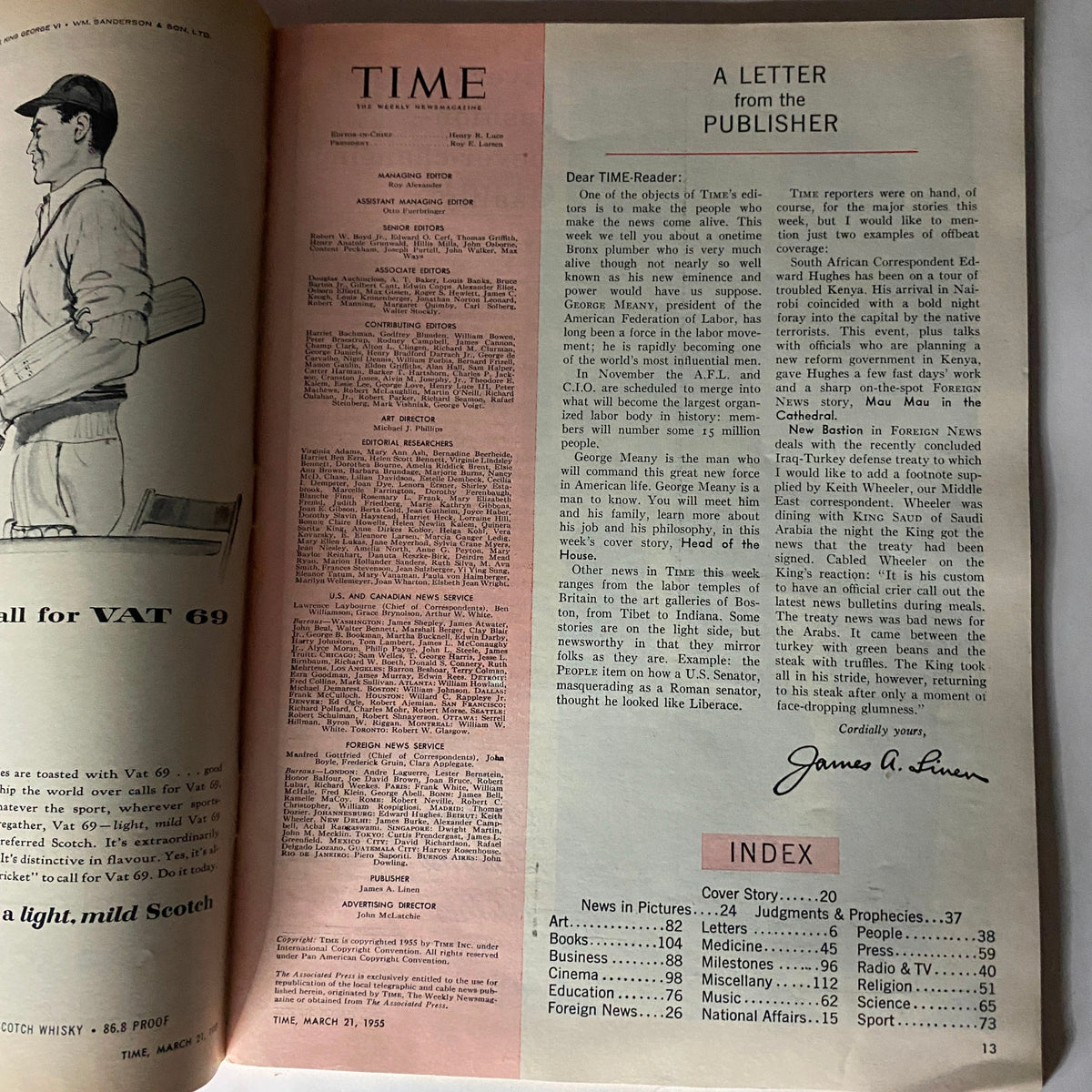
- “Head of the House” is the verified principal labor feature associated with George Meany’s cover appearance. It examines his rise from the plumbing trade to the presidency of the American Federation of Labor and his efforts to impose greater unity and discipline within the organization. The article also considers the planned merger with the C.I.O., which had been negotiated but was not formally completed when the issue was published.
- The national-affairs section includes reporting on President Dwight D. Eisenhower, Congress, the Democratic Party, foreign relations, military matters, investigations, agriculture, and state politics. A separate feature titled “Should It Be Cut?” presents opposing positions concerning the federal capital-gains tax. These articles preserve political and economic arguments as they were framed during the Eisenhower administration rather than providing conclusions based upon later policy developments.
- International coverage includes reports titled “Diem Besieged” on South Vietnam and “Trouble for Ho” on North Vietnam. Additional items address Tibet, India, Kenya, Hungary, Britain, France, Italy, the Soviet Union, and security arrangements in the Middle East. The range reflects a Cold War news environment shaped by decolonization, Communist expansion, regional instability, and the effort to construct Western alliances.
- The science department includes “Circular Take-Off,” “Venus Observed,” “First Wall of Jericho,” and “New Wrinkles.” Medical reporting includes “Deep in the Brain,” “With Needle & Wormwood,” and shorter clinical developments collected in the magazine’s capsules department. These pieces should be read as contemporary popular-science journalism whose terminology and conclusions may differ from later research.
- Business coverage addresses the economic outlook, Wall Street, real estate financing, corporate competition, personnel, government spending, and newly marketed goods and services. Other departments examine religion in industrial Pittsburgh, education, hot-rod racing, music, cinema, books, radio, television, and contemporary art. Together, these features establish the edition as a wide weekly record of American and international affairs rather than a publication devoted only to Meany or organized labor.
Condition & Rarity
The supplied listing states that the photographed magazine is the exact physical issue represented by the description. No formal collector grade is provided, so its preservation should be evaluated from the accompanying images rather than from an assumed classification such as good or very good. The written description does not identify particular creases, tears, marks, stains, or binding defects. The presence or absence of a mailing or address label is also not confirmed. That detail should therefore be determined through direct inspection of the cover rather than inferred from another surviving example of the same issue. A plastic protective covering accompanies the magazine and may reduce additional exposure to dust, fingerprints, and surface abrasion. The sleeve does not establish page completeness, secure staples, firm cover attachment, or the condition of the interior paper. Time issues from this period may display edge rubbing, softened corners, spine stress, paper toning, small tears, surface impressions, or wear around the staples. Particular attention should be given to Chaliapin’s portrait, the symbolic labor scenes, the red border, the Time nameplate, and the “A.F.L.’s George Meany” identification. Interior examination should check that the complete “Head of the House” article and the other listed departments remain present without clipping, writing, moisture damage, tape, or previous repairs. Historical importance and Meany’s later role in the AFL-CIO do not independently establish rarity, which should be assessed through documented availability and the physical condition of the individual magazine.
Looking for More Issues Like This?
Exact Time issues can require patience to identify when research is centered on a particular labor leader, union federation, cover artist, and publication week. The March 21, 1955 edition is especially relevant to readers studying George Meany, the American Federation of Labor, Walter Reuther, and the approaching A.F.L.–C.I.O. merger. Related labor and political reporting can be explored through the broader collection of vintage Time Magazines. Other editions document strikes, collective bargaining, industrial unions, craft organizations, labor legislation, political endorsements, corruption investigations, and changing relations between unions and employers. Comparing Meany’s 1955 appearance with later coverage can reveal how his public identity changed after he became president of the combined AFL-CIO. The collection of original magazines from 1955 provides a wider view of the year in which organized labor achieved formal reunification. Publications from that year preserve Cold War diplomacy, civil rights, business, manufacturing, television, cinema, advertising, consumer culture, and workplace change. Examining several titles together helps distinguish Time’s interpretive newsmagazine style from the photographic, literary, business-oriented, and specialist approaches used by other publications. Closely dated magazines remain historically useful even when this precise Volume 65, Number 12 edition is not represented because they establish the surrounding political and labor chronology. Together, the Time and 1955 collections provide a valuable foundation for continued research into George Meany and American labor history at mid-century.