


Description
Collector's Note – Why This Issue Matters
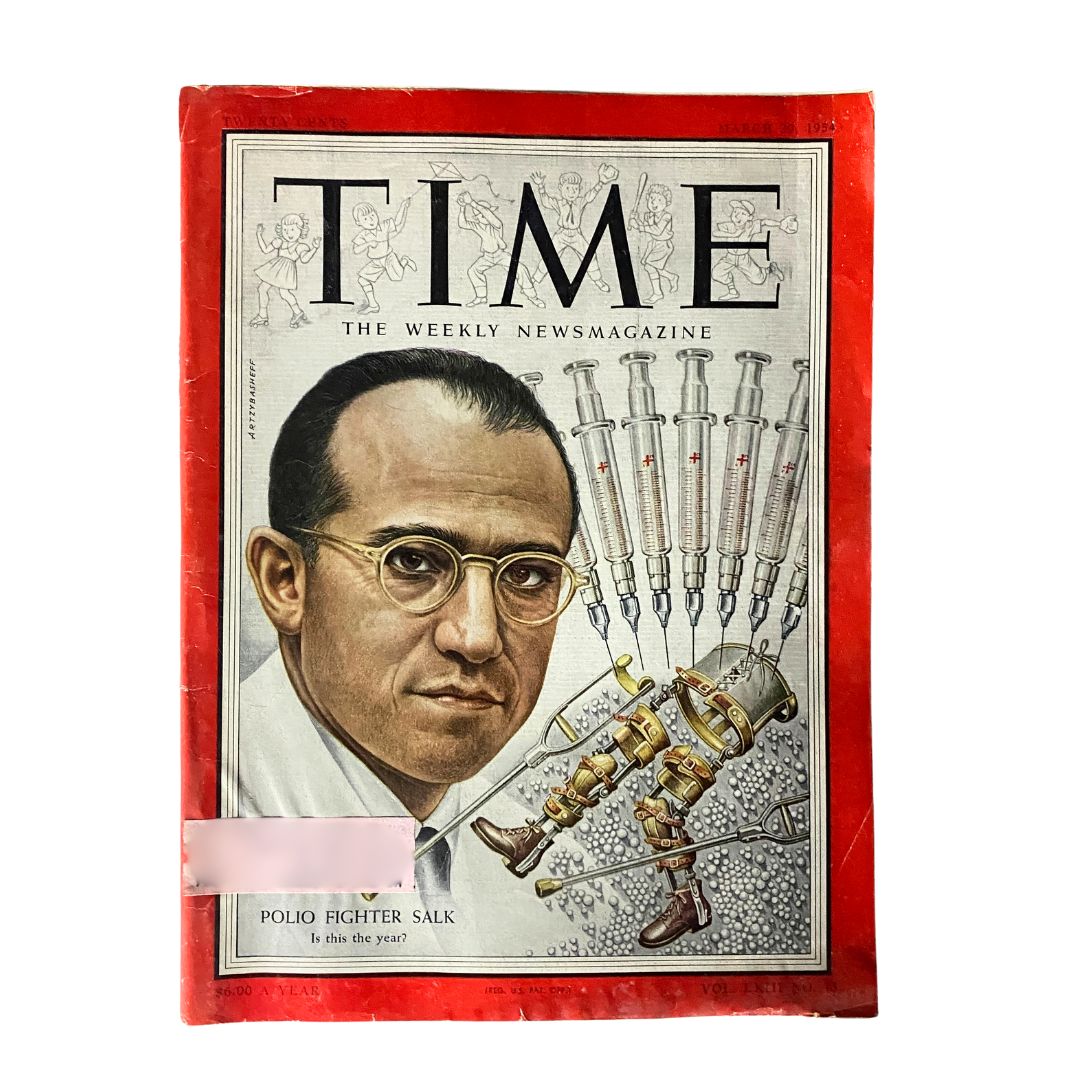
The March 29, 1954 issue of Time magazine — Volume 63, Number 13 — featuring Jonas Salk on its cover is one of the most historically significant science and medicine covers the publication produced in its entire run, and understanding its full weight requires understanding precisely what was happening in the world of public health in the spring of 1954. Polio had been one of the most feared diseases in America for decades — a virus that struck without warning, that paralyzed or killed thousands every summer, and that had made the warm months of every year a season of genuine dread for parents of young children across the country. The disease had acquired a particular cultural power from its most famous victim, Franklin Roosevelt, whose presidency had been conducted from a wheelchair and whose personal connection to polio had given the disease an unusual visibility in American political life. By 1954 the National Foundation for Infantile Paralysis — which would become the March of Dimes — had been funding polio research for nearly two decades, and Jonas Salk, working at the University of Pittsburgh, had developed an inactivated poliovirus vaccine that was about to undergo the largest clinical trial in American medical history. The Salk vaccine field trials of 1954 — involving nearly two million American schoolchildren who would be known as the Polio Pioneers — were just beginning when this Time cover appeared, making this issue a primary document of one of the most consequential moments in the history of American public health, produced at the precise moment of maximum anticipation before the trial results were known. For collectors building a serious archive of Time magazine covers from the history of medicine and science, this March 1954 issue is among the most historically freighted and editorially significant pieces available from any era of the publication's run.
Jonas Salk's appearance on the cover of Time in March 1954 represents a specific and historically important moment in the relationship between American science, American public health, and mainstream media — a moment when a scientist's work had achieved a level of public salience and emotional urgency that made him the natural subject for the most widely read newsmagazine in the country. Salk was not yet the validated hero he would become after the vaccine's success was announced in April 1955 — that announcement, made by Thomas Francis Jr. at the University of Michigan, would produce one of the most spontaneous and widespread celebrations in American peacetime history, with church bells ringing and strangers embracing in the streets. In March 1954 the work was promising but not yet proven, the trials were just beginning, and Salk was a figure of immense hope rather than confirmed achievement. The Time cover at this moment therefore captures something particularly interesting and historically specific: a scientist being celebrated for work that had not yet fully succeeded, reflecting the degree to which the American public's need for the vaccine — after years of polio summers — had invested Salk's research with an emotional urgency that transcended normal scientific caution. That combination of scientific promise and public desperation gives this cover a human and historical depth that the triumphant post-1955 coverage of Salk, valuable as it is, cannot quite replicate.
The broader context of March 1954 in American science and public life adds further historical texture that makes this issue valuable to researchers and collectors working across multiple areas of mid-century American history. The early fifties were a period of both extraordinary scientific ambition and profound public anxiety in the United States — the Cold War was driving enormous investment in basic science and technology, the nuclear age had made scientific achievement simultaneously a source of national pride and existential threat, and the relationship between scientific institutions, government funding, and public health was being actively renegotiated in ways that would shape American medicine for decades. Salk's work, and the massive public investment in the polio vaccine program, was one of the clearest and most emotionally accessible expressions of the positive dimension of that scientific ambition — the idea that American science could solve problems that had seemed intractable, that organized research and public investment could eliminate diseases that had terrorized generations. The March 1954 Time cover of Salk participated in that national narrative at its most hopeful and most charged moment. Those assembling a comprehensive archive of 1954 magazines as primary documents of one of the most scientifically and politically consequential years of the postwar decade will find this issue one of the most historically significant and editorially resonant pieces in that collection.
About the Publication
Time magazine, co-founded by Henry Luce and Briton Hadden in 1923, had established itself by the mid-fifties as the definitive American weekly newsmagazine and one of the most widely read and editorially influential periodicals in the world, reaching millions of subscribers at the height of its postwar authority and cultural reach. Its editorial format combined concise, opinionated reporting on the week's major domestic and international news with longer analytical features, cultural coverage, and regular departments spanning science, medicine, business, religion, and the arts — a breadth that made it genuinely indispensable to the educated American reader navigating the rapidly changing world of the postwar decade. The magazine's science and medicine coverage was a consistent strength, reflecting Henry Luce's genuine interest in the relationship between scientific progress and American national life, and its willingness to devote cover stories to scientists and medical researchers — as it did with Salk in March 1954 — reflected a conviction that scientific achievement deserved the same prominent editorial treatment as political or military events. The March 29, 1954 cover, appearing at the moment of maximum public anticipation surrounding the polio vaccine trials, represented Time at its most editorially confident: making the judgment that a scientist's imminent clinical trial was the most important story in the world that week, and devoting its most prominent editorial real estate to making that case to its enormous readership.
Key Highlights Inside
- The cover features Jonas Salk — the University of Pittsburgh virologist whose inactivated poliovirus vaccine was in March 1954 on the verge of the largest clinical trial in American medical history, involving nearly two million schoolchildren — documenting one of the most significant figures in twentieth-century medicine at the precise moment of maximum scientific anticipation, before the trial results confirmed his vaccine's efficacy and made him one of the most celebrated scientists in American history.
- The issue is precisely identified as Volume 63, Number 13, published March 29, 1954 — placing it in the spring of the year when the Salk vaccine field trials were just beginning, months before the April 1955 announcement that the vaccine was safe and effective, and capturing the story at the specific moment when hope and scientific promise were at their most charged and most emotionally resonant for an American public that had lived with annual polio epidemics for decades.
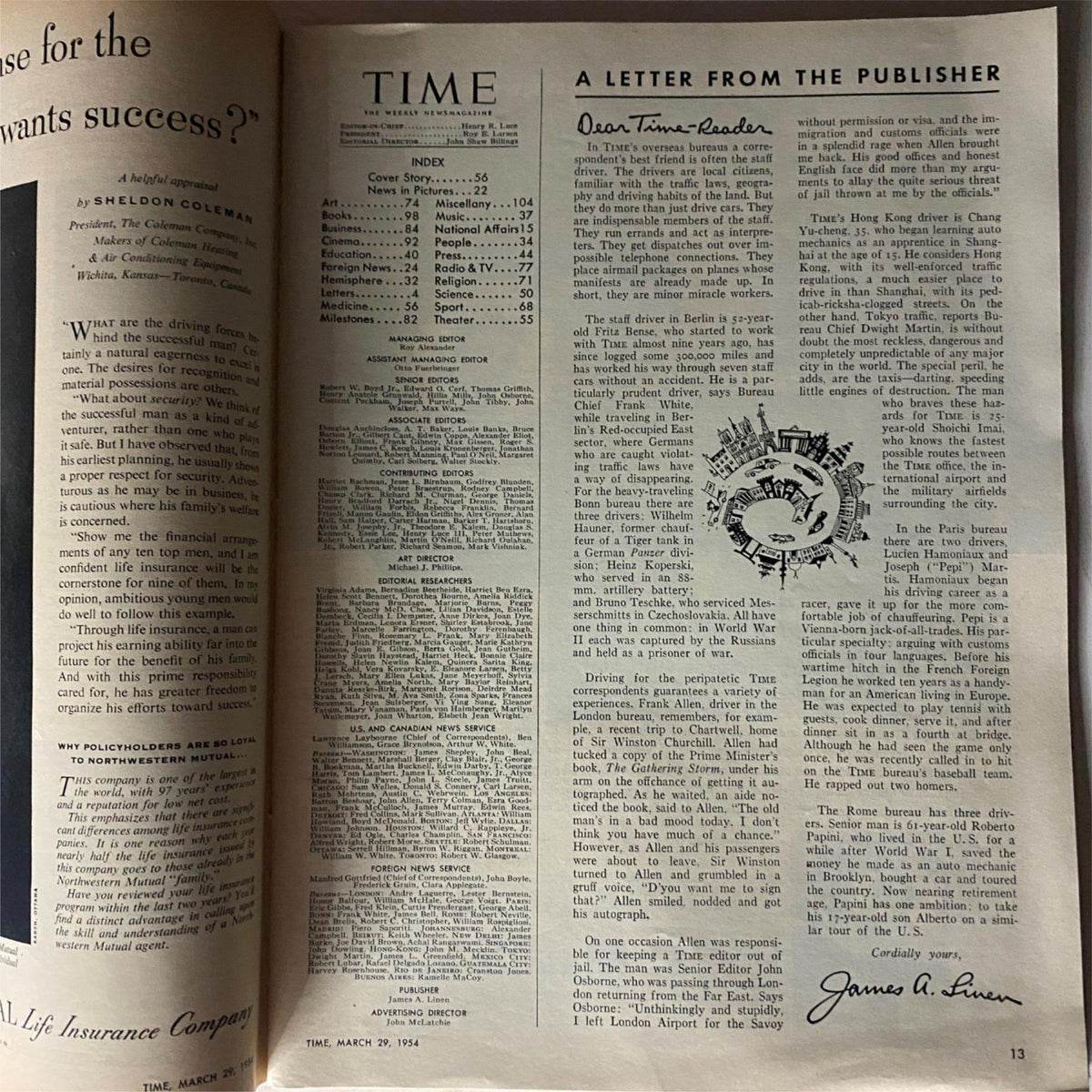
- The listing confirms the presence of "fascinating articles and images that pay tribute to Jonas Salk's contributions" — editorial content that would have engaged with the history of the polio fight, the science of vaccine development, the structure of the trial program, and the enormous public investment that the March of Dimes and the National Foundation for Infantile Paralysis had made in the search for a polio vaccine, providing readers with the full context of a scientific achievement that was still in the process of being validated.
- A Time cover devoted to Salk in March 1954 represents the mainstream American press's recognition that the polio vaccine story was not merely a medical news item but a national emotional event — a story that touched the lives of virtually every American family and that carried the weight of years of summer dread, institutional fundraising, and scientific labor that the entire country had invested in the hope of exactly the kind of breakthrough Salk was on the verge of delivering.
- As a late-March 1954 issue, the magazine would have carried Time's comprehensive coverage of the full range of domestic and international events of that week — including the early months of the Army-McCarthy hearings, the ongoing Cold War, and the full sweep of mid-fifties American political and cultural life — making it a rich documentary cross-section of a specific and historically consequential week in a year of particular significance for both American science and American politics.
- Note: Specific article titles, interview content, additional features, and full interior editorial details beyond the confirmed cover subject have not been independently verified for this issue. The above reflects what is documented from the cover, volume and issue identification, the listing's general content description, and the well-established historical record surrounding Jonas Salk and the polio vaccine trials in March 1954.
Condition & Rarity
Surviving copies of the March 29, 1954 Time in collectible condition present the characteristic aging profile of a seventy-plus-year-old weekly newsmagazine that has passed through multiple generations of storage and ownership. Time of this era was printed on a combination of coated stock for photographic and cover pages and lighter text-weight paper for its news and editorial sections — more resilient than pure newsprint but not engineered for archival longevity across seven decades — and the characteristic aging patterns of early-fifties issues are well established among serious collectors of the publication: some tanning and possible brittleness to outermost pages, spine softening from decades of varied storage, and the small handling marks and edge wear that accumulate over seventy-plus years of ownership transitions. The listing for this issue directs collectors to the provided photographs as the primary condition reference — an honest and appropriate approach for a vintage periodical whose specific condition attributes are best assessed visually — and collectors evaluating any surviving copy of this issue should examine the cover stock condition and the legibility of the Salk cover portrait as the primary visual assets, alongside the structural assessments of spine integrity and page completeness that determine a copy's archival stability and long-term display suitability. The listing does not specify the presence or absence of an address label, a detail that matters for display-focused collectors, as label-free copies preserve the complete Salk cover presentation without the adhesive residue that subscriber labels routinely left on the coated cover stock of early-fifties Time issues. Protective plastic sleeve storage is the appropriate preservation standard for coated-stock newsmagazines of this type and period.
Looking for More Issues Like This?
The March 29, 1954 Jonas Salk Time cover is one of the most historically significant science and medicine covers the magazine produced in its entire publishing history — a primary document of the polio vaccine story at the moment of maximum scientific anticipation, before the 1955 announcement that confirmed Salk's vaccine and transformed him into one of the most celebrated scientists in American history — and copies in any collectible condition are consistently sought by medical historians, science journalism researchers, and serious Time magazine archivists who understand the specific weight this particular edition carries. The Time magazine collection at OriginalMagazines.com spans a wide and carefully assembled range of issues from across the publication's remarkable run, and is the essential starting point for anyone building a serious archive of mid-century American newsmagazine journalism and its engagement with the scientific achievements that defined the postwar decade. For collectors drawn to the full historical landscape of the year the polio trials began, the 1954 magazine collection offers a rich cross-section of one of the most consequential years in postwar American history — from the Army-McCarthy hearings to the Brown v. Board of Education decision to the polio vaccine trials — across multiple titles and editorial perspectives.