



Description
Collector's Note – Why This Issue Matters
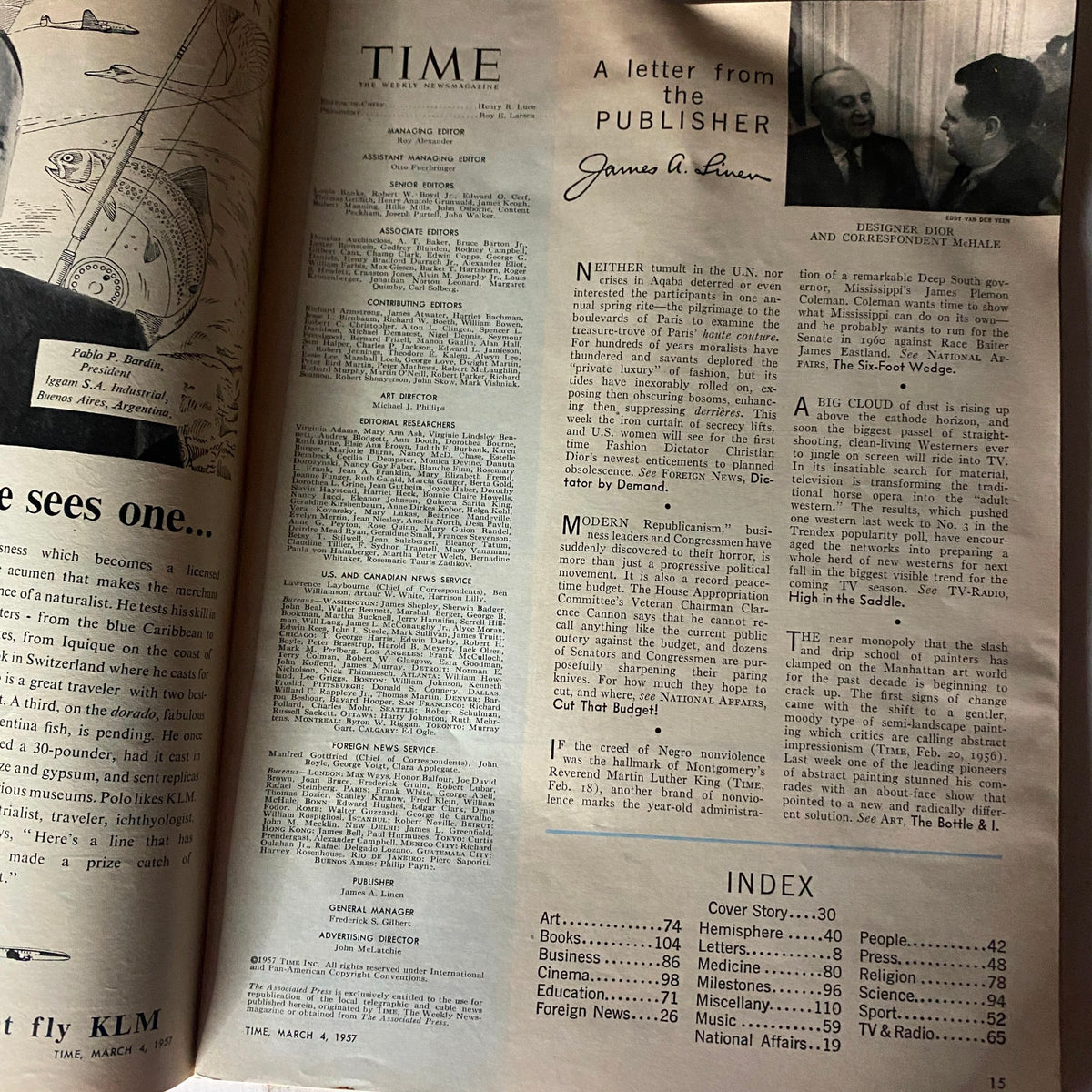
The March 4, 1957 issue of Time magazine, Volume 69 Number 9, featuring Christian Dior on the cover is a primary document of one of the most historically consequential figures in the history of twentieth-century fashion at a specific and profoundly significant moment — because March 1957 was, as it turned out, almost exactly seven months before Dior's death on October 24, 1957. A Time cover story on Christian Dior in March 1957 therefore represents the American mainstream media's fullest and most institutionally authoritative engagement with his life, work, and legacy while he was still alive — the definitive contemporaneous American assessment of a designer whose influence on the history of fashion was already recognized as extraordinary and whose remaining creative output would prove to be his last. The ten years between Dior's founding of his couture house in 1946 and this March 1957 cover had been among the most consequential in the history of modern fashion: the New Look of February 1947 had been a genuine cultural earthquake, reversing the utilitarian wartime silhouette and reorienting Western women's fashion around a new vocabulary of femininity, luxury, and postwar aspiration that shaped the industry for the following decade. A Time cover story in March 1957 was a reckoning with that decade of influence and a recognition of Dior's place in the history of American and global fashion culture, made at the height of his powers and influence. For collectors researching Time's coverage of fashion, culture, and design across its most historically significant decades, the Time magazine archive is the most concentrated resource for tracing how the publication engaged with the cultural figures who shaped the postwar world.
The specific date of March 4, 1957 places this issue within a particular and historically interesting phase of Dior's career. By early 1957 the house had survived the controversies that had attended the New Look's initial reception — including the accusations of retrograde anti-feminism from women who had fought for practical clothing during the war years — and had consolidated its position as the most commercially successful and most critically respected haute couture house in Paris. Dior had continued to evolve his aesthetic across ten years of collections, and the spring 1957 season — the last he would present before his death that autumn — was being produced in the final months of a career whose full historical significance was still being actively written. The designers who had trained under Dior's influence, including Yves Saint Laurent who had joined the house in 1955, were preparing to carry his aesthetic legacy forward in ways that would shape fashion across the following decades. A Time cover at this specific moment captured Dior at the precise intersection of established legacy and continuing creative activity, making this issue a document of unusual historical completeness — a contemporaneous assessment that could not yet know it was also, in retrospect, one of the final major public engagements with his career during his lifetime. The complete 1957 magazine archive provides essential context for understanding this issue within the full publishing and cultural landscape of a year that would prove to be one of the most historically significant in the history of postwar fashion.
The broader significance of Christian Dior appearing on the cover of Time in March 1957 extends beyond the fashion world to what it says about how American mainstream culture was engaging with European luxury and aesthetic achievement in the mid-fifties. The postwar American relationship with French couture was complex and culturally loaded — simultaneously aspirational and suspicious, admiring of European sophistication and committed to American democratic values that were sometimes uncomfortable with the explicit elitism of haute couture. A Time cover story on Dior was an act of cultural translation as well as fashion journalism, presenting the work of a Parisian couturier to an American mass audience in terms that made his significance legible and his achievement comprehensible within the American cultural framework. That translation, made at the height of both Dior's career and the postwar fashion world's most creative phase, is itself a historically significant cultural document.
About the Publication
Time was founded in 1923 by Henry Luce and Briton Hadden and grew across the twentieth century into the most widely read and institutionally authoritative weekly newsmagazine in the United States — a publication whose cover appearances were understood by the American public and by cultural figures alike as among the most significant markers of mainstream cultural recognition that American journalism could confer. Its format combined comprehensive weekly news reporting with the analytical and contextual framing of a publication that understood itself as an interpreter of events and cultural significance for the broadest possible American readership. A fashion designer on the cover of Time was a specific and deliberate cultural statement — one that the magazine made rarely and with full awareness that the choice would be understood as a declaration about which cultural figures had achieved significance that transcended their own immediate professional world.
Key Highlights Inside
- A cover story on Christian Dior — one of the most historically significant fashion covers in Time's publishing history, appearing in March 1957 less than eight months before Dior's death in October 1957, making this the definitive contemporaneous American mainstream assessment of his career, legacy, and significance during his lifetime at its final and most complete phase.
- Editorial engagement with the New Look and Dior's decade of influence — a Time cover story in March 1957 would necessarily have addressed the ten-year arc from the foundational 1947 New Look through the evolution of his aesthetic across ten seasons, providing a contemporaneous overview of the most consequential single decade in postwar fashion history.
- Coverage consistent with Time's approach to major cultural figures — the analytical framing and contextual depth that distinguished the magazine's treatment of significant cultural subjects, applied to a designer whose influence on American and global fashion was already recognized as extraordinary and whose legacy was being actively constructed in real time by the publication's coverage.
- Broader news and cultural content consistent with Time's March 4, 1957 weekly format — the full range of domestic and international reporting surrounding the Dior cover story, providing a complete snapshot of American and world affairs in the first week of March 1957.
- Note: The listing does not specify detailed condition attributes beyond the confirmed protective covering and the Volume 69, Number 9 designation. Beyond the confirmed Christian Dior cover story, specific article titles, named contributors, and full interior content details have not been independently confirmed for this issue. The highlights above reflect what is verifiable from the named cover subject, volume and issue designation, date, and the publication's well-documented editorial format and approach for the period.
Condition & Rarity
Surviving copies of this issue present with the physical characteristics consistent with copies of a weekly newsmagazine that have been preserved through private ownership over nearly seven decades. The listing does not specify detailed condition attributes beyond the confirmed presence of a protective plastic sleeve, and collectors evaluating any surviving copy of this issue should assess available photographs carefully for cover condition, page tanning, spine integrity, and any surface wear or marking that reflects nearly seventy years of storage and handling. Time magazine was printed on coated paper stock of relatively good quality for its era, which supports better long-term interior page condition than the newsprint typical of many contemporary periodicals, and copies preserved in protective sleeves maintain this advantage more reliably than unprotected examples. The inclusion of a protective plastic sleeve indicates conscious collectible treatment. March 1957 Time magazine issues featuring Christian Dior carry a specific and well-defined historical significance within the vintage fashion and mainstream media collector market — they are the definitive contemporaneous American mainstream assessment of the most influential fashion designer of the postwar era, produced less than eight months before his death and therefore occupying a unique position in the documentary record of his life and career that no later publication can replicate.
Looking for More Issues Like This?
Mid-fifties Time magazine covers featuring the defining figures of postwar European fashion and culture are among the most historically specific and culturally resonant items in the vintage American newsmagazine collector market — contemporaneous assessments of figures whose long-term significance was already recognized but whose careers were still active, produced by the most institutionally authoritative American weekly at the height of its cultural influence. If this particular March 4, 1957 Christian Dior issue has already been claimed, the full Time magazine archive at OriginalMagazines.com is the most comprehensive resource for exploring other issues from the publication's remarkable run, including additional numbers from the pivotal mid-to-late-fifties years when the magazine was covering the full breadth of postwar American and world culture with its characteristic depth and authority. Collectors building a wider picture of the 1957 publishing and cultural landscape will also find the complete 1957 magazine archive an invaluable reference — spanning titles across the full spectrum of that year's output and offering essential context for anyone researching the postwar fashion world, Christian Dior's legacy, and the American mainstream media that recognized and documented his significance while he was still alive to receive it.