





Description
Collector's Note – Why This Issue Matters
March 9, 1953 places this issue of Time at one of the most consequential junctures of the Korean War. Armistice negotiations had been grinding through their second year at Panmunjom, and the central obstacle to any agreement was increasingly Syngman Rhee himself. As the first president of the Republic of Korea — a position he had held since 1948 — Rhee was categorically opposed to any armistice that left Korea divided, and he made no effort to conceal his willingness to obstruct the peace process that the United States and United Nations were laboriously constructing. His defiance of Washington's diplomatic objectives made him a deeply complicated figure for American policymakers: a reliable anti-communist ally whose intransigence threatened to unravel negotiations entirely. Time's decision to put him on the cover in March 1953 reflects exactly how central — and how difficult — he had become to the war's resolution. Just three months after this issue appeared, Rhee would order the unilateral release of North Korean prisoners of war, a deliberate act of sabotage against the armistice framework that nearly collapsed the talks altogether.
The timing carries additional historical weight that only became clear in retrospect. Joseph Stalin died on March 5, 1953 — four days before this issue's cover date. Stalin's death fundamentally altered the geopolitical calculus of the Korean War, removing the Soviet leader whose support had enabled North Korea's original invasion and whose strategic calculations had shaped the conflict from the beginning. Whether Time's editorial team had fully absorbed that news by press time is a function of the magazine's production schedule, but the issue exists at the precise intersection of two enormous events: Stalin's death and the ongoing drama of Rhee's resistance to peace. For collectors building a serious archive of Time magazine's Korean War-era coverage, this issue occupies a specific and unrepeatable position in the chronological record.
Syngman Rhee is not a figure who receives extensive coverage in American popular history today, which makes primary press documents from his most active political period all the more valuable as research sources. He governed South Korea until 1960, when a student-led uprising forced his resignation and exile to Hawaii, where he died in 1965. His complicated legacy — authoritarian ruler, fierce nationalist, instrumental figure in South Korea's survival as an independent state — is documented most honestly in the contemporaneous press of the 1950s, before his reputation had been filtered through decades of retrospective analysis. The magazine record from 1953 captures him at the height of his international visibility, in real time, without the smoothing effect of historical distance.
About the Publication
Time was founded in 1923 by Henry Luce and Briton Hadden as the first American weekly news magazine. By 1953 it was one of the most widely read publications in the United States and carried significant influence in shaping how American readers understood international affairs. Its format combined tight, opinionated news summaries across departments — National, Foreign, Business, Science, Arts — with a cover story devoted to a single figure or event deemed most significant that week. The cover subject selection was itself an editorial statement, and Time's covers from the Korean War era constitute a documentary record of which international figures the American press establishment considered most consequential during the conflict.
Key Highlights Inside
- Cover feature on Syngman Rhee — The cover story examines Rhee at a pivotal moment in Korean War diplomacy, when his opposition to armistice negotiations had made him simultaneously indispensable and deeply problematic for the United States and its allies.
- Korean War context, early March 1953 — The issue appears during the final months of active armistice negotiations at Panmunjom, with the war in its third year and a ceasefire still four months away from the July 1953 agreement.
- Cold War geopolitical backdrop — Published days after the death of Joseph Stalin on March 5, 1953, the issue exists at a precise moment of transition in the broader Cold War alignment that had shaped the Korean conflict from its origins.
- Primary source documentation of 1950s East Asian politics — As a contemporaneous account of Rhee's leadership and international standing, the issue serves as a primary document for researchers studying South Korean political history and U.S.-Korean relations in this period.
Condition & Rarity
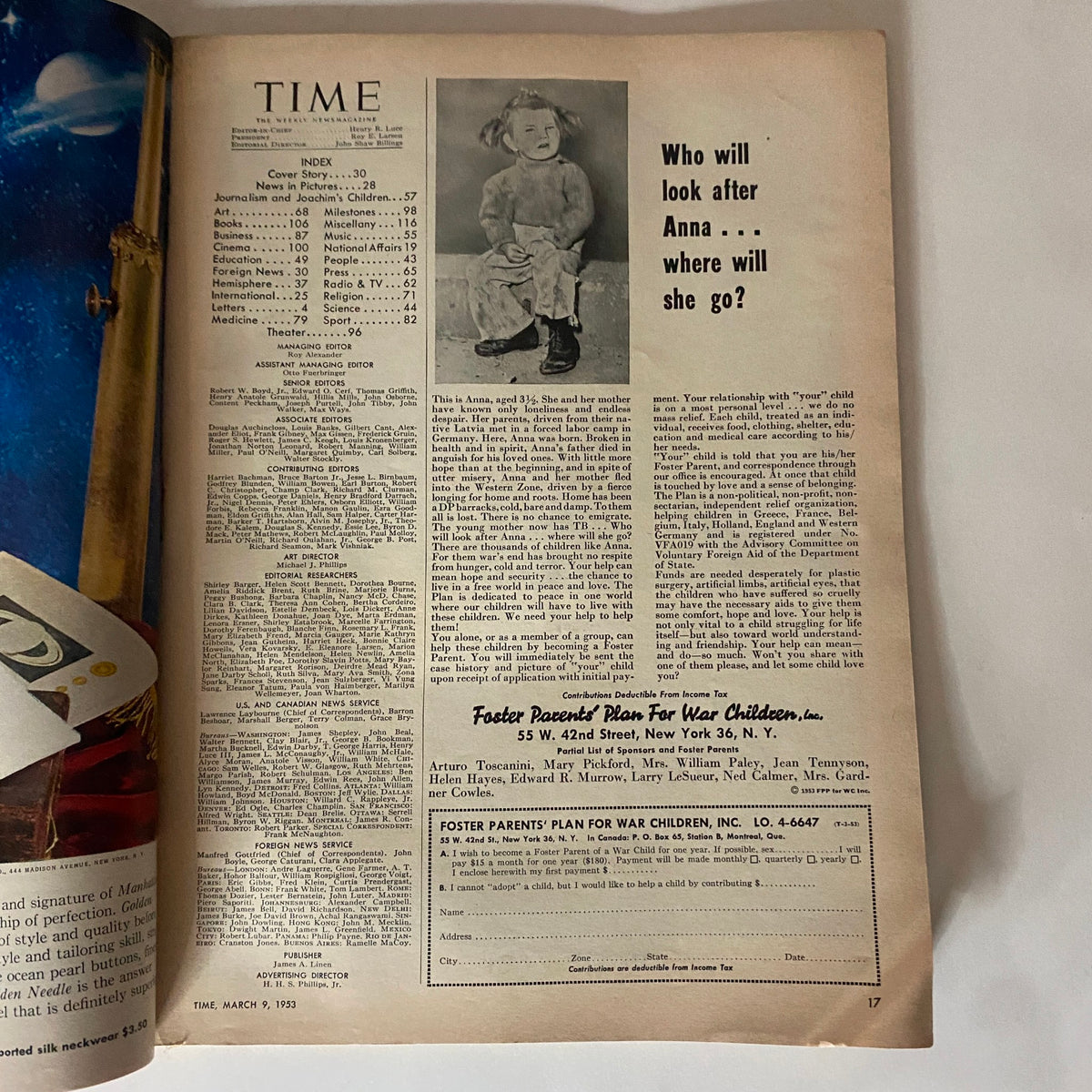
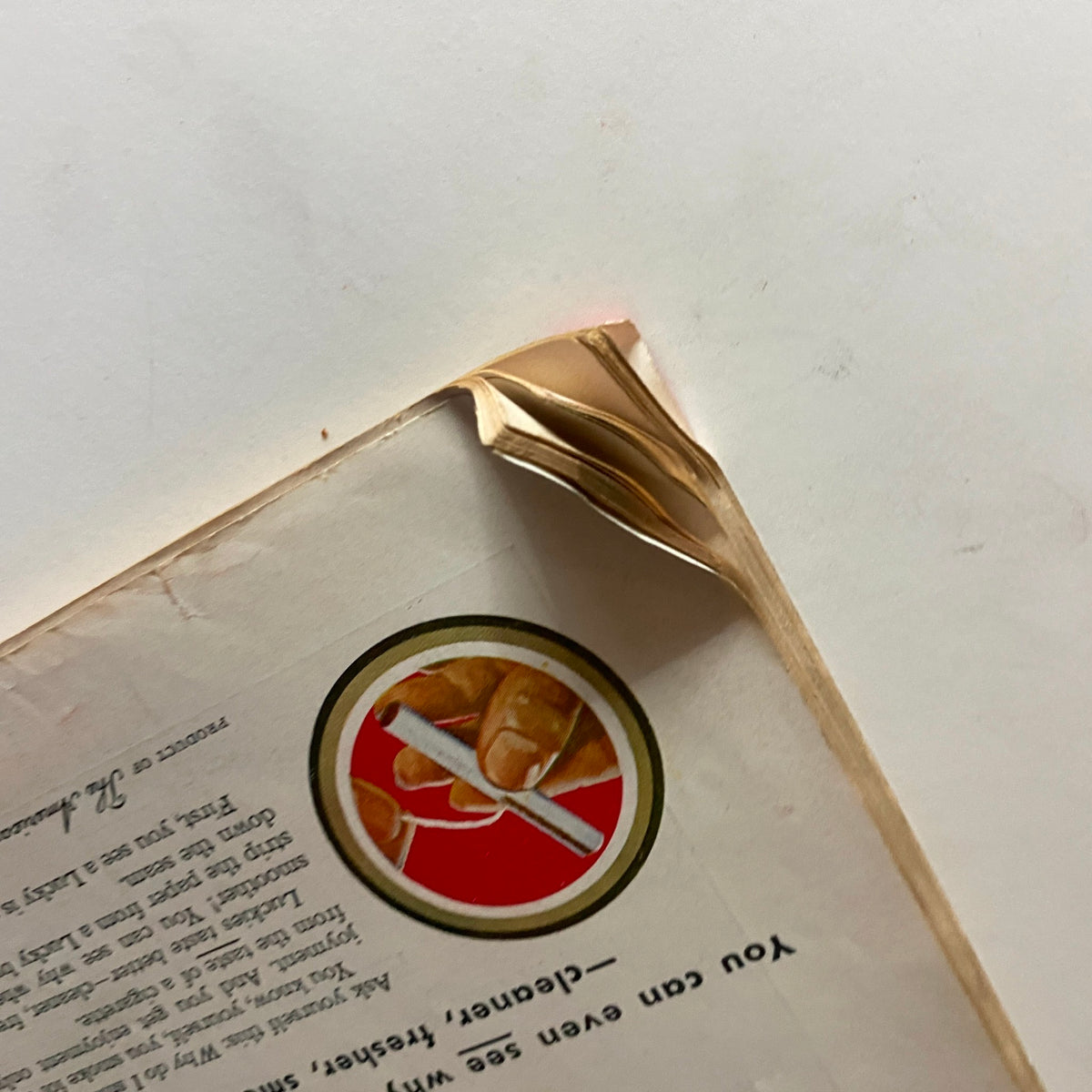
Time issues from 1953 are now more than seventy years old, and water damage is among the more serious condition issues a surviving copy can present. The nature and extent of water damage varies considerably — light tide lines on peripheral pages affect a copy's grade far less than warping, staining across the cover image, or damage to the centerfold area. Collectors evaluating any surviving copy of this issue should examine the cover surface carefully for staining or buckling, check the spine for separation or brittleness accelerated by moisture exposure, and assess interior pages for foxing or adhesion. The presence of a plastic protective covering indicates deliberate storage, though it should be noted that plastic enclosure does not retroactively reverse water damage that occurred prior to storage; it prevents further deterioration rather than restoring prior condition. For research and reference purposes, water-damaged copies of historically significant issues retain their documentary value even when display quality is compromised.
Looking for More Issues Like This?
Time's Korean War-era issues are among the more purposefully collected runs in the magazine's long history, sought by researchers, political historians, and collectors of Cold War documentation alike. The full Time magazine archive at OriginalMagazines.com is the best place to explore other issues from this period and from the magazine's broader run of historically significant covers. For collectors focused specifically on the events and figures of this year, the 1953 magazine collection gathers contemporaneous coverage across multiple publications and captures a year that proved to be one of the most consequential of the entire postwar decade.