



Description
Collector's Note – Why This Issue Matters
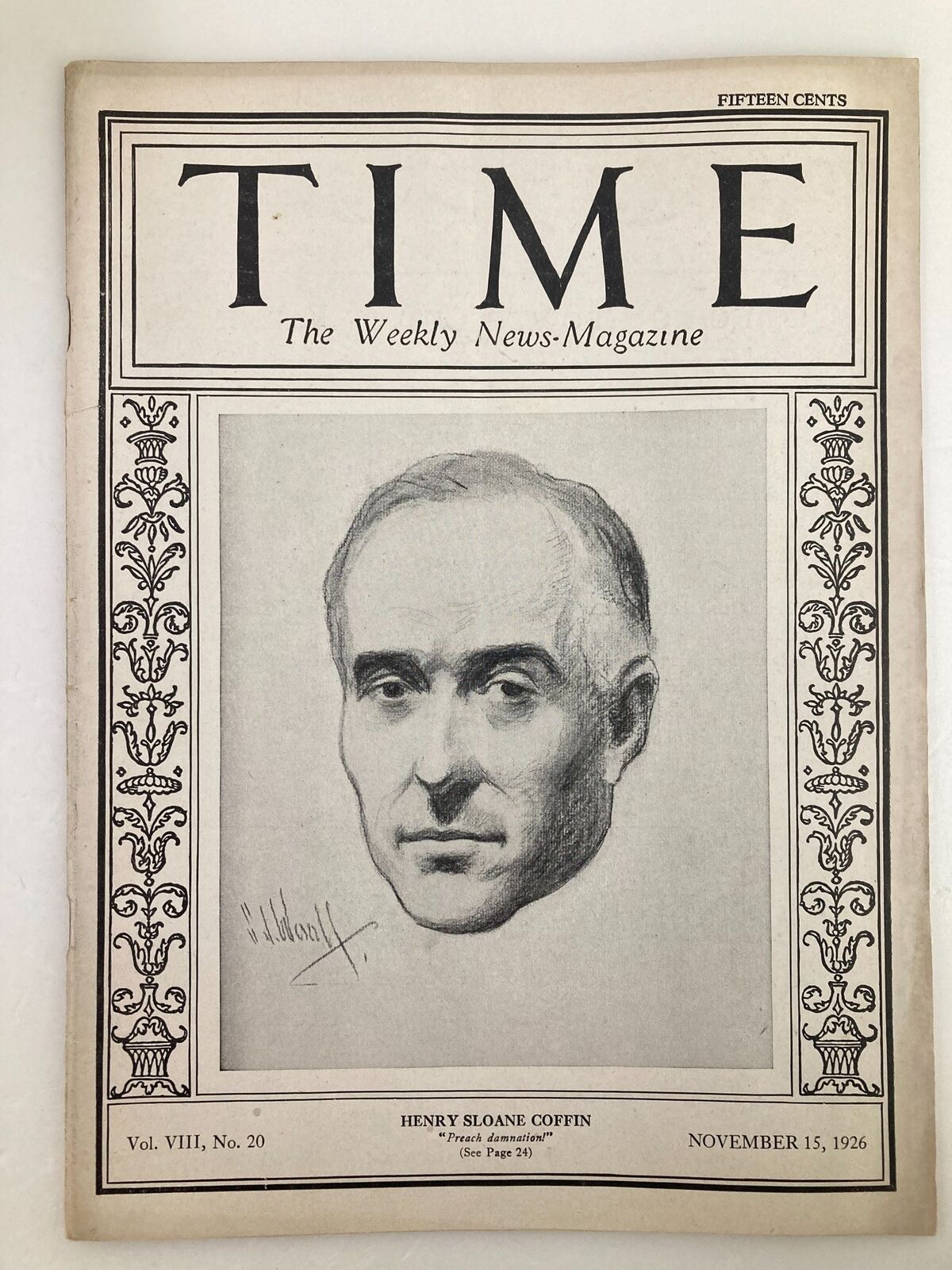
The November 15, 1926 issue of Time magazine, Volume 8, Number 20, featuring Henry Sloane Coffin on the cover, is a primary document of American religious and intellectual life in one of the most culturally consequential decades of the twentieth century — and the specific figure chosen for the cover makes this issue particularly rich for researchers working at the intersection of religious history, cultural history, and the history of American journalism. Henry Sloane Coffin was one of the most significant figures in American Protestantism of the early twentieth century: a prominent liberal Presbyterian minister, the president of Union Theological Seminary from 1926 to 1945, and a central figure in the modernist-fundamentalist controversy that had been tearing American Protestant Christianity apart through the early and mid-twenties. The Scopes Trial of 1925, in which the teaching of evolution in public schools had been the explicit subject of national debate, had occurred just the previous year, and the theological controversy between modernist and fundamentalist Protestantism that surrounded it was still actively and publicly contested in November 1926. A Time cover featuring Coffin — one of the most articulate and culturally influential voices for the modernist position — documents the mainstream American press's engagement with this theological controversy at a specific and historically important moment in its development. The full scope of Time's coverage of American religious and cultural life across this founding period is traceable through the Time magazine collection.
November 1926 sits at the heart of the Roaring Twenties' cultural formation, and a Time cover from this specific moment in the magazine's own institutional history carries the additional significance of documenting a publication that was itself still finding its voice and its audience. Time had been founded by Luce and Hadden in 1923 and by November 1926 was in its fourth year — still in what historians of journalism recognize as its formative period, when the editorial approach, the specific writing style, the cover format, and the cultural authority that would define it for decades were all still being actively developed. This Volume 8, Number 20 issue is therefore a primary document not only of its editorial subject — Coffin and the religious controversies of the mid-twenties — but of the magazine itself at an early and historically interesting stage of its institutional development. The broader cultural context of the mid-twenties — the Jazz Age, Prohibition, the aftermath of the Scopes Trial, the economic prosperity that was simultaneously producing extraordinary social transformation — is documented across the 1926 magazine collection, which brings together publications from a year whose cultural significance in American history rewards sustained collector attention.
The condition details of this issue place it in the authentic, aged-artifact category that collectors of nearly-century-old periodicals understand and evaluate with specific criteria. The label on the back rather than the front is a favorable condition attribute for display: the front cover's Coffin portrait and Time's masthead survive without label obscuration. The marks and rip on the back, the binding wear, and the minor wear throughout are the honest evidence of a publication that has existed for nearly one hundred years without institutional preservation. For researchers whose primary interest is in the editorial content — the Coffin feature and the surrounding journalism of a Time from November 1926 — the interior pages' accessibility is separate from the surface condition attributes, and the issue retains its full value as a primary historical source.
About the Publication
Time magazine was founded by Henry Luce and Briton Hadden in 1923 and was in November 1926 still in the active process of establishing the editorial identity and readership that would eventually make it the most widely read weekly newsmagazine in America. Its distinctive cover portrait format — a single person anchoring the week's most significant story — was already operational, but the specific combination of accessible narrative journalism, confident editorial voice, and comprehensive national coverage that would define its mature identity was still being refined issue by issue. A Volume 8 issue from 1926 occupies a specific and historically interesting position in the magazine's institutional development: past the precarious early months of its existence, but still well within the founding period when its editors were actively experimenting with what the publication could and should be. Its audience in 1926 was the educated urban American professional who wanted comprehensive news coverage in an accessible weekly format, and its cover choices reflected the editorial team's evolving judgment about which individuals and events were most important for that readership to understand.
Key Highlights Inside
- Henry Sloane Coffin cover feature — a primary document of one of the most significant figures in early-twentieth-century American liberal Protestantism, featured at a moment when the modernist-fundamentalist controversy that he embodied was still actively and publicly contested in the immediate aftermath of the Scopes Trial.
- Mid-twenties American religious and cultural journalism — Time's coverage of a national theological controversy that was simultaneously a cultural, educational, and political debate, reflecting the specific ways in which American mainstream journalism was framing religious questions for a secular readership in November 1926.
- Founding-era Time editorial content — the news coverage, writing style, and editorial voice of a publication in its fourth year of existence, still actively developing the approach that would define it for the following century, providing primary evidence of the magazine's institutional development alongside the historical subjects it was covering.
- Note: Specific additional article titles, secondary cover features, and further interior content beyond those indicated in the listing have not been confirmed from available sources. The highlights above reflect what is documented in the listing and Time's well-established editorial format for this founding period.
Condition & Rarity
A November 1926 Time in good condition is a meaningful artifact from the publication's founding era and from one of the most culturally distinctive years in twentieth-century American history. The label on the back rather than the front is a favorable condition attribute, preserving the front cover — the Coffin portrait and Time's masthead — without label obscuration. The binding wear, marks, rip on the back, and minor wear throughout are the honest and expected attributes of a nearly-century-old periodical without institutional preservation care; they authenticate the artifact as an original rather than a reproduction. For any publication approaching one hundred years of age, good condition with these noted surface attributes represents a legitimate and research-quality surviving example. The protective plastic sleeve is the appropriate conservation measure for a publication of this age and fragility, stabilizing further deterioration without altering the original item.
Looking for More Issues Like This?
A November 1926 Time featuring Henry Sloane Coffin — a founding-era issue documenting one of the mid-twenties' most significant theological controversies — is the kind of nearly-century-old primary source that serious collectors of American religious history, Twenties cultural history, and early Time institutional history pursue with sustained patience. If this particular issue is no longer available, the full Time magazine collection at OriginalMagazines.com is the most comprehensive source for exploring other issues across the publication's extraordinarily long and historically rich run. For collectors building a broader archive of the mid-twenties cultural moment, the complete 1926 magazine collection brings together publications from a year whose place at the heart of the Roaring Twenties rewards serious and sustained collector attention.