



Description
Collector's Note – Why This Issue Matters
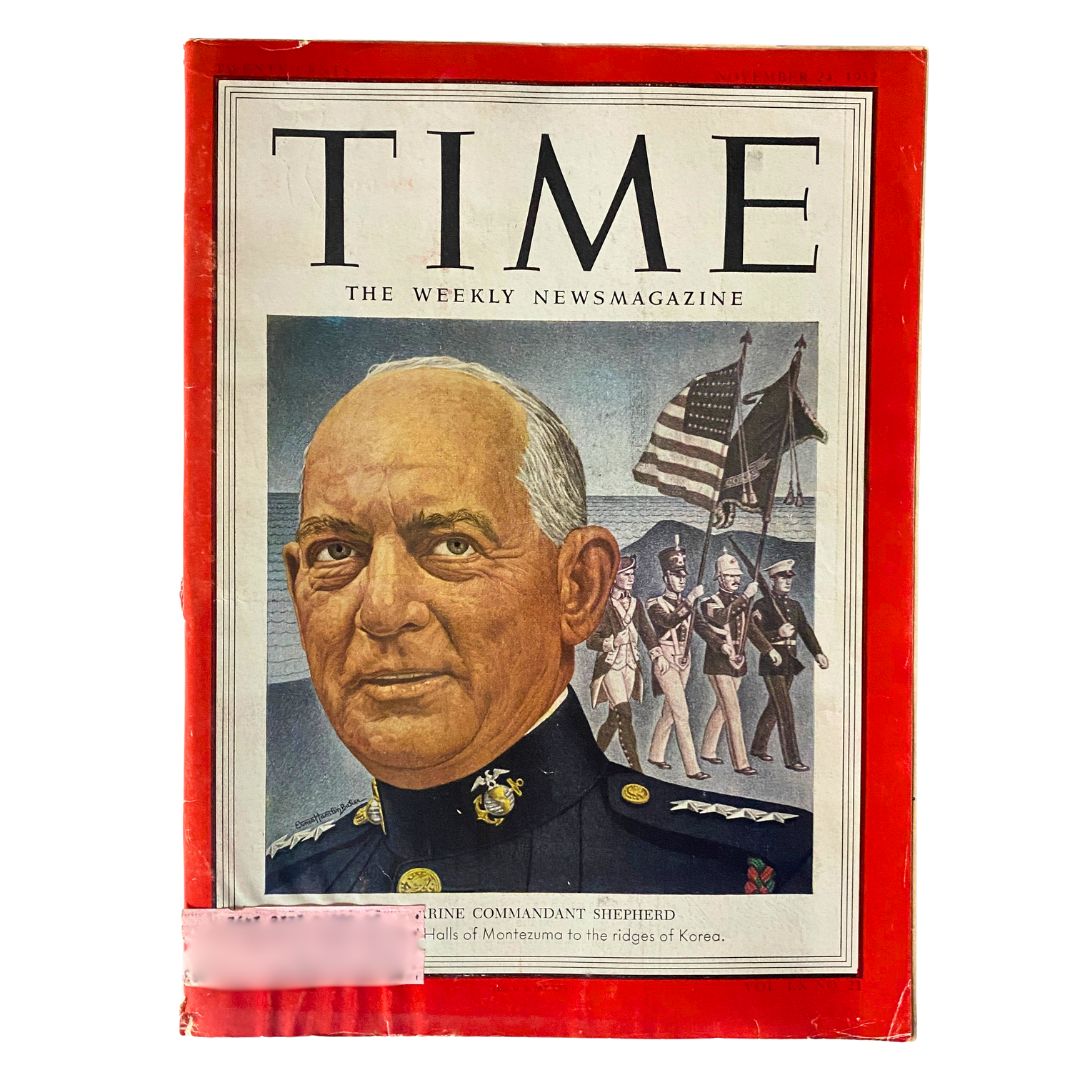
The November 24, 1952 issue of Time Magazine features General Lemuel C. Shepherd Jr. on a painted cover by Ernest Hamlin Baker. The official Time archive identifies the edition as Volume 60, Number 22, correcting the Number 21 designation appearing in some secondary catalog descriptions. Its principal Armed Forces profile is titled “The Sunday Punch.” Shepherd was then serving as the 20th Commandant of the United States Marine Corps, a position he had assumed on January 1, 1952. The cover appeared while Marines remained engaged in the Korean War and while the future organization of American military power was receiving intense public attention. Baker’s portrait presents Shepherd not simply as a battlefield commander but as the institutional leader of a service balancing combat operations, government budgets, weapons development, recruitment, and political representation. The issue therefore documents both an individual military career and the changing place of the Marine Corps within the postwar national-defense establishment.
Shepherd’s military experience extended across the major conflicts of the first half of the twentieth century. Commissioned in 1917, he served with the 5th Marines in France and was wounded during the fighting at Belleau Wood. He later held assignments in China and Haiti before taking important command and training positions within the developing Fleet Marine Force. During the Second World War, he served in the Pacific and eventually commanded the 6th Marine Division during the Okinawa campaign. When the Korean War began, Shepherd was commanding Fleet Marine Force, Pacific, and became closely involved in the deployment of Marine forces to the conflict. He participated in planning and command discussions connected with the Inchon landing and the later withdrawal from northeastern Korea. Time’s profile could therefore present him as an officer whose views about amphibious warfare, air-ground cooperation, readiness, and service identity had been shaped through direct operational experience.
“The Sunday Punch” also appeared during an important institutional moment for the Marine Corps. Federal legislation enacted in 1952 protected a minimum active structure of three Marine divisions and three Marine aircraft wings while giving the Commandant a stronger role in Joint Chiefs of Staff discussions concerning the Corps. Shepherd became the first Commandant to participate regularly with the Joint Chiefs under that arrangement. The development reflected earlier Marine concerns that postwar military unification and budget reductions might weaken the service or transfer some of its functions elsewhere. The article examines the modern general as a commander who also had to deal with legislators, appropriations, industry, research, public relations, and competition among the armed services. The complete issue places that military profile beside reports on the hydrogen age, the Korean War, the incoming Eisenhower administration, Europe, science, business, religion, sport, and the arts. Related military and political reporting can be examined through other vintage issues of Time Magazine and through additional magazines published in 1952.
About the Publication
Time Magazine was founded by Henry R. Luce and Briton Hadden, with its first issue published in March 1923. The weekly publication was designed to organize major national and international developments into a concise and recognizable news format. Its departments covered government, diplomacy, armed conflict, business, labor, science, medicine, religion, education, sport, books, theater, cinema, music, radio, and visual art. Articles were generally brief and arranged so readers could move through a broad survey of the week’s events. Time became especially associated with cover portraits of presidents, military commanders, scientists, executives, writers, performers, clergy members, and athletes. During the middle decades of the twentieth century, many of these covers were commissioned paintings rather than ordinary news photographs. Artists such as Ernest Hamlin Baker used facial expression, uniform, posture, background, and symbolic detail to interpret the public role of the subject. The magazine’s red border became one of the most recognizable design elements in American periodical publishing. Its writing frequently blended factual reporting with interpretation, compressed character descriptions, and a distinctive editorial voice. Military coverage examined strategy, leadership, weapons, organization, budgets, service rivalries, and the experience of personnel in combat. Surviving issues now document both the events being reported and the editorial framework through which contemporary readers were encouraged to understand them.
Key Highlights Inside
- “The Sunday Punch” is the verified principal Armed Forces feature associated with General Lemuel Shepherd’s cover appearance. It examines his military career, leadership style, responsibilities as Commandant, and relationship with the modern institutional Marine Corps. The original article should be consulted before assigning additional private opinions, quotations, or policy positions to Shepherd.
- “Into the Hydrogen Age” addresses the rapidly developing implications of thermonuclear weapons. The feature appeared shortly after the United States conducted the first full-scale thermonuclear device test during Operation Ivy in November 1952. Its language reflects a period when much technical information remained classified and public understanding of the new weapon was incomplete.
- “What Ike Faces” examines the continuing Korean War shortly after Dwight D. Eisenhower won the 1952 presidential election. Eisenhower had promised during the campaign that he would travel to Korea, and the article considers the military situation the president-elect would inherit. The report was written before the July 1953 armistice ended large-scale fighting.
- The national-affairs section also covers the outgoing Truman administration, the incoming Republican government, Democratic political reorganization, the Supreme Court, military planning, and federal succession. International reporting addresses the United Nations, Western European defense, Germany, France, Britain, Japan, South Africa, Greece, Peru, Canada, and the British West Indies. These articles preserve a political world shaped by the Cold War, decolonization, military alliances, and the transition between presidential administrations.
- Science and medicine features include “Water-Based,” “Telescope on the Stomach,” “Life Begins,” “Calculated Kiss,” and “Pseudopolio.” Business departments examine real estate, advertising, retailing, aviation, automobiles, management, and the motion-picture industry. Music, theater, radio, cinema, books, art, religion, education, sport, press criticism, letters, and personal milestones complete the issue’s broad weekly record.
Condition & Rarity
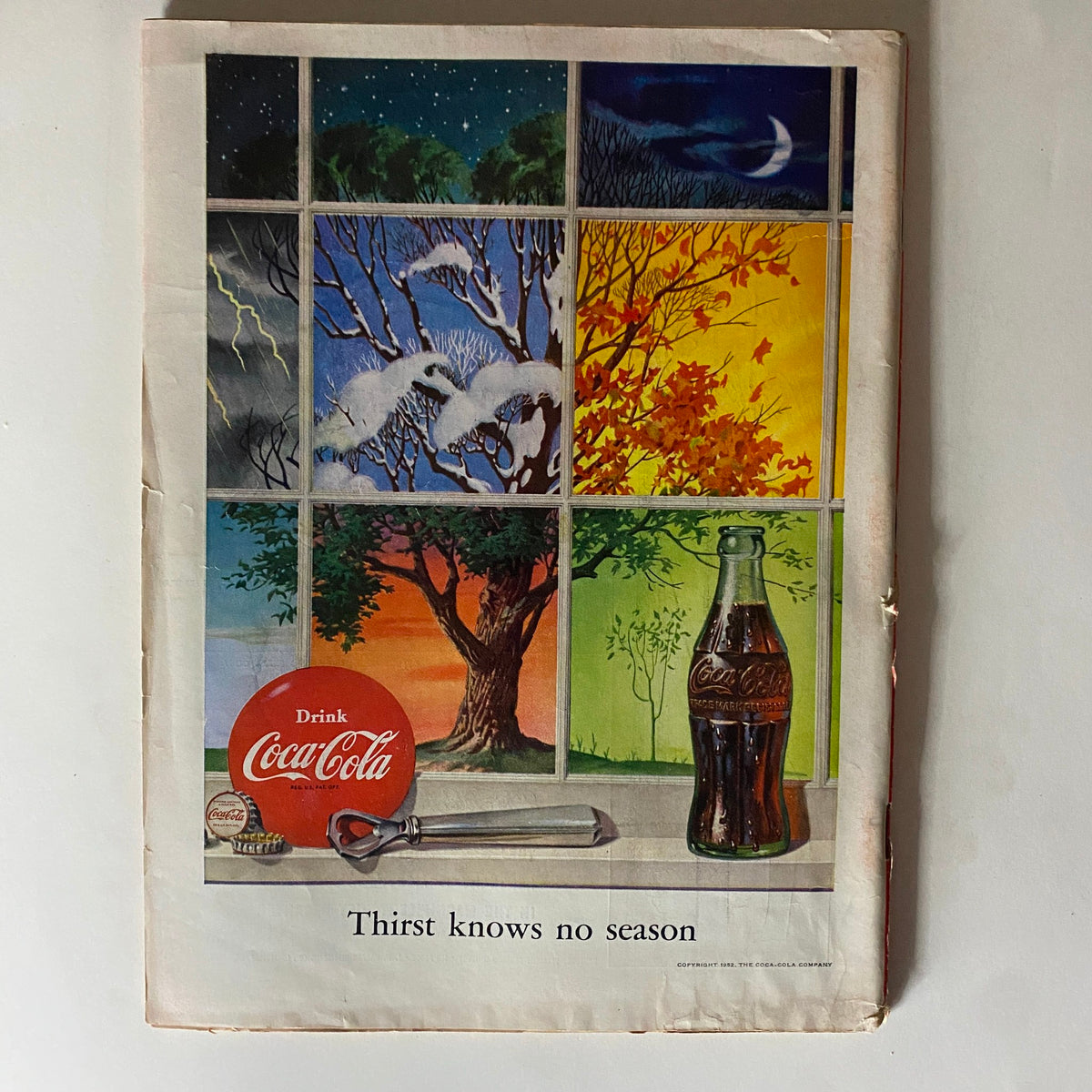
The listing states that the photographed magazine is the exact physical issue represented by the description. It is characterized as being in great condition, although no standardized collector grade is supplied. The accompanying images should therefore be used to evaluate the amount and location of any visible wear. Minor age-related characteristics may include softened corners, edge rubbing, shallow creases, surface impressions, paper toning, or modest stress around the stapled spine. The presence or absence of a mailing or address label is not confirmed in the written description. That detail should be established directly from the cover photograph rather than inferred from another November 24, 1952 example. A plastic protective covering accompanies the magazine and may reduce further exposure to dust, fingerprints, and surface abrasion. The sleeve does not verify page completeness, firm staples, secure cover attachment, or the condition of the interior paper. Particular attention should be given to Baker’s portrait, Shepherd’s uniform, the Time nameplate, the red border, and the printed date. Interior inspection should confirm that “The Sunday Punch” and the other listed departments remain present without clipping, writing, stains, moisture damage, loose leaves, tape, or previous repairs. Historical importance and Shepherd’s position as Commandant create clear research interest, but rarity and final grade should be determined through documented availability and direct inspection of the individual magazine.
Looking for More Issues Like This?
Exact Time issues can require patience to identify when research is centered on a particular commander, military service, cover artist, and publication week. The November 24, 1952 edition is especially relevant to readers studying Lemuel Shepherd, the United States Marine Corps, the Korean War, and postwar military organization. Related profiles and defense reporting can be explored through the broader collection of vintage Time Magazines. Other issues document Marine operations, military commanders, service organization, nuclear weapons, Korea, President Truman, and the incoming Eisenhower administration. Comparing consecutive editions can reveal how Time’s attention shifted from the presidential election toward the practical military and diplomatic problems facing the president-elect. The collection of original magazines from 1952 provides a wider view of the historical year in which Shepherd appeared on the cover. Publications from that year preserve Cold War strategy, the Korean conflict, nuclear development, television, cinema, business, advertising, sport, and American consumer life. Examining several titles together helps distinguish Time’s interpretive newsmagazine approach from the photographic, literary, and specialized formats used by other publications. Closely dated issues remain historically useful even when this precise Volume 60, Number 22 edition is not represented because they establish the surrounding political and military chronology. Together, the Time and 1952 collections provide a useful foundation for continued research into General Lemuel Shepherd and the institutional history of the United States Marine Corps.