
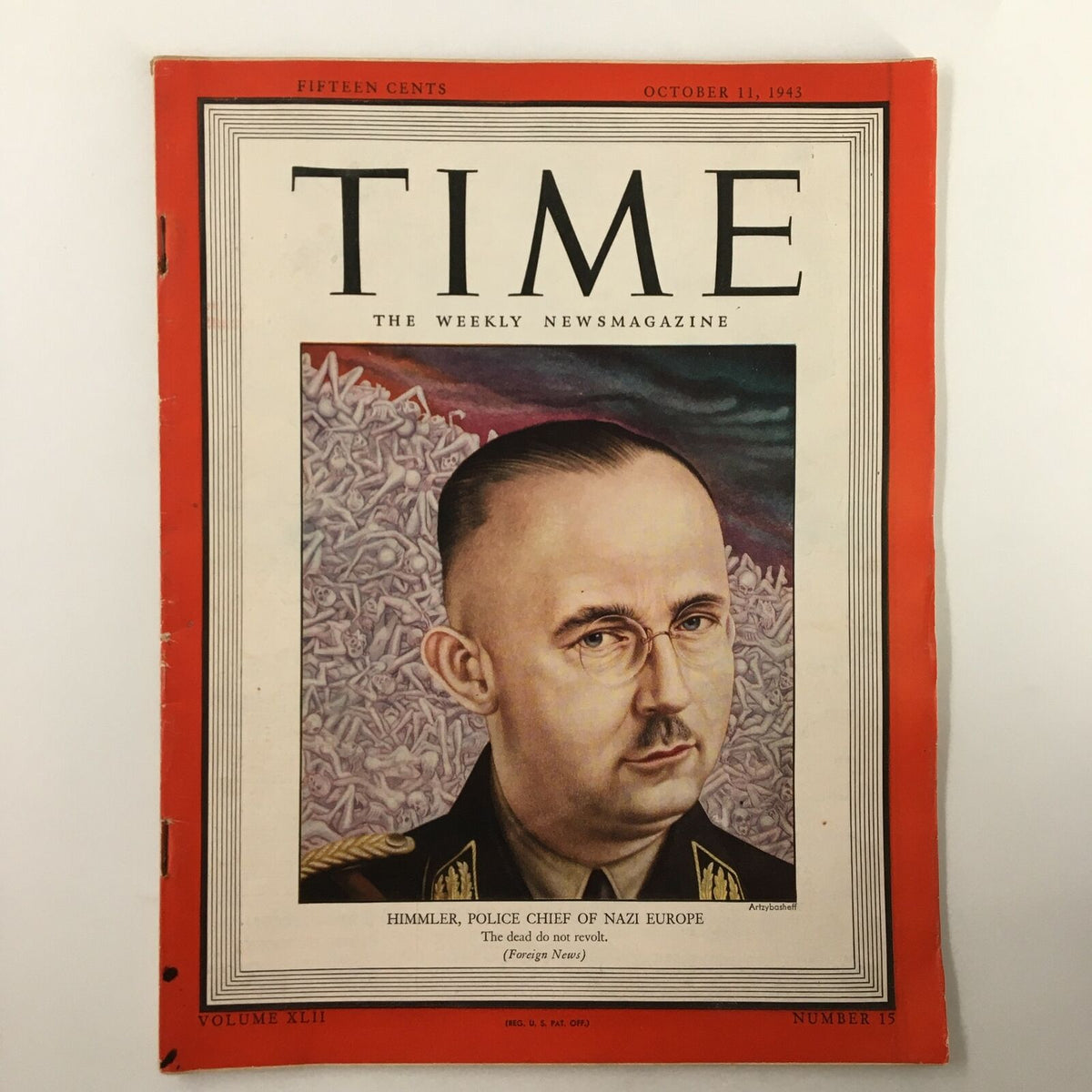


Description
Collector's Note – Why This Issue Matters
By the autumn of 1943, the course of the Second World War had shifted decisively. The Allied landings in Sicily and the Italian mainland had begun, Stalingrad was already a catastrophic German defeat, and the Nazi regime — facing pressure on multiple fronts — was intensifying its internal machinery of terror. It is against this backdrop that Time magazine chose to put Heinrich Himmler on its cover: not a battlefield general, not a politician negotiating terms, but the architect of the SS, the Gestapo, and the concentration camp system. Himmler's appearance on an American newsstand cover in October 1943 was a deliberate editorial statement about who was truly directing the war behind the lines.
Heinrich Himmler was, by 1943, arguably the second most powerful figure in Nazi Germany. As Reichsführer-SS and Chief of German Police, he commanded a state-within-a-state that oversaw the Holocaust, the occupation policies of conquered Europe, and the ideological enforcement of National Socialism across the Reich. Time's editorial decision to profile him at this precise moment in the war reflects the magazine's effort to help American readers understand the full nature of the enemy — not just its armies, but its governing ideology of organized violence. Collectors of vintage Time magazine issues recognize this cover as one of the most historically significant of the entire wartime period, a direct confrontation with the face of Nazi administrative evil at a moment when that evil was still very much operational.
Issues from the war years — particularly those depicting named Nazi leadership — occupy a unique position in the collector's market precisely because they document public knowledge in real time. American readers in October 1943 were encountering Himmler as a current, living threat, not a historical figure. That immediacy is irreplaceable. For anyone building a serious collection around 1943 magazines, this issue represents a primary source artifact of the highest order: a record of how the press understood and communicated the machinery of the Nazi state while the war was still being decided.
About the Publication
Time magazine was founded in 1923 by Henry Luce and Briton Hadden as the first American weekly news magazine, designed to synthesize the week's events into a digestible format for a broad, educated readership. By the 1940s it had become the defining American periodical of record for geopolitical events, with a global circulation and editorial influence that made its cover choices as newsworthy as the stories inside. The magazine followed a consistent format of department-organized reporting — National, Foreign, Science, Business, Arts — anchored by a named cover subject whose selection itself was understood as editorial commentary. During the Second World War, Time's foreign coverage was especially authoritative, drawing on a network of international correspondents to document events that most American readers could not otherwise access firsthand.
Key Highlights Inside
- Heinrich Himmler cover portrait: The issue features a striking cover portrayal of Himmler in his capacity as Police Chief of the Nazi regime — a characterization that, while understating his full scope of power, signaled to readers the centrality of internal repression to the Nazi war effort.
- Wartime geopolitical context: October 1943 falls between Italy's armistice with the Allies (September 8) and the intensifying Allied campaigns on the Italian peninsula, making this issue's foreign coverage a snapshot of a pivotal transition in the European theater.
- The SS and Nazi administrative apparatus: Time's wartime profiles of Nazi leadership typically combined biographical detail with analysis of their institutional roles — placing Himmler in the context of the broader SS structure would have been consistent with the magazine's editorial approach during this period.
- Interior content unconfirmed beyond the cover: Specific article titles, page-by-page contents, and additional features for this issue have not been independently verified. Collectors seeking confirmed interior details are encouraged to consult digitized archival copies held by major research libraries.
Condition & Rarity
This issue is described as being in good overall condition with minor wear throughout — a reasonable expectation for a periodical now more than eighty years old. The presence of a label on the back cover is consistent with newsstand or subscriber circulation copies of the era; such labels are common on surviving wartime Time issues and do not significantly diminish collector value, though label-free copies do command a premium in the highest condition grades. The protective plastic sleeve noted in the listing indicates the copy has been stored with collector intent at some point in its history, which generally correlates with better preservation of spine integrity and page stability. When evaluating any surviving copy of this issue, the primary condition points to assess are: cover brightness and color retention (wartime paper stock was often acidic and prone to tanning), spine tightness, and the presence or absence of moisture damage to the interior pages. A copy presenting well on all these measures, even with a back label, represents a genuinely scarce find — wartime weeklies saw heavy circulation and were rarely preserved with care by their original readers.
Looking for More Issues Like This?
The October 11, 1943 Himmler issue is a difficult one to track down in collectible condition, and copies surface infrequently. If this specific issue is currently unavailable, the broader Time magazine collection at OriginalMagazines.com spans decades of covers and may surface other wartime issues of comparable historical weight. For collectors focused specifically on the Second World War period, the 1943 magazine archive is worth browsing in full — the year produced some of the most consequential newsstand covers of the entire twentieth century.