


Description
Collector's Note – Why This Issue Matters
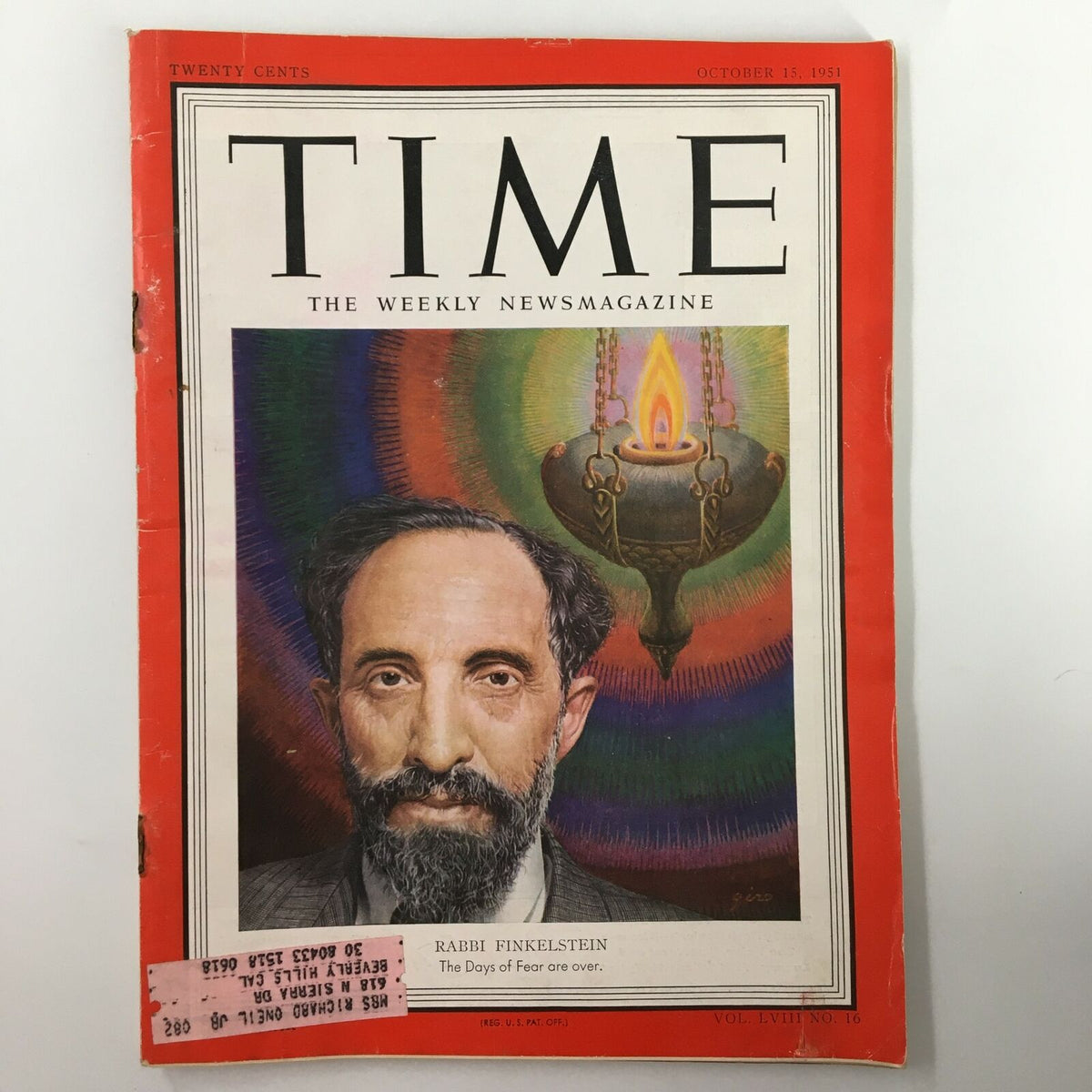
The October 15, 1951 issue of Time Magazine, identified as Volume 58, Number 16, features Rabbi Louis Finkelstein as its principal cover subject. The corresponding cover story is titled “A Trumpet for All Israel.” Finkelstein was then one of the most influential scholars and institutional leaders associated with Conservative Judaism in the United States. He had served for eleven years as president of the Jewish Theological Seminary of America in New York. During the week represented by the magazine, the seminary announced that he would move into the position of chancellor while other administrators assumed his presidential responsibilities. The cover therefore records a specific transition in his career rather than presenting only a general portrait of a prominent rabbi. It also reflects Time’s recognition that American religious leadership could be a subject of national newsmagazine attention.
The feature appeared in connection with the Jewish High Holy Days and begins with Finkelstein participating in Yom Kippur worship. From that setting, the article considers what its editors interpreted as a renewed interest in religious practice, Jewish education, synagogue participation, and inherited tradition among American Jews. Finkelstein argued that the destruction of European Jewish communities during the Holocaust had placed a new spiritual and institutional responsibility upon American Jewry. He believed that Jewish religious commitment could contribute not only to the survival of Judaism but also to the moral life of the United States. His position within Conservative Judaism placed him between the stricter observance associated with Orthodoxy and the modernizing approach of Reform Judaism. The article also discusses disagreements surrounding Zionism, the recently established State of Israel, religious law, assimilation, and the meaning of Jewish peoplehood. Because the feature reflects Time’s terminology and editorial assumptions in 1951, its descriptions of Jewish communities should be read as historical journalism rather than as neutral definitions for the present day.
Finkelstein’s importance extended beyond the administration of a rabbinical seminary. He promoted conversations among Jewish, Protestant, and Roman Catholic scholars through the Institute for Religious and Social Studies and related intellectual gatherings. He also supported public education through broadcasting, including the Jewish Theological Seminary’s radio program “The Eternal Light.” His goal was to make Jewish thought accessible while encouraging cooperation across religious boundaries. These activities placed him within a broader postwar discussion about faith, democracy, prejudice, education, and moral responsibility. The complete issue surrounds his religious profile with reports on the Korean War, Iran, Europe, science, medicine, business, sports, books, theater, cinema, music, and radio. Readers studying this period can compare the edition with other vintage issues of Time Magazine and with additional magazines published in 1951. Together, the cover and interior reporting preserve a revealing cross-section of American public concerns during the early Cold War.
About the Publication
Time Magazine was founded by Henry R. Luce and Briton Hadden, with its first issue published in March 1923. The weekly publication was created to organize major national and international developments into a compact and recognizable news format. Its departments addressed politics, diplomacy, armed conflict, business, labor, science, medicine, education, religion, books, theater, music, art, radio, cinema, and sports. Articles were generally concise and arranged so that readers could move through a broad survey of the week’s events. Time became especially associated with cover portraits of political leaders, military commanders, religious figures, scientists, executives, writers, performers, and athletes. During the middle decades of the twentieth century, many of these covers were commissioned paintings rather than conventional news photographs. The magazine’s red border became one of the most recognizable visual elements in American periodical publishing. Its editorial writing frequently combined factual reporting with strong interpretation, compressed character descriptions, and a distinctive house style. Religious coverage introduced a mass readership to institutions, theological debates, clergy, revival movements, and changing patterns of worship. During the early Cold War, Time generally approached world affairs from an internationalist, anti-Communist, and strongly American-centered perspective. Surviving editions now document both the events being reported and the editorial judgments through which contemporary readers were encouraged to understand them.
Key Highlights Inside
- “A Trumpet for All Israel” profiles Rabbi Louis Finkelstein and examines his leadership of the Jewish Theological Seminary. The article considers Conservative Judaism, American Jewish religious participation, education, Zionism, interfaith work, and the institutional consequences of the Holocaust. Its descriptions and demographic estimates reflect Time’s 1951 reporting and should be evaluated within that historical context.
- The war section includes “Limited Offensive,” reporting on the continuing Battle of Korea, and “New Location,” concerning cease-fire negotiations. A separate article addresses French reinforcements arriving by air during the conflict in Indochina. These reports preserve contemporary coverage of two Asian wars whose long-term consequences were not yet known to the magazine’s readers.
- International reporting includes “Darkness in Abadan,” concerning the crisis surrounding Iran’s nationalization of its oil industry. Additional features examine Turkey’s strategic importance, political developments in Britain, France, Germany, Italy, China, Malaya, Chile, Canada, and the Caribbean. The range reflects the magazine’s concentration on alliance politics, decolonization, Communist expansion, economic resources, and Cold War security.
- Science and medicine departments include “Leonardo’s Machines,” “Atomic Glue,” “Satellite XII,” and “Improvised Bone Bank.” These articles introduce historical engineering, atomic research, astronomy, archaeology, and developing medical practices to a general readership. Their terminology and scientific conclusions should be read alongside later research when used for modern technical study.
- The sports section covers the New York Giants and New York Yankees during the 1951 World Series, while the arts departments review contemporary music, theater, radio, cinema, books, and visual art. Confirmed subjects include “The Dybbuk,” “The Roosevelt Story,” new radio programs, and several current books and films. Business reporting adds material on oil, government spending, securities, mobilization, corporate control, rare-earth metals, and the financial aftermath of Hadacol.
Condition & Rarity
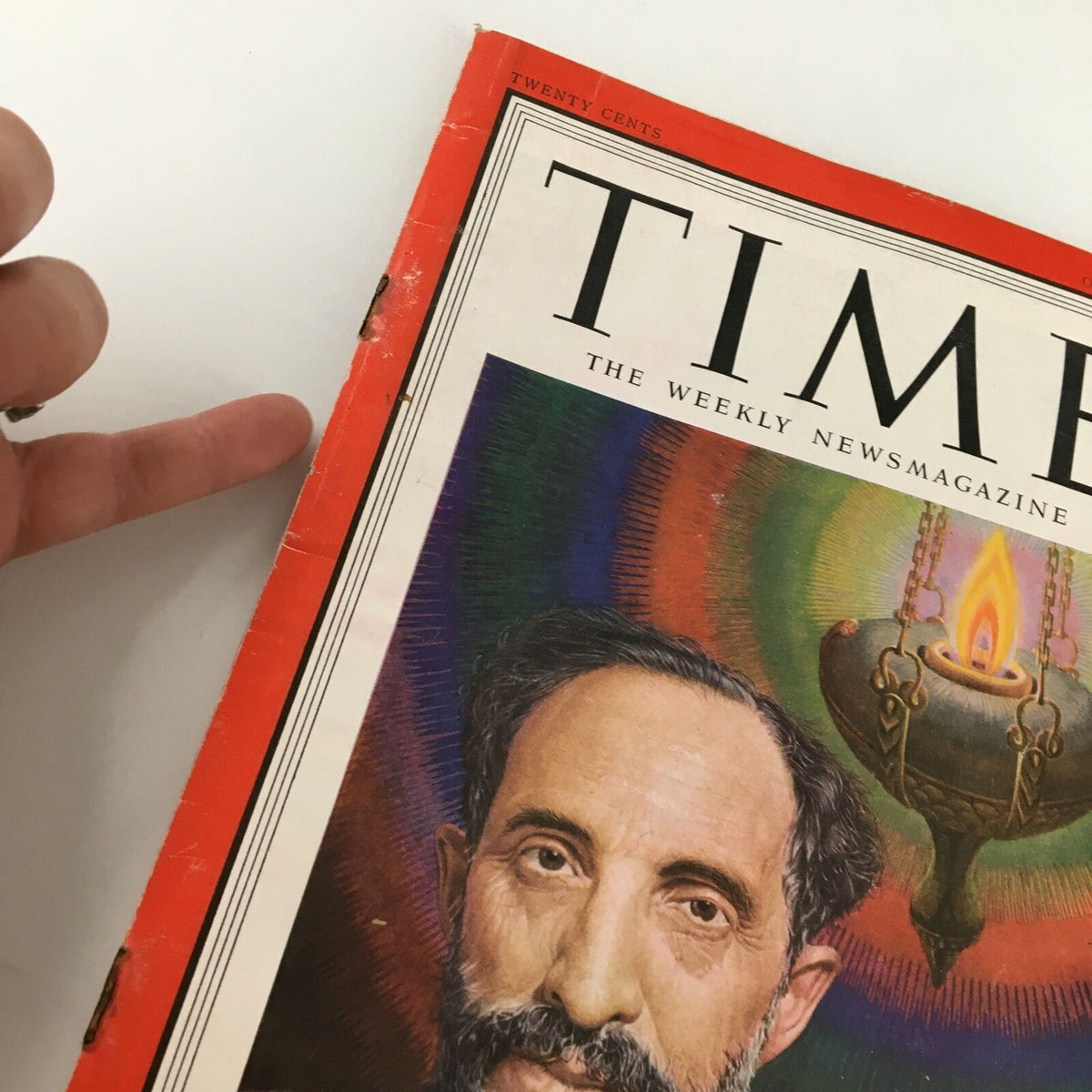
The October 15, 1951 issue is described as being in good overall condition with minor wear consistent with age, handling, and long-term storage. A good collector-grade description normally indicates that the magazine remains readable and structurally serviceable while displaying visible signs of previous use. Some marks are reported, although their precise size, number, and location are not specified in the written description. Marks affecting Finkelstein’s face, the Time nameplate, the red border, or the printed date may have greater visual importance than marks confined to an outer margin. Additional expected wear may include softened corners, light creases, edge rubbing, surface impressions, or stress near the stapled spine. An address label is affixed to the front cover, identifying the magazine as a subscription-delivered example. Such labels are common on surviving weekly newsmagazines and form part of their original circulation history. The label should be evaluated for adhesive staining, lifting, paper loss, writing, or damage to the printed area beneath it. A plastic protective covering accompanies the magazine and may reduce further exposure to dust, fingerprints, and surface abrasion. The covering does not verify page completeness, secure staples, firm cover attachment, or the absence of clipping, stains, moisture exposure, fading, brittleness, and earlier repairs. Historical interest in Finkelstein and the cover story does not independently establish rarity, which should be assessed through documented availability and the physical condition of individual surviving examples.
Looking for More Issues Like This?
Exact Time issues can require patience to identify when research is centered on a particular religious leader, institution, volume number, and publication week. The October 15, 1951 edition is especially relevant to readers studying Louis Finkelstein, the Jewish Theological Seminary, Conservative Judaism, and postwar American Jewish life. Related religious, political, and cultural reporting can be explored through the broader collection of vintage Time Magazines. Other issues document rabbis, Christian clergy, theologians, religious institutions, interfaith initiatives, Israel, immigration, antisemitism, and debates about faith in public life. Comparing consecutive editions can also show how religious subjects were positioned beside war, diplomacy, economics, science, and entertainment. The collection of original magazines from 1951 provides a wider view of the historical year in which Finkelstein appeared on the cover. Publications from that year preserve the Korean War, Cold War alliances, American politics, religious life, television, cinema, advertising, sports, and postwar social change. Examining several periodicals together helps distinguish Time’s compressed interpretive style from the photographic, literary, and specialized approaches used by other magazines. Closely dated issues remain historically useful even when this precise Volume 58, Number 16 edition is not represented because they establish the surrounding political and cultural chronology. Together, the Time and 1951 collections provide a useful foundation for continued research into American religion and newsmagazine culture during the early Cold War.