

Description
Collector's Note – Why This Issue Matters
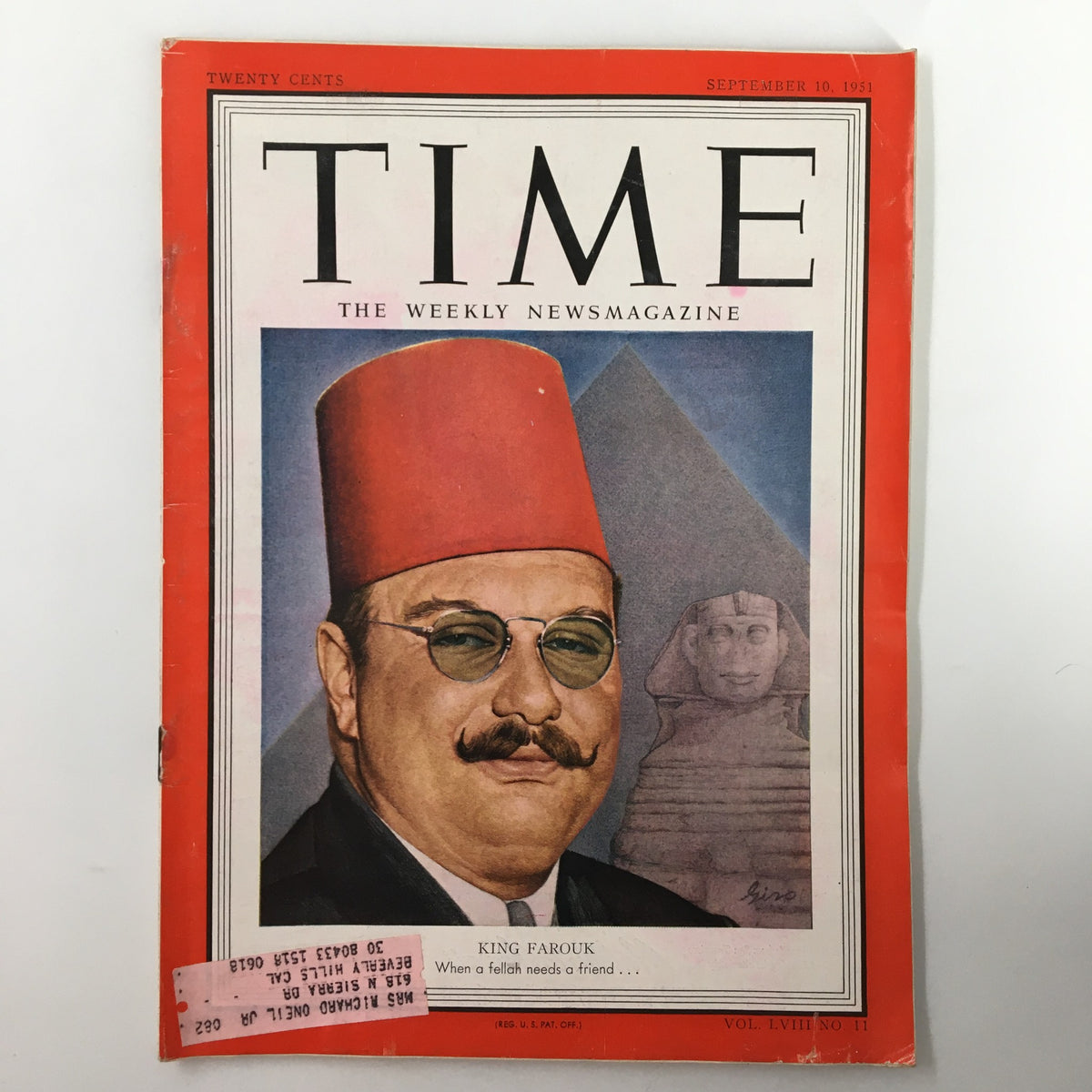
September 10, 1951 places this Time Magazine cover story on King Farouk of Egypt at one of the most consequential moments in the postwar history of the Middle East — and one of the most personally precarious moments of Farouk's reign. Egypt in September 1951 was a country in active political ferment. The Anglo-Egyptian relationship, which had defined Egyptian politics since the British occupation of the late nineteenth century, was reaching a breaking point over the question of the Suez Canal and British military presence in the Canal Zone. Nationalist sentiment was intensifying across Egyptian society, and Farouk — who had come to power as a young, reformist-seeming monarch in 1936 and had steadily accumulated political enemies and popular disillusionment through the following decade and a half — was caught between the pressures of nationalist politics he could not fully control and a Western audience that watched him with increasing skepticism. Time's decision to put Farouk on its cover in September 1951 reflected the magazine's recognition that Egypt was becoming one of the most important stories in global geopolitics — a judgment that would be confirmed less than a year later when the Free Officers Revolution of July 1952 forced Farouk into exile and ended the Egyptian monarchy entirely. For collectors building an archive of Time Magazine covers from the postwar era, this September 1951 edition is a primary document of a pivotal figure captured just ten months before his fall — a historical photograph taken, unknowingly, on the edge of an abyss.
King Farouk himself was one of the more genuinely compelling figures in mid-twentieth-century world politics, and the specific qualities that made him compelling were precisely those that Time's cover treatment was designed to engage. His personal extravagance — the palace lifestyle, the legendary collections, the gambling and womanizing that filled the European gossip press — coexisted with genuine political complexity: he was the ruler of a strategically critical nation at the intersection of Western Cold War interests and Arab nationalist aspirations, and his inability to navigate those competing pressures was as much a structural problem as a personal failure. The Time cover story of September 1951 arrived at the moment when the tensions around the Suez Canal and British military presence were most acute — the Egyptian government would unilaterally abrogate the 1936 Anglo-Egyptian Treaty just weeks after this issue was published, in October 1951, triggering a crisis that would eventually contribute to the conditions for the 1952 revolution. A Time magazine cover is not merely a portrait; it is a historical assessment, and the editors' choice of Farouk at this specific moment reflects a geopolitical judgment about where Egypt and the broader Middle East were heading. Collectors researching political and historical magazines from 1951 will find this issue a precisely dated primary source record of one of the twentieth century's most significant geopolitical transitions, documented at the moment before its outcome was determined.
The broader editorial context of a September 10, 1951 Time Magazine adds further historical texture to an already consequential cover story. The Korean War was active and consuming American military resources and public attention; the Cold War competition between the United States and the Soviet Union for influence in newly decolonizing nations — of which Egypt was one of the most strategically important — was intensifying; and the postwar international order was still being negotiated in ways that made individual political figures in key nations subjects of genuine global significance rather than merely regional interest. Time's coverage of Farouk in this context was not celebrity journalism but serious geopolitical reporting, addressed to the millions of American readers who needed to understand why Egypt mattered and what its king's position meant for American interests in the region. That seriousness of purpose is precisely what gives this issue its lasting documentary value — it is not a novelty cover but a historical assessment, made at a moment of genuine consequence, that the subsequent events of 1952 would render even more significant in retrospect.
About the Publication
Time Magazine was founded in 1923 by Henry Luce and Briton Hadden as the first weekly news magazine in the United States, and by September 1951 had sustained nearly three decades as one of the most widely read and institutionally authoritative publications in American journalism. Its editorial format organized the week's most significant events across a consistent set of departments — Nation, World, Business, Science, Medicine, Law, Religion, Education, Arts, Sport — into a single authoritative digest that millions of Americans used as their primary framework for understanding current events. The cover story, chosen each week to represent the single most consequential figure or development in the news, carried a cultural authority that extended well beyond the magazine's subscriber base; a Time cover was broadly understood as a formal marker of historical significance, which is precisely why the Farouk cover of September 10, 1951 registers as a meaningful editorial judgment about where the Middle East stood at that specific moment in postwar history. At its peak circulation in the early fifties, Time reached tens of millions of readers weekly, making it the primary lens through which mainstream America understood the geopolitical developments that were reshaping the postwar world.
Key Highlights Inside
- King Farouk of Egypt cover story — a primary document of Time's geopolitical assessment of Egypt and its monarch at one of the most consequential moments in the country's modern history, published ten months before the Free Officers Revolution of July 1952 would force Farouk into exile and end the Egyptian monarchy, making this cover one of the last major American mainstream media portraits of him as a reigning sovereign.
- World affairs coverage consistent with Time's September 1951 editorial scope — the Korean War, the Anglo-Egyptian Canal Zone tensions that would produce the treaty abrogation of October 1951, and the broader Cold War competition for influence in the decolonizing world were all active stories at this moment, and Time's World section would have placed the Farouk cover story in the full geopolitical context that gave it its significance.
- National affairs, business, science, medicine, arts, and sport coverage consistent with Time's established departmental format — the full editorial architecture of a September 1951 Time providing a comprehensive weekly cross-section of American and world life at a specific moment in the early Cold War period, collectively constituting a primary source record of the concerns and preoccupations of an American readership navigating an extraordinarily complex global landscape.
- Period advertising reflecting the consumer culture of Time's affluent, politically engaged early-1950s readership — the advertising pages of a September 1951 Time capture the brands, products, and aspirational messaging of a specific moment in postwar American commercial culture, providing documentary material for researchers studying the intersection of political media and consumer marketing in the early Cold War era.
- Note: Specific article titles, confirmed departmental content details, and individual bylines beyond the cover story have not been individually verified for this issue. The highlights above reflect Time's well-documented editorial format, the verified cover subject, and the well-established geopolitical context of September 10, 1951.
Condition & Rarity
Weekly newsmagazines from September 1951 are approaching their seventy-fifth year of existence, and the condition landscape for surviving copies reflects the full weight of that age alongside the specific physical characteristics of Time's format and distribution model. The magazine's enormous subscriber base in this period means that the overwhelming majority of surviving copies carry mailing labels — the standard condition factor most frequently encountered in Time issues from the early fifties, reflecting the magazine's original distribution as a mailed subscription rather than a newsstand purchase. The address label present on this issue places it within the most commonly encountered category of surviving Time copies from this era, and its characterization as creating only minor wear is consistent with what careful collectors should expect. Good condition with minor wear is an honest and appropriate grade for a seventy-four-year-old weekly newsmagazine — it describes a copy that retains structural integrity, readable interior content, and a cover image sufficiently intact to convey the Farouk story that defines the issue's documentary identity. The plastic protective sleeve provides ongoing archival protection for a publication of this age and paper chemistry. Collectors evaluating surviving examples of this issue should prioritize cover legibility — the Farouk image and the Time masthead are the primary visual documents — alongside spine integrity and the completeness of the full departmental content as primary condition criteria.
Looking for More Issues Like This?
A Good-condition copy of the September 10, 1951 Time Magazine with the King Farouk cover is a historically specific find that sits at one of the most significant geopolitical junctures of the postwar Middle East — the last year of Farouk's reign and the final months before the Egyptian revolution that would reshape the region's political landscape for decades. If this issue is no longer available, the full Time Magazine collection at OriginalMagazines.com is the most comprehensive place to browse surviving issues from across the publication's history and locate other postwar-era covers, significant geopolitical stories, or specific years from the magazine's early-fifties run. The 1951 magazine collection brings together surviving issues from across that year's major publications for collectors interested in the full breadth of American and world affairs journalism during one of the most consequential years of the early Cold War period.