



Description
Collector’s Note – Why This Issue Matters
TIME Magazine’s September 24, 1956 issue, Volume LXVIII, Number 13, features philanthropist John D. Rockefeller Jr. in a formal painted portrait by Boris Chaliapin. The cover identifies its subject simply as “Philanthropist Rockefeller,” emphasizing the public role that had come to define him by the mid-1950s. Rockefeller was the only son of Standard Oil founder John D. Rockefeller Sr., but his own historical identity became increasingly connected with philanthropy, civic development, conservation, education, religion, medicine, and historic preservation. TIME’s principal profile, titled “The Good Man,” examined a figure whose inherited wealth had been redirected toward a vast network of public projects and institutions. By the time this issue appeared, Rockefeller was eighty-two years old and had spent much of his adult life managing charitable responsibilities on a scale rarely associated with a single private citizen. His appearance on the cover therefore represents more than the continuation of a famous family name. It documents the transformation of Rockefeller’s public image from heir to an industrial fortune into one of the most prominent philanthropic stewards of the twentieth century. Within a collection of magazines featuring John D. Rockefeller and the Rockefeller family, this issue provides an especially direct portrait of the younger Rockefeller’s mature legacy.
John D. Rockefeller Jr.’s influence extended across the built environment, cultural institutions, international cooperation, and the preservation of historically significant places. He played a central role in the development of Rockefeller Center after the original plan for a new Metropolitan Opera House collapsed during the Great Depression. He financed the restoration of Colonial Williamsburg, supporting an ambitious effort to reconstruct and interpret Virginia’s eighteenth-century capital. His cultural and conservation interests also contributed to projects associated with The Cloisters, Fort Tryon Park, Acadia National Park, Grand Teton, and other protected landscapes. In 1946, he provided the funds used to acquire the East River property later donated as the permanent site of the United Nations headquarters. These activities illustrate why TIME could frame him as a national figure whose importance was based less on business management than on stewardship and institution building. The portrait by Boris Chaliapin presents Rockefeller in a restrained and contemplative manner that suits the issue’s emphasis on age, responsibility, and accumulated public service. The cover consequently joins visual biography with a larger historical record of American wealth, civic responsibility, and organized philanthropy.
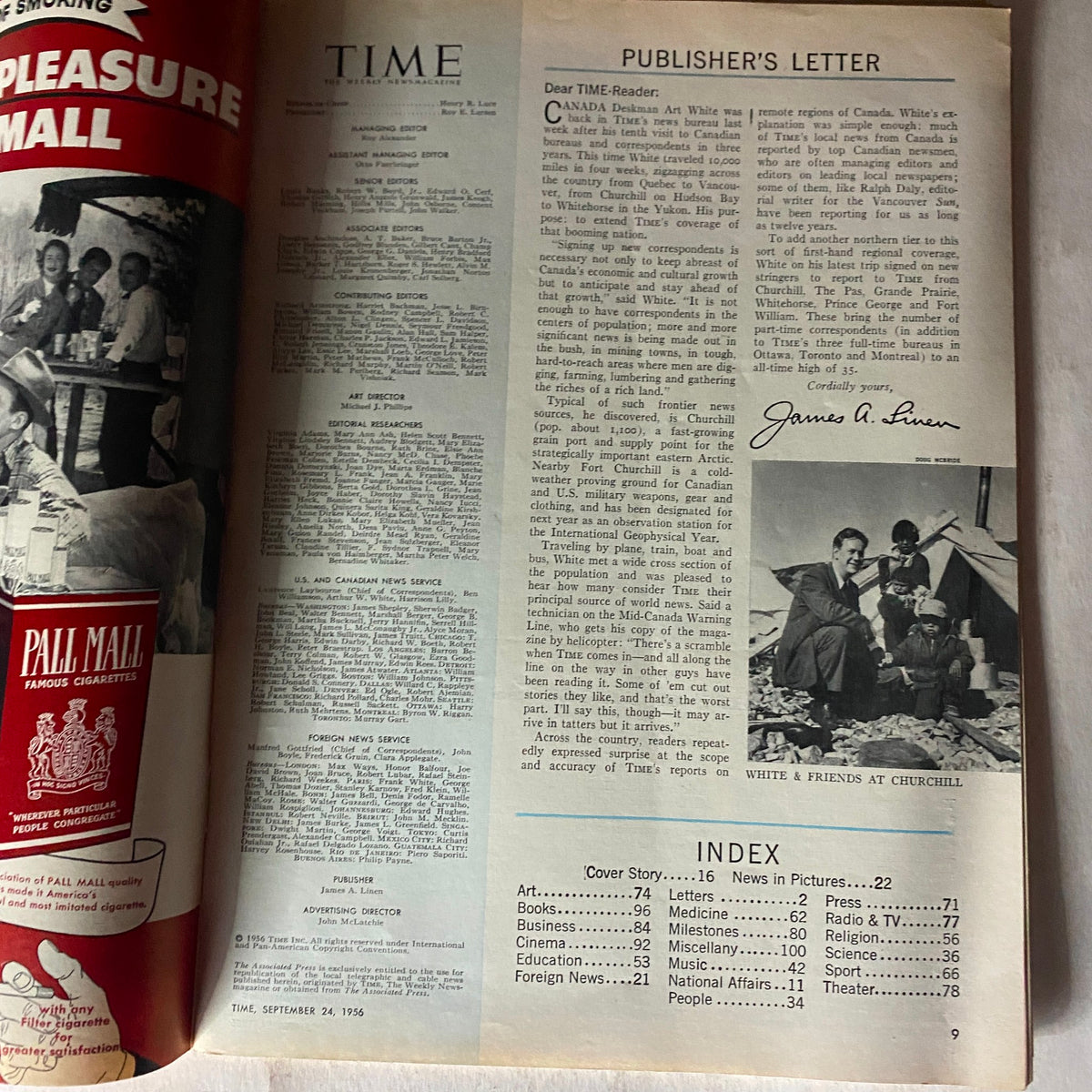
The importance of the September 24, 1956 issue is strengthened by the broad editorial record surrounding its Rockefeller profile. TIME’s national coverage addresses the approaching presidential election, party politics, primary contests, corruption, and other developments within the Eisenhower-era political landscape. International reporting concentrates heavily on the Suez Crisis while also examining Israel, Indonesia, Great Britain, West German rearmament, Okinawa, Morocco, Japan, and Pakistan. Science and medicine departments discuss subjects ranging from nuclear rockets and cosmology to heart disease, feeding methods, and possible snakebite treatments. Business reporting considers the pace of the economy, corporate leadership, civic-minded executives, railroads, government activity, fashion, and international commercial competition. Education articles engage with school integration, nonviolent resistance, and the idea of an international language, preserving subjects of substantial social importance during the 1950s. Music, fine art, radio, television, theater, cinema, books, and professional sports complete the issue’s extensive survey of contemporary culture. This editorial breadth makes the magazine useful not only as a Rockefeller document but also as a weekly record of the concerns occupying American journalism in September 1956. It belongs naturally among historical TIME Magazine issues and within the wider archive of magazines published in 1956.
About the Publication
TIME was founded by Henry R. Luce and Briton Hadden, with its first issue appearing in 1923. The publication was created as a weekly news digest that could organize major developments into concise and recognizable editorial departments. Its coverage regularly included American politics, international affairs, business, science, medicine, religion, education, sports, books, theater, cinema, and the arts. TIME developed a highly distinctive editorial voice that combined factual reporting with compressed narrative, characterization, and interpretive language. By the 1950s, it had become one of the most influential general news magazines in the United States. Its weekly selection of cover subjects helped establish public figures as symbols of larger political, economic, cultural, or scientific developments. The magazine’s red border became one of the most immediately recognizable elements in twentieth-century periodical design. Painted portraits remained especially important during this era, allowing artists to present recognizable likenesses while also suggesting personality, authority, conflict, or symbolic meaning. Boris Chaliapin was among the prominent artists whose portrait work appeared repeatedly on TIME covers. The selection of John D. Rockefeller Jr. demonstrates the magazine’s interest in people whose influence operated through private institutions as well as elected government or corporate office. This September 1956 edition also shows how TIME placed an extended personality profile within a much larger weekly survey of domestic and international events. Surviving issues provide dated primary sources for studying journalism, political language, advertising, visual culture, and the changing public reputations of major twentieth-century figures.
Key Highlights Inside
- The principal Rockefeller feature appears under the title “The Good Man” and examines John D. Rockefeller Jr. as a figure associated with philanthropy and civic responsibility. His cover designation as “Philanthropist Rockefeller” distinguishes his mature public identity from the oil-industry career of his father. The article gives the issue its central biographical and historical focus.
- The national-affairs section surveys the political environment of the 1956 election year through reports on Republicans, Democrats, elections, primaries, corruption, and campaign strategy. These articles preserve TIME’s weekly interpretation of American party politics during President Dwight D. Eisenhower’s reelection campaign. They place the Rockefeller profile within a broader discussion of leadership, public trust, and national institutions.
- International reporting gives substantial attention to the Suez Crisis through coverage of the developing confrontation, Egyptian president Gamal Abdel Nasser, and the response of Western governments. Additional foreign reports address Israel, Indonesia, Great Britain, West Germany, Okinawa, Morocco, Japan, and Pakistan. The section captures a period of Cold War tension, decolonization, regional conflict, and shifting international alliances.
- The science department includes reports titled “Loft Bombing,” “Nuclear Rocket?” and “The Filled-Out Universe.” These subjects illustrate the era’s fascination with advanced weapons, space-oriented propulsion, and changing scientific models of the universe. Their inclusion reflects the close relationship between scientific reporting, military technology, and public imagination during the 1950s.
- Medical coverage examines deaths from heart disease, accelerated feeding methods, a possible snakebite remedy, and additional developments collected in the magazine’s capsule feature. The selection shows the range of health questions being introduced to general readers in 1956. It also preserves contemporary approaches to medical research, treatment, prevention, and public-health communication.
- The education section addresses school integration, nonviolent resistance, and proposals concerning an international language. These topics connect the issue with the expanding civil-rights debate and with wider questions about communication, protest, and social change. Their presence demonstrates that the magazine’s educational reporting extended beyond classroom administration into major national and international concerns.
- Arts coverage includes articles on Vincent van Gogh, young American artists abroad, contemporary music, popular records, radio, television, theater, cinema, and books. The variety of these departments provides a detailed view of the cultural works and personalities TIME considered noteworthy during the week of publication. This material broadens the issue beyond politics and philanthropy while preserving mid-century critical judgments and entertainment interests.
- Sports reporting includes championship coverage, the Brooklyn baseball club’s pennant hopes, Casey Stengel’s seventh pennant, and a weekly scoreboard. These features appeared during a notable period in New York baseball history, when the Brooklyn Dodgers and New York Yankees remained central to national sports attention. The department adds a popular-cultural dimension to an issue otherwise dominated by politics, international conflict, business, and philanthropy.
Condition & Rarity
The supplied description does not assign this September 24, 1956 issue a formal collector grade. Instead, the accompanying photographs are identified as the primary means of evaluating its visible physical condition. The pictured magazine is described as the same example represented by the original listing rather than a substitute or generic image. No specific written details have been provided concerning creasing, rubbing, edge wear, corner wear, spine stress, discoloration, or binding weakness. There is likewise no confirmed statement about an address label, mailing mark, handwriting, clipping, detached page, stain, tear, or restoration. Those characteristics should remain unconfirmed unless they can be established through the photographs or direct examination. The magazine is reported to come with a plastic protective covering intended to reduce exposure to dust and unnecessary handling. That covering should be understood as a later storage accessory rather than an original component of the 1956 issue. The preservation of the Boris Chaliapin portrait is particularly relevant because the cover image and its “Philanthropist Rockefeller” caption are central to the edition’s identity. Completeness of the interior is also important because the issue contains the Rockefeller profile and a wide range of dated political, international, scientific, business, educational, cultural, and sports coverage. Mid-century TIME issues were produced for extensive weekly circulation, but individual examples can vary substantially after decades of mailing, reading, stacking, and storage. Collector interest in this date is supported by the Rockefeller subject, Chaliapin artwork, philanthropic theme, and documented contents rather than by an unsupported claim that every surviving example is exceptionally rare.
Looking for More Issues Like This?
Related cover appearances and historical features can be examined through the John D. Rockefeller magazine collection. That archive can help readers compare the public representation of John D. Rockefeller Sr., John D. Rockefeller Jr., and later members of the family across different periods and publications. Such comparisons reveal how the Rockefeller name moved through discussions of industry, inherited wealth, politics, banking, philanthropy, cultural institutions, and public service. Additional weekly news coverage can be explored in the TIME Magazine archive. Examining nearby TIME issues can place the September 24 edition within the magazine’s evolving treatment of the 1956 presidential campaign, the Suez Crisis, Cold War strategy, civil rights, science, business, and popular culture. It also allows comparison between Boris Chaliapin’s Rockefeller portrait and other painted or photographic covers from the same editorial era. Readers interested in the broader historical setting can consult the 1956 magazine collection. Publications from that year document an America shaped by Eisenhower-era prosperity, international tension, expanding television culture, racial integration debates, technological ambition, and rapidly changing consumer life. Comparing different magazine titles can show how newsweeklies, entertainment publications, business journals, and general-interest magazines interpreted these developments for distinct audiences. The Rockefeller issue is especially useful within such a comparison because it connects private philanthropy and inherited wealth with questions of public responsibility and institutional influence. Its extensive contents further preserve the political, cultural, and scientific environment in which that interpretation appeared. Together, these related archives provide a richer documentary understanding of John D. Rockefeller Jr., TIME’s editorial methods, and the historical character of 1956.