



Description
Collector's Note – Why This Issue Matters
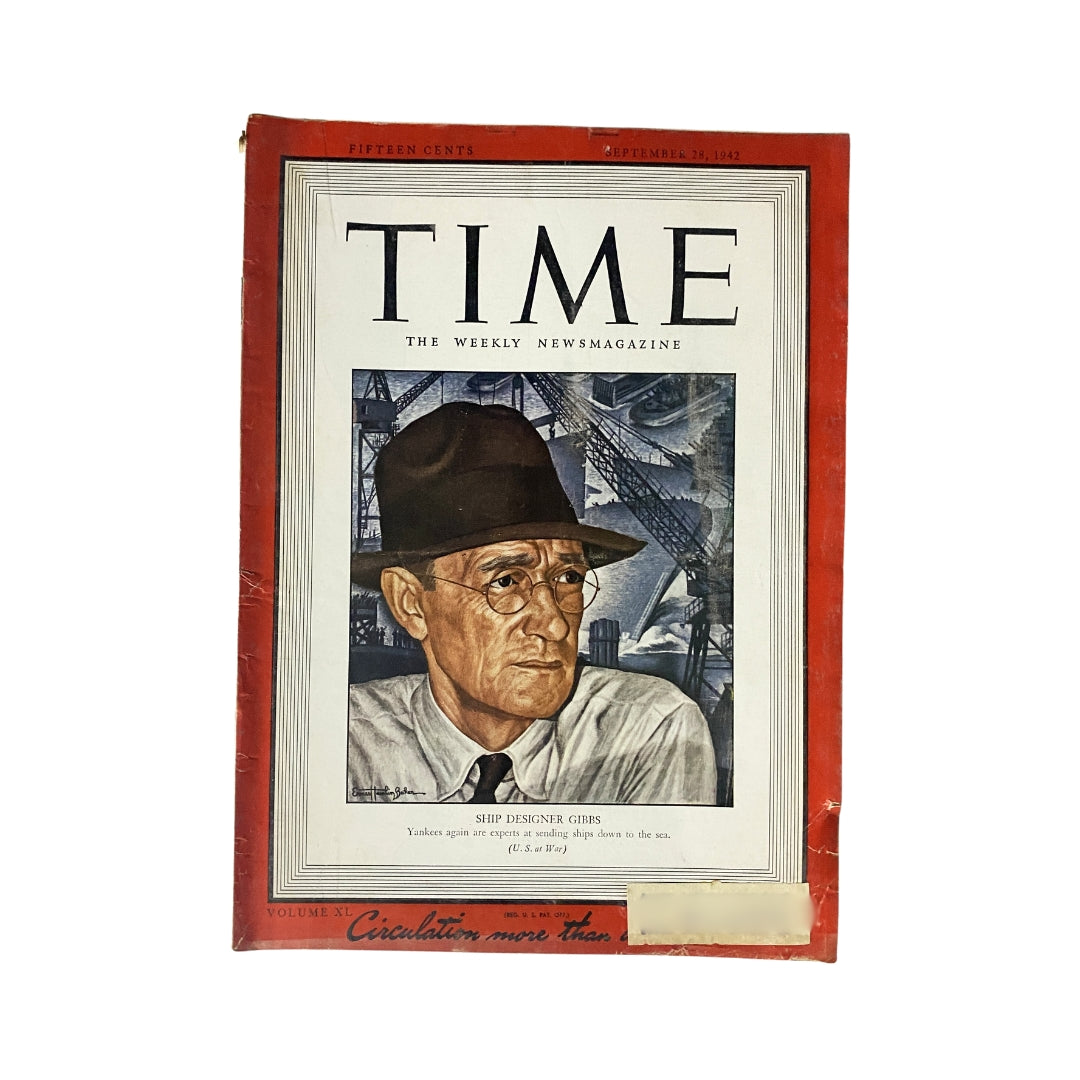
September 28, 1942 places this Time Magazine cover story on William Francis Gibbs at one of the most consequential moments in the history of American naval and maritime engineering. The United States had been at war for less than a year following Pearl Harbor, and the mobilization of American industrial capacity for military production was reaching its first significant peak. Gibbs & Cox, the naval architecture firm that Gibbs had founded and led, had become arguably the single most important ship design organization in the United States — responsible for the design of destroyers, destroyer escorts, and other naval vessels that were being produced in unprecedented numbers at American shipyards in 1942. The Battle of the Atlantic was at its most desperate phase, with German U-boats sinking Allied shipping faster than it could be replaced, and the American ability to design and build warships at industrial scale was one of the critical variables in the war's eventual outcome. Time's decision to put Gibbs on its cover in September 1942 was therefore not merely a profile of an interesting industrialist but an editorial statement about one of the most strategically important men in the American war effort — a figure whose work at a drafting table was directly connected to the survival of Allied supply lines and the ability of American forces to project power across both oceans. For collectors building an archive of Time Magazine covers from the Second World War period, this September 1942 edition is a primary document of American industrial and military mobilization at its most urgent phase.
William Francis Gibbs himself was one of the more remarkable figures in American industrial history, and the specific qualities that made him remarkable were precisely those that Time's cover treatment was designed to convey. He had transformed himself from a self-taught marine engineer — he had no formal naval architecture training when he began his career — into the most technically demanding and commercially dominant ship designer in the country, his firm eventually responsible for nearly a quarter of all American naval tonnage during the Second World War. His perfectionism was legendary: Gibbs reportedly refused to allow anyone to smoke aboard the ships he designed, his obsessive attention to fire prevention reflecting a personal experience with a catastrophic ocean liner fire earlier in his career. By September 1942 his firm was working simultaneously on hundreds of naval vessels while also contributing to the design of the Liberty Ships that were becoming America's primary response to the U-boat crisis — a breadth of productive capacity that was without precedent in the history of American engineering. The full departmental index preserved in the listing reveals the complete editorial architecture of the issue surrounding the Gibbs cover: the "Battlefronts" section on page 29, "U.S. at War" on page 17, and "Army & Navy" on page 57 collectively provide the wartime military context within which Gibbs's work had its direct operational meaning. Collectors researching American magazines from 1942 will find this issue a primary source document of the industrial mobilization that ultimately determined the war's outcome.
The full departmental index documented in the listing gives this issue a bibliographic completeness that allows researchers to appreciate the full scope of what Time was covering in the last week of September 1942. The "Battlefronts" section would have engaged the active military situation across multiple theaters — the fighting on Guadalcanal, the ongoing desert war in North Africa, the desperate Soviet defense at Stalingrad that was then at its most critical phase — providing the military context that gave the Gibbs engineering story its immediate strategic relevance. The Business section, the Science section, the Press department, and the Radio section collectively document the full breadth of American institutional life in the specific week that this issue was produced — a comprehensive primary source record of what Americans at war were being told about their world in late September 1942. The Medicine section, the Cinema section, the Music and Theater departments, and the Milestones column add the cultural and human dimensions that made Time's wartime coverage something more than purely military journalism, preserving the full texture of American life at a moment of national mobilization in a single weekly document.
About the Publication
Time Magazine was founded in 1923 by Henry Luce and Briton Hadden as the first weekly news magazine in the United States, and by September 1942 had sustained nearly two decades as one of the most widely read and institutionally authoritative publications in American journalism. Its wartime editorial approach was among the most ambitious in its history — the magazine committed its full editorial resources to covering the global conflict from every angle simultaneously, addressing military strategy, industrial mobilization, home front economics, and the cultural life of a nation at war within a single weekly package whose departmental index, preserved in this listing, documents the full range of that commitment. The cover system, which designated a single figure or development as the week's most historically significant, gave Time's wartime covers a particular gravity that makes surviving issues from this period some of the most historically consequential artifacts in twentieth-century American periodical publishing. The Gibbs cover in September 1942 represents that system operating at its most strategically acute: identifying, in a figure who worked largely outside public visibility, the industrial architect whose work was most directly connected to America's ability to fight the war it had entered.
Key Highlights Inside
- William Francis Gibbs cover story — a primary document of Time's editorial engagement with the most important ship designer in America during the war's most critical production year, published at the peak of the Battle of the Atlantic when the speed of American shipbuilding was directly connected to Allied survival, and representing one of the more historically significant industrial cover stories in the magazine's wartime run.
- "U.S. at War" section on page 17 and "Battlefronts" on page 29 — wartime military coverage from the last week of September 1942, a period of extraordinary military activity across multiple theaters simultaneously: Guadalcanal, Stalingrad, the North African desert, and the Atlantic U-boat war, all of which would have been active subjects in the issue that also profiled the man most responsible for producing the warships engaged in those conflicts.
- "Army & Navy" section on page 57 — a departmental engagement with the American military establishment at the height of its first full year of wartime mobilization, providing the institutional and organizational context within which Gibbs's design work had its direct operational application.
- Business section on page 71, Science on page 44, and Press on page 50 — documentation of American commercial, scientific, and media institutions at a specific wartime moment, collectively constituting a primary source record of how American institutional life was being reorganized around the demands of global conflict in September 1942.
- Cinema on page 82, Music on page 38, Theater on page 47, Books on page 92, Radio on page 54, Sport on page 79, and Milestones on page 48 — the full cultural and human documentation of a Time issue at war, providing the complete texture of American life in late September 1942 and contextualizing the industrial and military cover story within the broader experience of a nation at total war.
- Foreign News on page 25, Education on page 67, Medicine on page 86, and People on page 40 — the international and domestic institutional coverage that completed Time's weekly portrait of the world in the last week of September 1942, making this issue a comprehensive primary source document of the United States and the world at a specific and consequential moment in the Second World War.
Condition & Rarity
Time Magazine issues from September 1942 are approaching their eighty-fourth year of existence, and the condition landscape for surviving copies reflects the combined weight of that age and the specific paper quality constraints of wartime production. The Second World War period saw significant reductions in American paper quality as wartime materials restrictions took effect — Time issues from 1942 were produced on paper that was already of lower quality than prewar editions, which accelerates the tanning and brittleness that affect all period periodicals over long storage periods. The listing directs collectors to the photographs for condition assessment — the standard and appropriate practice for a publication of this age — and the plastic protective sleeve provides ongoing archival protection for what is now an eighty-three-year-old publication whose paper stock has had ample time to develop the characteristic aging of mid-century newsprint under any storage conditions. Collectors evaluating surviving examples of this issue should prioritize cover legibility — the Gibbs portrait and Time masthead are the primary visual documents — alongside spine integrity and the completeness of the wartime military and industrial coverage sections as the primary condition criteria most directly relevant to this issue's documentary and collector value. Any surviving copy from this period in readable and structurally intact condition represents a meaningful survival against the odds that have claimed most of its contemporaries.
Looking for More Issues Like This?
A surviving copy of the September 28, 1942 Time Magazine with the William Francis Gibbs cover and the complete departmental index preserved is a historically specific wartime industrial journalism find that surfaces infrequently — Time issues from 1942 documenting American war production figures outside the military chain of command are among the more substantive and less commonly encountered entries in the wartime archive, and this issue's direct connection to the Battle of the Atlantic crisis gives it a strategic historical significance beyond standard wartime cover profiles. If this issue is no longer available, the full Time Magazine collection at OriginalMagazines.com is the most comprehensive place to browse surviving issues from across the publication's history and locate other wartime covers, significant industrial or military profiles, or specific issues from Time's Second World War run. The 1942 magazine collection brings together surviving issues from across that year's major publications for collectors working to document the full breadth of American print journalism during the most consequential year of the United States' involvement in the Second World War.