



Description
Collector's Note – Why This Issue Matters
Audrey Hepburn on the cover of Time Magazine on September 7, 1953 documents one of the most meteoric rises in Hollywood history at its precise moment of arrival. Just weeks earlier, on August 25, 1953, Roman Holiday had been released in the United States — the film in which Hepburn played a European princess who escapes her official duties for a day of anonymous adventure in Rome opposite Gregory Peck. The film was an immediate critical and commercial sensation, and Hepburn's performance was recognized from its first screenings as something genuinely new: a quality of presence, intelligence, and natural grace that defied the prevailing Hollywood glamour conventions of the early 1950s. Time's decision to put her on the cover just thirteen days after Roman Holiday's release reflects how quickly and completely she had captured the American cultural imagination. She was twenty-four years old. She had not yet won the Academy Award she would receive the following spring — that moment was still ahead — but the cover date means this issue captures her at the precise instant of breakthrough, before the full weight of her legend had settled. Collectors building a serious archive of Audrey Hepburn's documented presence in the press treat this cover as the foundational entry — the moment the American mainstream first fully registered who she was.
The September 1953 timing carries additional resonance. Hepburn had also just completed her Broadway run in Gigi, which had run from late 1951 into 1952, and she had won the Tony Award for that performance. She was therefore arriving in Hollywood not as an unknown but as a stage actress of established credibility — a fact that distinguished her from the typical studio-groomed starlet and that Time's cover story would have engaged with in framing her significance. The convergence of stage success and immediate film stardom in a single year was unusual enough to demand serious coverage, and Time provided it. For collectors of Time's entertainment and cultural covers from the 1950s, this issue sits alongside a handful of covers that documented the emergence of genuinely transformative careers in real time — not in retrospect, but in the first flush of recognition.
Hepburn's subsequent career — Sabrina, Breakfast at Tiffany's, My Fair Lady, her UNICEF humanitarian work — made her one of the most enduring figures in twentieth-century popular culture, and her 1953 Time cover has appreciated in collector significance accordingly. But what gives this specific issue its irreplaceable documentary value is the date: September 7, 1953 is not a retrospective celebration or a career milestone issue. It is the first major national mainstream acknowledgment of a new kind of star, published while the ink on Roman Holiday's opening-week reviews was barely dry. The magazine record from 1953 is one of the richest in the postwar decade, and this cover stands as one of its most historically resonant entries.
About the Publication
Time was founded in 1923 by Henry Luce and Briton Hadden as the first American weekly news magazine. By 1953 it was one of the most widely read publications in the United States, reaching millions of Americans weekly with its signature format of opinionated news summaries organized across departments — National, Foreign, Business, Science, Arts — anchored each week by a cover story on the figure or event the editors deemed most significant. A Time cover in the early 1950s carried considerable cultural authority, functioning as a formal statement of national significance, and the selection of a newly emerged film actress just days after her American debut reflects the magazine's confidence in its own editorial judgment about who would matter.
Key Highlights Inside
- Audrey Hepburn cover feature — The cover story examines Hepburn at the moment of her American film breakthrough, thirteen days after the release of Roman Holiday and before her Academy Award win the following spring, capturing her at the instant of first national recognition.
- Documentation of a career-defining moment — The issue functions as a primary press document of Hepburn's emergence as a new kind of Hollywood star — one whose stage background, European sensibility, and unconventional screen presence distinguished her immediately from contemporary studio actresses.
- Early 1950s Hollywood and cultural context — Published at a moment when American cinema was navigating significant pressures — television competition, the decline of the studio system, the aftermath of the blacklist — the issue places Hepburn's arrival within the broader cultural landscape of the early postwar entertainment industry.
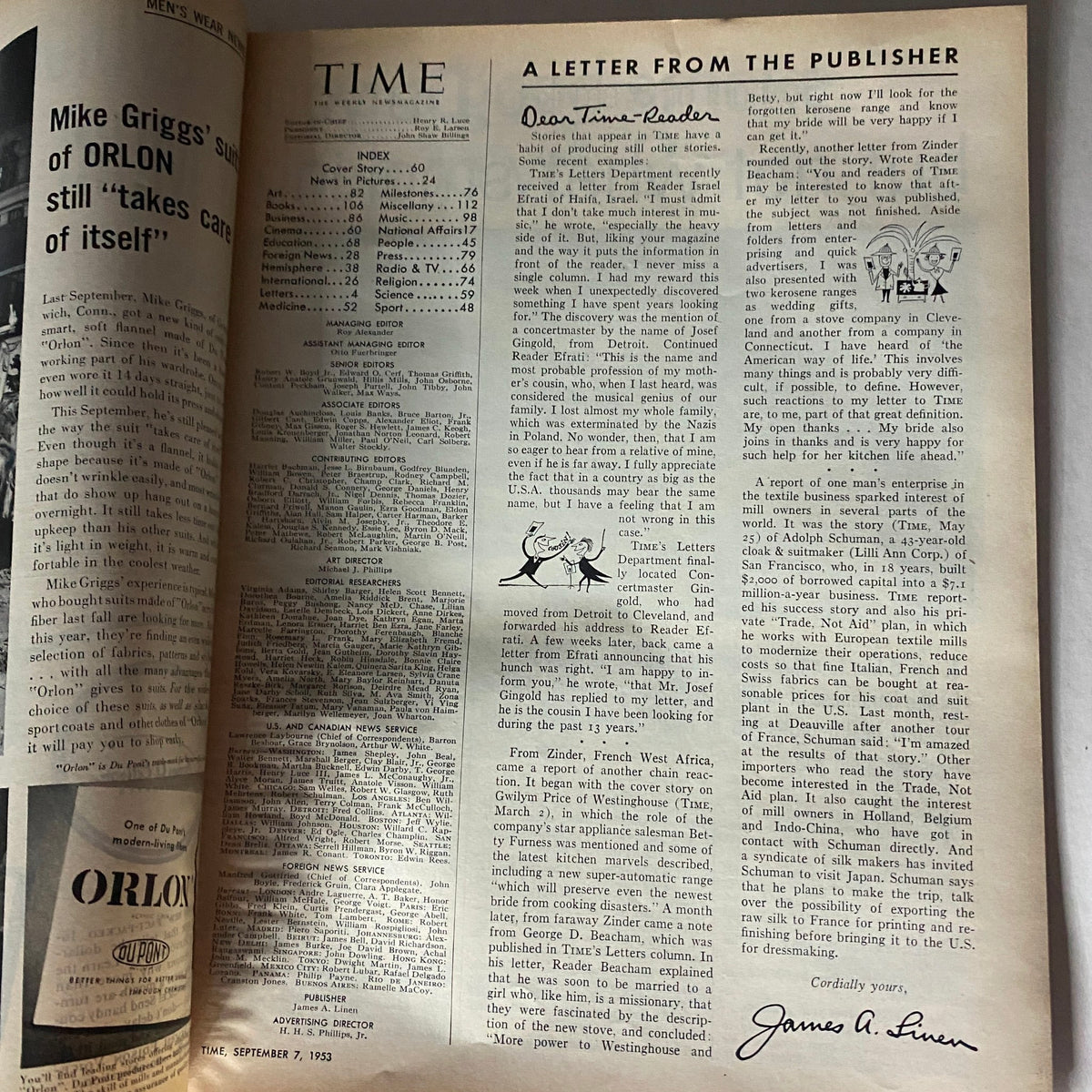
- Mid-century Time editorial content — Beyond the Hepburn feature, the issue reflects Time's coverage across its standard departments during one of the most eventful years of the postwar decade, providing a broader snapshot of September 1953's national and international concerns.
Condition & Rarity
Time issues from 1953 are now more than seventy years old, and the condition realities of any surviving copy reflect that age directly. The listing describes the issue as in great condition for its age without specifying a formal grade, which makes careful examination of available photographs the primary basis for collector assessment. The paper stock of early 1950s Time was acidic and not designed for archival longevity, meaning some degree of tanning and minor brittleness is expected in any unrestored example at this age. Protective plastic covering indicates deliberate preservation storage, which typically correlates with better structural integrity and reduced page fragility than unprotected long-term storage produces. For any surviving copy of this issue, the cover surface condition — particularly the clarity of Hepburn's portrait, which is the primary display element — and spine integrity are the factors that most directly determine collector grade. An Audrey Hepburn Time cover from 1953 has a broad collector base that extends from general magazine archive collectors into classic Hollywood memorabilia collecting, which means cover quality carries particular market weight.
Looking for More Issues Like This?
Audrey Hepburn press material from the early phase of her career — when she was still being discovered rather than retrospectively celebrated — is among the most consistently pursued in classic Hollywood memorabilia collecting, and this Time cover from the week of Roman Holiday's release is the most historically precise of all her early press appearances. The Audrey Hepburn magazine collection at OriginalMagazines.com is the natural place to continue, gathering her most significant press appearances across publications and across the full arc of her career. The broader Time magazine archive covers the full run of the magazine's entertainment and cultural covers, and the 1953 magazine collection provides context for one of the most eventful years of the postwar decade.