
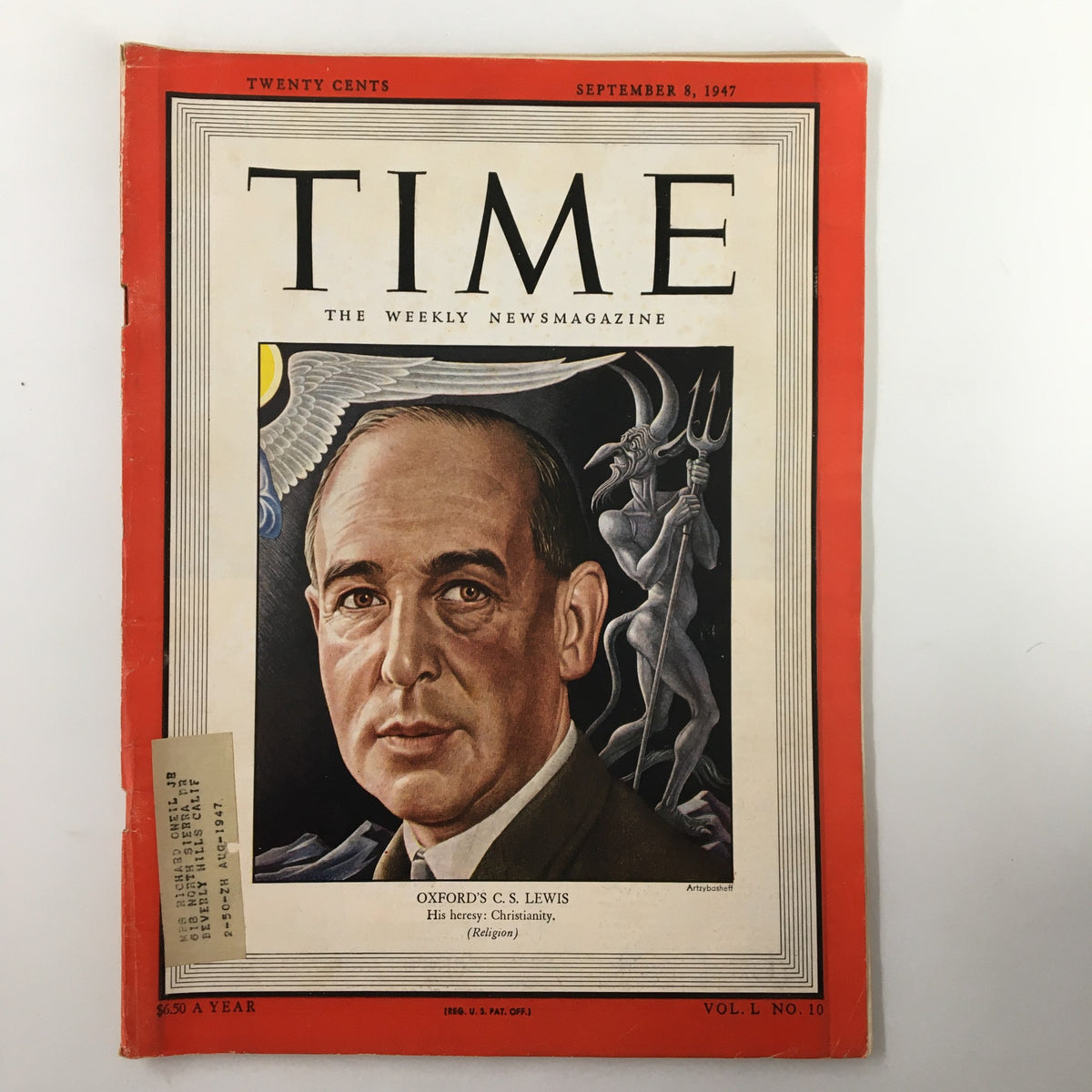

Description
Collector's Note – Why This Issue Matters
September 8, 1947 marks one of the most significant moments of recognition in C.S. Lewis's public career. By this point Lewis was already one of the most widely read Christian apologists in the English-speaking world — his BBC radio broadcasts had been delivered between 1941 and 1944 and published as Mere Christianity, The Screwtape Letters had appeared in 1942, and The Problem of Pain had established him as a rigorous popular theologian. But a Time cover was something different: it was American mainstream culture's acknowledgment that Lewis had crossed from religious publishing into the broader public consciousness, from Oxford don and BBC broadcaster to international figure. For a man who had spent his career at the margins of academic respectability — Christianity was not fashionable in the Oxford of his era — the cover represented a kind of vindication that his readers felt acutely.
The timing of the cover is also precisely calibrated to Lewis's literary output. Miracles: A Preliminary Study had been published in May 1947, just months before this issue appeared, and was generating significant debate in both theological and philosophical circles — the philosopher G.E.M. Anscombe's famous challenge to Lewis's argument at the Oxford Socratic Club came in February 1948, directly in the aftermath of this period of heightened public attention. The first of the Narnia Chronicles, The Lion, the Witch and the Wardrobe, was still five years away, meaning that this Time cover captures Lewis at the height of his reputation as an apologist and before the second wave of fame that the fantasy fiction would bring. It is a document of a specific, now-historical version of C.S. Lewis that the Narnia legacy has somewhat overshadowed.
For collectors of Time magazine covers devoted to literary and intellectual figures, a 1947 Lewis cover is a genuine prize. Time's cover subjects in the late 1940s were overwhelmingly politicians, military figures, and business leaders — a theologian and Oxford don receiving that recognition reflects the unusual breadth of Lewis's public reach and the specific postwar appetite for serious Christian thought that his work had helped to create. Among collectors building an archive of magazines from 1947 that document postwar intellectual and cultural life, this issue holds a distinctive place.
About the Publication
Time magazine, founded in 1923 by Henry Luce and Briton Hadden, was by September 1947 in its fiftieth volume and firmly established as the dominant weekly news magazine in the United States. Its format combined concise departmental news coverage with a single cover subject chosen to represent the most significant or culturally resonant figure of the week, and its reach into homes, offices, and waiting rooms across the country gave its cover selections genuine agenda-setting power. Volume 50, Number 10 places this issue in the magazine's silver anniversary year — a period during which Time was at the height of its Cold War-era editorial influence, covering the early confrontations between the Western powers and the Soviet Union alongside domestic political, cultural, and intellectual life. A cover devoted to an Oxford theologian and author in this context is a meaningful editorial statement about the kinds of intellectual seriousness the magazine considered worthy of its readership's attention.
Key Highlights Inside
- A cover feature on C.S. Lewis documenting his standing as the most widely read and publicly influential Christian apologist in the English-speaking world, coinciding with the period of heightened attention following the 1947 publication of Miracles: A Preliminary Study.
- Contextual framing of Lewis as an Oxford figure — the cover's identification of him as "Oxford's C.S. Lewis" signals the magazine's intent to present him to an American readership that may have known his work without knowing his institutional context, situating him within the tradition of English academic and literary life.
- News department coverage consistent with Time's format for early September 1947 — a period of active Cold War diplomacy, the early implementation of the Marshall Plan, and the developing confrontation between Western and Soviet spheres of influence that would define the postwar decade.
- Specific interior article titles and features beyond the cover story are unconfirmed from the listing; content described above reflects what is verifiable from the cover subject, volume and issue number, and publication date.
Condition & Rarity
A surviving copy of Time from September 1947 is now nearly 80 years old, and a Good condition grade with minor wear throughout represents a reasonable and honest survival for a weekly newsmagazine of this vintage that has passed through multiple hands over nearly eight decades. The front cover label is the primary condition qualifier — it sits directly on the cover portrait of Lewis and cannot be removed without damage risk, so its placement relative to the cover image is the key consideration for display purposes. For archival and research use, the label's presence does not compromise the integrity of the interior content. The protective plastic sleeve provides ongoing stabilization. Time covers featuring literary and intellectual figures from this era are produced in the same large print runs as any weekly issue, but the combination of age, active readership at the time of publication, and the intervening decades of storage means that copies in consistently Good or better condition require some effort to locate.
Looking for More Issues Like This?
Time covers devoted to literary and intellectual figures are among the less common categories in the magazine's archive, and a 1947 C.S. Lewis cover — arriving at such a precise and well-documented moment in his public career — is one that Lewis collectors and literary history enthusiasts pursue with real intent. If this issue has already been claimed, the Time magazine collection at OriginalMagazines.com is the best place to explore other available issues from across the magazine's century of publication. The 1947 magazine collection is also worth browsing for collectors building a broader archive of postwar intellectual and cultural life.