



Description
Collector's Note – Why This Issue Matters
Few magazine covers in the twentieth century carry the historical weight of Time's February 5, 1945 issue. At the moment this issue reached newsstands, the Second World War was entering its final, decisive months in Europe. The Allied armies were closing in on Germany from both east and west, the Pacific theater remained a brutal and unresolved conflict, and the diplomatic architecture of the postwar world was being quietly negotiated behind closed doors. It is almost impossible to overstate how much was in motion during the first weeks of February 1945 — and this issue of Time arrived in readers' hands at the precise center of that storm. For collectors who understand that the most valuable issues of any newsweekly are those that arrived at genuinely hinge moments in history, this date speaks for itself.
The Yalta Conference — the landmark summit between Stalin, Churchill, and Roosevelt that would redraw the map of Europe and set the terms of the postwar global order — convened on February 4, 1945, one day before this issue's cover date. Placing Joseph Stalin on the cover at precisely this juncture was not incidental. Time's editors understood that Stalin had become one of the central architects of the war's endgame, and that whatever emerged from Allied negotiations would bear his imprint for decades. The conference produced agreements on the postwar occupation of Germany, the formation of what would become the United Nations, and Soviet entry into the Pacific war — decisions that shaped the remainder of the twentieth century. This issue is, in effect, a primary document of the moment the postwar world was being decided. Collectors who focus on vintage Time Magazine issues will recognize February 1945 as one of the most historically loaded months the publication ever covered.
Joseph Stalin himself is among the most consequential and controversial figures of the entire twentieth century. He had already appeared on Time's cover multiple times by this point — including as the magazine's Man of the Year for 1939 and again for 1942 — reflecting the deeply complicated position he occupied in Western consciousness during the war years. As Soviet forces drove westward through Poland and toward Berlin, Stalin was simultaneously an indispensable Allied partner and a figure whose postwar ambitions deeply unnerved Western governments. He was a man the West needed, distrusted, and could not fully read. An issue of Time that puts his face on the cover in February 1945 captures that paradox at its most acute and historically charged. For collectors building around magazines from 1945, this issue represents the ideological and diplomatic tension at the very heart of the Allied coalition before victory had even been declared.
It is also worth considering what this issue meant to the Americans who originally purchased it. By February 1945, the country had been at war for more than three years. Rationing, casualty lists, war bond drives, and the constant anxiety of families with loved ones overseas had reshaped daily American life entirely. A newsstand copy of Time was not casual reading — it was a lifeline to understanding a complex, rapidly shifting global situation that touched virtually every household in the country. The person who bought this issue off a newsstand in February 1945 was living through the events it described. That human dimension — the fact that this was a contemporary document before it was ever a collectible — is part of what makes surviving copies so resonant for serious collectors and historians alike.
About the Publication
Time was founded in 1923 by Henry Luce and Briton Hadden with a mission to organize the week's news into a format busy Americans could absorb efficiently and intelligently. It was, from the beginning, an opinionated publication — not a neutral wire service, but an editorial voice that made deliberate choices about what mattered and why. By 1945, it had become required reading for policy-makers, military officers, intellectuals, and engaged citizens across the country and abroad. Its distinctive prose style — compressed, punchy, occasionally inverted in syntax — was so recognizable that it inspired parody, but also commanded genuine authority. The magazine was organized into clearly defined sections covering National Affairs, Foreign News, Science, Medicine, Business, Art, Cinema, and more, each written with the assumption that the reader wanted interpretation alongside information. The cover portrait was always a deliberate editorial statement rather than a decorative choice — a signal, carefully considered by Luce and his editors, of who and what defined the moment. During the war years, Time had correspondents embedded across every theater of conflict, and its foreign reporting carried a credibility and immediacy that set it apart from most competitors. A wartime issue of Time was not simply a news summary — it was one of the primary lenses through which educated Americans understood a world at war. By February 1945, the magazine's circulation was among the highest in its history, and its cultural authority was at a peak it would maintain well into the postwar decades.
Key Highlights Inside
- Stalin cover portrait and Soviet feature: The cover itself is the defining artifact of this issue — a deliberate editorial choice to center one of the war's most powerful and enigmatic figures at the precise moment the Yalta Conference was convening. Any interior feature accompanying the cover would have addressed Stalin's role in the final Allied push, Soviet military advances on the Eastern Front, and the looming question of what kind of postwar partner — or adversary — the USSR would prove to be.
- Yalta Conference context: With the historic summit between Stalin, Churchill, and Roosevelt opening on February 4, 1945 — one day before this issue's cover date — it is nearly certain that the editorial content addressed the conference's stakes, its participants, and the enormous diplomatic questions surrounding postwar Europe, German occupation, and the proposed United Nations framework.
- Eastern and Western Front war coverage: February 1945 saw Soviet forces advancing rapidly through Poland and into eastern Germany, while Allied forces on the Western Front were regrouping after the Battle of the Bulge. Time's foreign news section would have provided readers with detailed, correspondent-sourced coverage of these developments and their strategic implications.
- American home front reporting: Consistent with Time's editorial practice throughout the war years, this issue would have included domestic coverage reflecting the state of wartime America — industrial production, political affairs in Washington, and the social texture of a country still fully mobilized for a conflict not yet won.
- Advertising as historical document: The advertisements carried in any 1945 issue of Time are themselves primary historical material — wartime industry promotions, war bond encouragements, and consumer goods advertising that reflects what American commerce looked and sounded like at this specific moment. For collectors interested in mid-century material culture, these pages are often as revealing as the editorial content.
- Note: Specific interior articles, columns, and features for this issue have not been individually confirmed from available listing details. The above reflects what is verifiable from the cover subject, volume and issue number, publication date, and the well-documented editorial practices of wartime Time Magazine.
Condition & Rarity
Surviving newsstand copies of 1945 Time issues in any presentable condition are increasingly uncommon, and that scarcity will only deepen with time. Wartime paper stock was frequently produced under material constraints — lower-grade pulp, thinner pages, reduced ink quality — that accelerated natural deterioration even in issues that were stored carefully. The vast majority of copies printed in February 1945 were discarded, repurposed for wartime paper drives, or simply deteriorated beyond recognition over the following eight decades. What reaches the collector market today represents a genuinely small fraction of original print runs, and issues that have survived in displayable condition carry real historical weight.
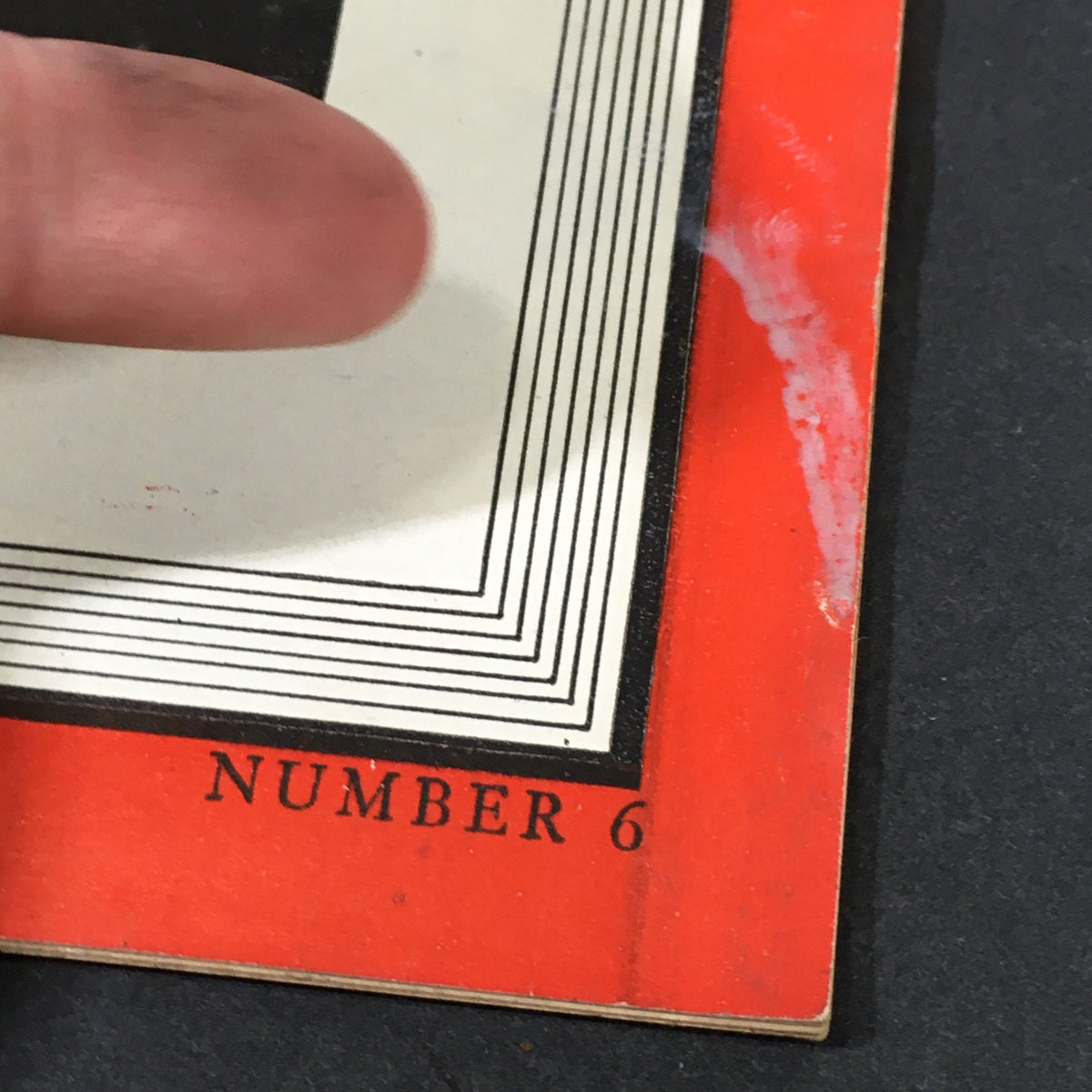
When evaluating any surviving copy of this issue, newsstand origin with no mailing label is a meaningful positive attribute. Subscriber copies — those mailed directly to homes — frequently sustained label adhesive damage to the lower portion of the cover, a flaw that is essentially permanent and significantly detracts from visual presentation. A clean, label-free cover indicates the copy reached its original reader through a newsstand or shop rather than through the mail, which generally correlates with better cover integrity. Minor edge wear and occasional marks are entirely expected in an eighty-year-old periodical and should be understood as honest evidence of survival rather than flaws in any disqualifying sense. The presence of a plastic protective covering indicates that a previous owner recognized the issue's value and took deliberate steps to prevent further deterioration — a positive sign in terms of the copy's recent storage history. Page integrity — the absence of missing, torn, or severely fragmented interior pages — is the single most important structural attribute to assess in any copy of this vintage, as it determines whether the issue functions as a complete historical document rather than a partial one. Copies that combine a clean cover, intact interior, and no label damage represent the upper tier of what survives from this period.
Looking for More Issues Like This?
A February 1945 Time with Stalin on the cover at the moment of the Yalta Conference is among the more historically significant — and consequently more sought-after — wartime issues to track down in collectible condition. The combination of the cover subject, the publication date, and the geopolitical weight of that specific week makes this a genuine centerpiece issue for any serious collection focused on World War II or Cold War origins. If this particular issue has already found a home, it is well worth exploring the broader Time Magazine collection at OriginalMagazines.com, which spans decades of covers and includes many other historically significant issues from the war years and beyond. Collectors with a specific focus on 1945 — the year that saw the end of the war in both Europe and the Pacific, the death of Roosevelt, the Nuremberg trials announcement, and the dawn of the atomic age — will find that the 1945 magazine archive brings together issues from across multiple major publications that document this extraordinary year from a remarkable range of editorial perspectives. Few years in the twentieth century produced a more historically dense body of contemporary print media, and building a collection around 1945 alone represents a meaningful curatorial achievement.