
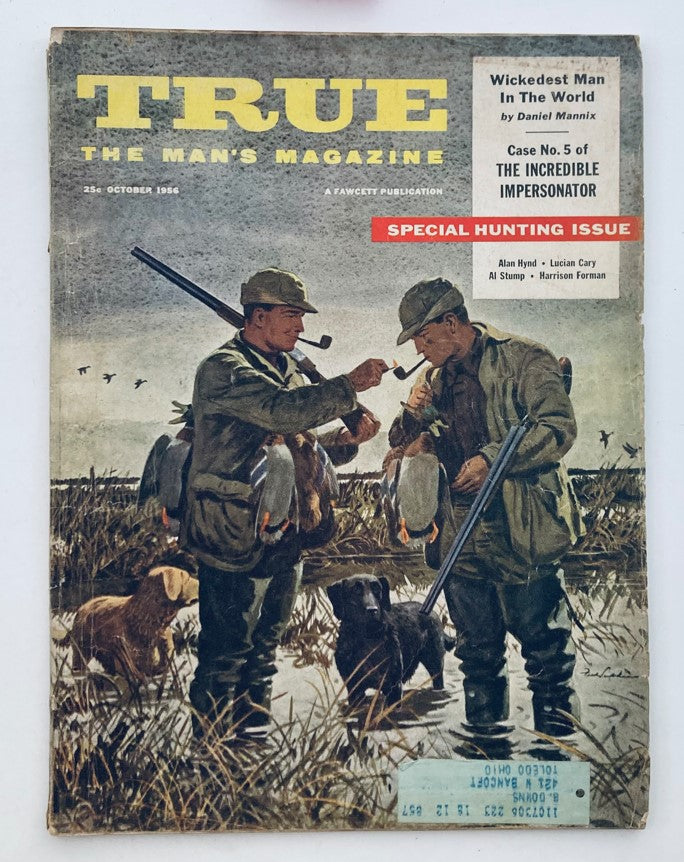


Description
Collector's Note – Why This Issue Matters
This October 1956 issue of True Magazine carries a substantial book-length feature titled "Wickedest Man in the World," a fourteen-page biography of the British occultist Aleister Crowley written by Daniel Mannix. Crowley had died in 1947, nearly a decade before this issue's publication, but his reputation as one of the most notorious and controversial figures of the early 20th century had remained firmly intact, kept alive by the very nickname this article borrows for its title. That nickname originated from a 1920s British tabloid press campaign against Crowley, following the death of a young follower at his commune in Sicily, and it stuck to him so thoroughly that it became the default shorthand by which mainstream publications introduced him to readers for decades afterward. Mannix's feature for True Magazine, arriving in 1956, situates this issue within that long tradition of mainstream media revisiting Crowley's life story for audiences who associated his name primarily with scandal and infamy rather than with the specific philosophical and esoteric system he had actually developed during his lifetime. This piece proved substantial enough that Mannix later expanded it into a full paperback biography titled "The Beast," making this True Magazine feature the original, condensed version of what would become a more widely circulated book-length treatment of Crowley's life.
Crowley's biography offered exactly the kind of sensational, larger-than-life material that magazines like True specialized in packaging for a general male readership during the 1950s. Born Edward Alexander Crowley in 1875 to a wealthy and strictly religious English family, he spent much of his adult life deliberately constructing a public persona built around occultism, unconventional sexuality, and open defiance of Victorian and Edwardian moral conventions, founding his own religious philosophy known as Thelema and referring to himself, among other titles, as "The Beast" drawn from the Book of Revelation. His life included genuinely dramatic and well-documented episodes, including significant mountaineering expeditions in the Himalayas and Mexico, a controversial 1905 attempt on Kanchenjunga that ended in an avalanche killing four climbers, and his time in New York during the First World War writing pro-German propaganda that some later suspected was itself a form of British intelligence work. That combination of daring physical adventure, genuine scandal, and unresolved mystery about his true loyalties and motivations made Crowley an almost perfectly suited subject for True Magazine's characteristic blend of sensational true-story content, offering readers a real historical figure whose actual biography read almost like adventure fiction.
Mannix's specific treatment of Crowley for True reflects the broader mid-century tendency to present Crowley primarily as a figure of scandal and moral warning rather than as a serious subject of religious or philosophical study, an approach consistent with how mainstream publications typically handled his life story throughout the decades following his death. That framing, emphasizing lurid biographical detail over genuine engagement with Crowley's actual belief system, was standard practice for magazines in this category, which prioritized dramatic narrative and moral spectacle over careful intellectual analysis. Crowley's later cultural influence, including his eventual association with figures ranging from members of The Beatles to various later countercultural and musical movements, still lay largely in the future at the time of this issue's publication, meaning this feature captures Crowley's reputation at a specific transitional point, after his death had ended his direct capacity for scandal but before his later, more complex cultural rehabilitation as a countercultural icon had begun in earnest. This issue offers a documented snapshot of exactly how a mainstream 1950s men's magazine chose to package his life story for a general audience during that specific transitional period.
Taken as a whole, this issue offers collectors and researchers of both true-crime magazine history and the broader cultural history of Aleister Crowley a substantive and well-documented primary source. Mannix's original True Magazine feature predates and directly informed his later, more widely circulated paperback biography "The Beast," giving this issue genuine bibliographic significance for collectors and researchers tracing the publishing history of Crowley biographical material specifically. For collectors of True Magazine more broadly, this issue's book-length feature exemplifies the publication's characteristic approach of dedicating substantial editorial space to a single dramatic, narrative-driven biographical subject. This issue stands as a meaningful artifact connecting mid-century American men's magazine publishing to the long and continuing cultural fascination with one of the 20th century's most notorious and mythologized figures.
About the Publication
True: The Man's Magazine was one of the notable titles within the American men's magazine category, published by Fawcett Publications and known for combining true-crime narratives, adventure stories, and substantial biographical features aimed at a general male readership. The magazine's editorial format frequently included book-length features on a single subject, presenting extended, narrative-driven biographical or historical content rather than the shorter multi-story format common to many competing titles. Its audience consisted of American men seeking dramatic, real-world narratives, drawn to the magazine's characteristic blend of genuine historical and biographical subject matter presented with a sensational, adventure-oriented editorial voice. True distinguished itself in part through its willingness to dedicate substantial space to a single major feature, as this issue's fourteen-page Crowley biography demonstrates, allowing for a more developed narrative treatment than shorter magazine features typically permitted. Illustration played a significant role in the magazine's presentation of these features, with this issue's Crowley biography illustrated by William A. Smith and Fred Ludekens, both notable commercial illustrators of the period. Advertising within the magazine during this period commonly reflected products aimed at its general male readership. Because magazines in this category were treated as disposable newsstand entertainment rather than material intended for long-term preservation, well-kept surviving issues, particularly those containing substantial standalone features like this one, are of specific interest to collectors and researchers of mid-century American magazine publishing and biographical writing.
Key Highlights Inside
- "Wickedest Man in the World," a fourteen-page book-length biography of Aleister Crowley written by Daniel Mannix. The piece was later expanded into a full paperback biography titled "The Beast." This feature represents a significant piece of Crowley biographical publishing history in its own right.
- Illustrations accompanying the Crowley feature by William A. Smith and Fred Ludekens. Both were notable commercial illustrators active in mid-century American magazine publishing. Their work here reflects True Magazine's characteristic visual presentation of major features.
- Biographical content covering Crowley's mountaineering expeditions, including his controversial 1905 Kanchenjunga attempt. This material reflects True's characteristic emphasis on dramatic, adventure-oriented true-story content. It situates Crowley's occult reputation alongside his lesser-known career as a serious mountaineer.
- Coverage of Crowley's activities in New York during the First World War, including his pro-German propaganda writing. This episode remains a subject of historical debate regarding his true loyalties. The feature's inclusion reflects True's interest in genuinely mysterious and unresolved historical episodes.
- Additional true-crime or adventure content likely present, consistent with True Magazine's standard issue structure during this period. Issues typically combined the featured book-length biography with shorter additional stories. Specific additional article titles for this issue are unconfirmed beyond the featured Crowley biography.
- Advertising content reflecting the magazine's general male readership, consistent with genre norms of the period. Specific advertisers appearing in this issue are not detailed in available records. Period advertising of this kind remains a useful secondary research resource for genre historians.
Condition & Rarity
Collectors evaluating any surviving copy of this issue should expect wear consistent with a periodical that has survived nearly seven decades since its original publication, including potential cover rubbing, light creasing, and page browning typical of magazines from this era. True Magazine issues from the 1950s are generally scarce in well-preserved condition, as these disposable newsstand publications were rarely archived with intentional care by their original readers and were often subjected to heavy handling given the genre's casual, high-turnover readership. Issues containing substantial standalone features on subjects with enduring cultural fascination, such as this one's book-length Crowley biography, often carry additional collector interest beyond general genre scarcity, since demand for material connected to Crowley's life and legacy extends well beyond typical True Magazine collectors into broader circles interested in occult history and biography specifically. A plastic protective covering, when present, functions as a stabilizing measure intended to preserve a copy's current condition rather than a factor that changes its underlying grade. Collectors evaluating any surviving copy of this issue should examine binding and page integrity closely, since these are typically the first points of wear in periodicals of this age and paper stock. Given the combination of general genre scarcity and this issue's specific significance within the publishing history of Crowley biographical material, a surviving copy represents a meaningful find for collectors spanning both true-crime magazine history and occult biographical literature.
Looking for More Issues Like This?
Issues of True Magazine featuring substantial book-length biographical content, particularly one as historically significant as Daniel Mannix's original Aleister Crowley feature, are genuinely sought after by collectors spanning both mid-century magazine history and the broader literature surrounding Crowley's life and legacy. For those drawn to this particular issue, our True: The Man's Magazine collection is a great place to continue browsing, since it gathers other surviving issues from across the publication's history of true-crime and biographical feature writing. That collection offers a broader look at how True approached major historical and biographical subjects across different years of its publishing run. Collectors with a specific interest in Aleister Crowley, mid-century occult history, or Daniel Mannix's broader body of biographical writing may find related material of interest scattered throughout that same collection. Beyond the publication itself, our 1956 magazines collection offers useful context for the broader publishing landscape of the same year, spanning titles well outside true-crime and men's magazine content. Browsing by year can be especially valuable for researchers interested in a specific cultural moment rather than one particular magazine. Given how sought-after issues connected to Crowley's biography tend to be among collectors once discovered, we'd encourage anyone interested in this era to browse both collections at their own pace. There is always more of this history available than a single issue can represent on its own. We hope these collections help round out whatever corner of mid-century magazine and biographical publishing history you're most drawn to.