


Description
Collector’s Note – Why This Issue Matters
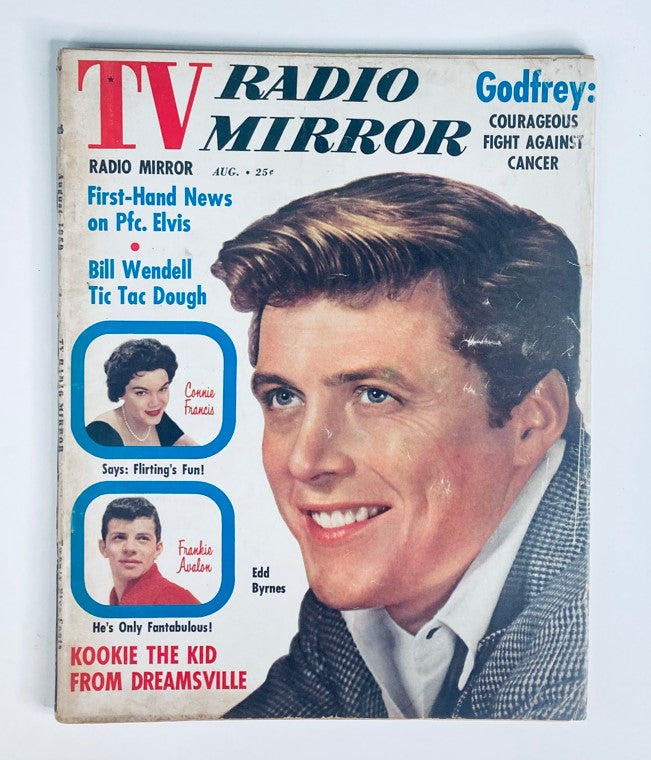
The August 1959 issue of TV Radio Mirror places Edd Byrnes at the center of one of television’s most intense late-1950s teen-idol moments. The supplied title misspells his name as “Edd Brynes,” but the cover and outside listings identify him correctly as Edd Byrnes. His large color portrait dominates the page, while smaller cover features promote Connie Francis, Frankie Avalon, Elvis Presley, and Bill Wendell. Byrnes appears polished, clean-cut, and youthful, with the carefully styled hair that had become inseparable from his screen identity. The magazine’s visual strategy is clear: it uses one television personality’s face to anchor a broader issue about music, youth culture, quiz shows, celebrity news, and popular entertainment. The cover also reflects how quickly television could transform a supporting character into a nationally marketable personality. By 1959, Byrnes’s role as Kookie on 77 Sunset Strip had moved beyond ordinary series publicity and into the realm of slang, records, hairstyles, and teenage fascination. This issue preserves that short but powerful cultural moment in a compact fan-magazine form.
The available issue records also indicate that the supplied numbering should be corrected. Marketplace documentation identifies the August 1959 TV Radio Mirror as Volume 52, Number 3, not Volume 52, Number 2. That distinction matters for collectors assembling a monthly run because neighboring issues from 1959 are commonly cataloged by both date and volume number. The August cover belongs to a period when TV Radio Mirror had fully shifted from its earlier radio-centered identity toward television, records, and screen personalities. The cover line promising “First-Hand News on Pfc. Elvis” places the issue within Elvis Presley’s military-service period, when magazines continued to feed reader interest even while he was away from ordinary entertainment work. Connie Francis and Frankie Avalon represent the teenage record market, while Bill Wendell connects the issue to television quiz and game-show culture. The cover therefore gathers several entertainment currents at once: detective television, Army-era Elvis coverage, pop singing, teen idols, and daytime or evening broadcasting personalities. Its value lies in that mixture as much as in Byrnes alone.
Byrnes’s importance in this issue comes from the extraordinary popularity of his Kookie persona. On 77 Sunset Strip, he became associated with a hip parking attendant, youthful slang, a comb, and a carefully maintained ducktail hairstyle. The character’s appeal was strong enough to support the novelty hit “Kookie, Kookie (Lend Me Your Comb),” recorded with Connie Stevens in 1959. TV Radio Mirror’s cover captures Byrnes during the same wave of recognition, when he was being marketed not only as an actor but as a teen personality and pop-culture symbol. This makes the issue useful for studying the overlap between television stardom and record promotion at the end of the 1950s. It also shows how fan magazines built emotional access around performers by promising personal news, behind-the-scenes information, and friendly proximity. As part of the TV Radio Mirror magazine archive and the wider collection of magazines published in 1959, the issue documents a moment when television, pop music, and youth fandom were becoming increasingly difficult to separate.
About the Publication
TV Radio Mirror developed from the earlier Radio Mirror tradition and reflected the entertainment industry’s shift from radio dominance to television-centered celebrity culture. The title had roots in fan publishing for radio performers, but by the 1950s it had adapted to the new world of television stars, pop singers, movie personalities, quiz hosts, and household broadcasting names. The Library of Congress identifies TV Radio Mirror as a Macfadden publication. Macfadden’s magazine empire had long specialized in popular, personality-driven periodicals that addressed readers through emotion, confession, celebrity, romance, health, and entertainment. TV Radio Mirror carried that accessible style into the television age. Its readers were not simply looking for program listings; they wanted stories about the people they heard on records, saw on television, and followed through fan culture. The magazine’s covers often used close celebrity portraits, short emotional headlines, and promises of exclusive or first-hand information. Its contents could include features on actors, singers, announcers, quiz-show personalities, military-service updates, family stories, photographs, advertisements, and reader-oriented departments. By 1959, television had become a central part of American leisure, while rock and roll, teen idols, and network programming were reshaping popular entertainment. TV Radio Mirror’s value today lies in how it records that transition through the language and imagery of ordinary fan readership. Surviving issues provide primary-source evidence of celebrity promotion, television fandom, record culture, advertising, beauty ideals, youth marketing, and the changing relationship between radio-era publishing and television-era fame.
Key Highlights Inside
- Edd Byrnes is the confirmed cover subject and should be identified with the correct spelling of his name. His portrait reflects his 1959 fame as Kookie from 77 Sunset Strip. The cover uses his youthful image and recognizable hairstyle as the issue’s strongest visual attraction.
- The August 1959 issue is more reliably cataloged as Volume 52, Number 3. The supplied title’s “Vol 52 #2” appears inconsistent with surviving marketplace records for this month. Collectors should use the date and volume-number correction when cataloging this copy.
- The cover line “First-Hand News on Pfc. Elvis” connects the issue with Elvis Presley’s military-service period. This feature should be described broadly unless the original article is available for exact text, author, and page number. It reflects continued reader demand for Elvis coverage even while he was serving in the Army.
- Connie Francis appears in a small cover portrait with the line “Says: Flirting’s Fun!” Her inclusion places the issue within the youth-oriented pop-music culture of 1959. The exact article title and content should be confirmed from the interior before being summarized beyond the cover wording.
- Frankie Avalon is also pictured on the cover with the line “He’s Only Fantabulous!” That phrasing captures the playful promotional language used for teen singers at the end of the 1950s. His presence connects the issue with the same teen-idol market that surrounded Byrnes and other young television or recording personalities.
- Bill Wendell is promoted through a cover line referring to “Tic Tac Dough.” Wendell was associated with broadcasting and game-show presentation, and his appearance broadens the issue beyond actors and singers. The feature demonstrates how TV Radio Mirror treated hosts and announcers as personalities worthy of fan attention.
- The cover also carries a “Fight Against Cancer” message. This shows that the issue included or supported a public-health appeal alongside its entertainment content. The placement of that message illustrates how mid-century magazines could combine celebrity promotion with civic or charitable campaigns.
- The complete table of contents has not been supplied in the listing description. Claims about a specific Byrnes interview, exact feature titles, or full article lineup should therefore remain cautious unless verified from interior pages. The safest archival description centers on the confirmed cover, corrected issue number, visible cover lines, publication context, and condition notes.
Condition & Rarity
The supplied title identifies this August 1959 copy as having no subscriber mailing label on the front cover. That detail is visually meaningful because it leaves Edd Byrnes’s portrait, the masthead, and the smaller cover portraits unobstructed. The absence of a front label does not by itself prove original newsstand distribution. The supplied description calls the magazine excellent with light wear characteristic of its age. That wording should be treated as the seller’s general assessment rather than as a standardized or independently certified grade. The listing states that the pictured item is the exact copy represented, so the photographs should remain the primary evidence for assessing corners, spine, edge wear, creasing, rubbing, surface marks, fading, and interior page condition. No complete written inventory has been supplied concerning detached pages, clipping, handwriting, stains, water exposure, tape repairs, missing material, restoration, or loose staples. Those characteristics should remain unconfirmed unless visible in the listing images or verified through direct inspection. A plastic protective covering is reported, but that sleeve is a later storage accessory rather than an original component of the 1959 publication. Because television and teen-idol magazines were often read casually, cover clarity and page completeness are especially important. Historical and collector interest is best evaluated through the Edd Byrnes cover, corrected volume number, no-label presentation, confirmed cover features, interior completeness, and actual physical state rather than through unsupported claims of rarity.
Looking for More Issues Like This?
Additional television and radio fan material can be explored through the TV Radio Mirror magazine collection. Comparing issues from 1958, 1959, and 1960 helps show how quickly the magazine adapted to teen idols, network drama, pop records, television hosts, and youth-centered fan culture. Edd Byrnes issues are especially useful for tracing the rise and marketing of Kookie from 77 Sunset Strip. Issues featuring Elvis Presley during his Army years provide another path into how magazines sustained celebrity interest during periods when a performer was less visible in ordinary entertainment work. Connie Francis and Frankie Avalon appearances can be studied alongside other teen singers who moved between records, television, film, and fan magazines. Game-show and announcer features, including material on Bill Wendell, show that television personality culture extended beyond actors and singers. No-label examples are attractive for display, while labeled copies preserve a different record of subscription circulation. Condition comparisons should focus on cover presentation, spine strength, page completeness, clipping, writing, and any missing photographs or special features. The broader 1959 magazine archive places this issue beside contemporary music, movie, television, teen, and general-interest publications. This August 1959 TV Radio Mirror stands out because it captures Byrnes at peak Kookie visibility while surrounding him with Elvis, Connie Francis, Frankie Avalon, Bill Wendell, and the fast-changing entertainment culture of the late 1950s.