


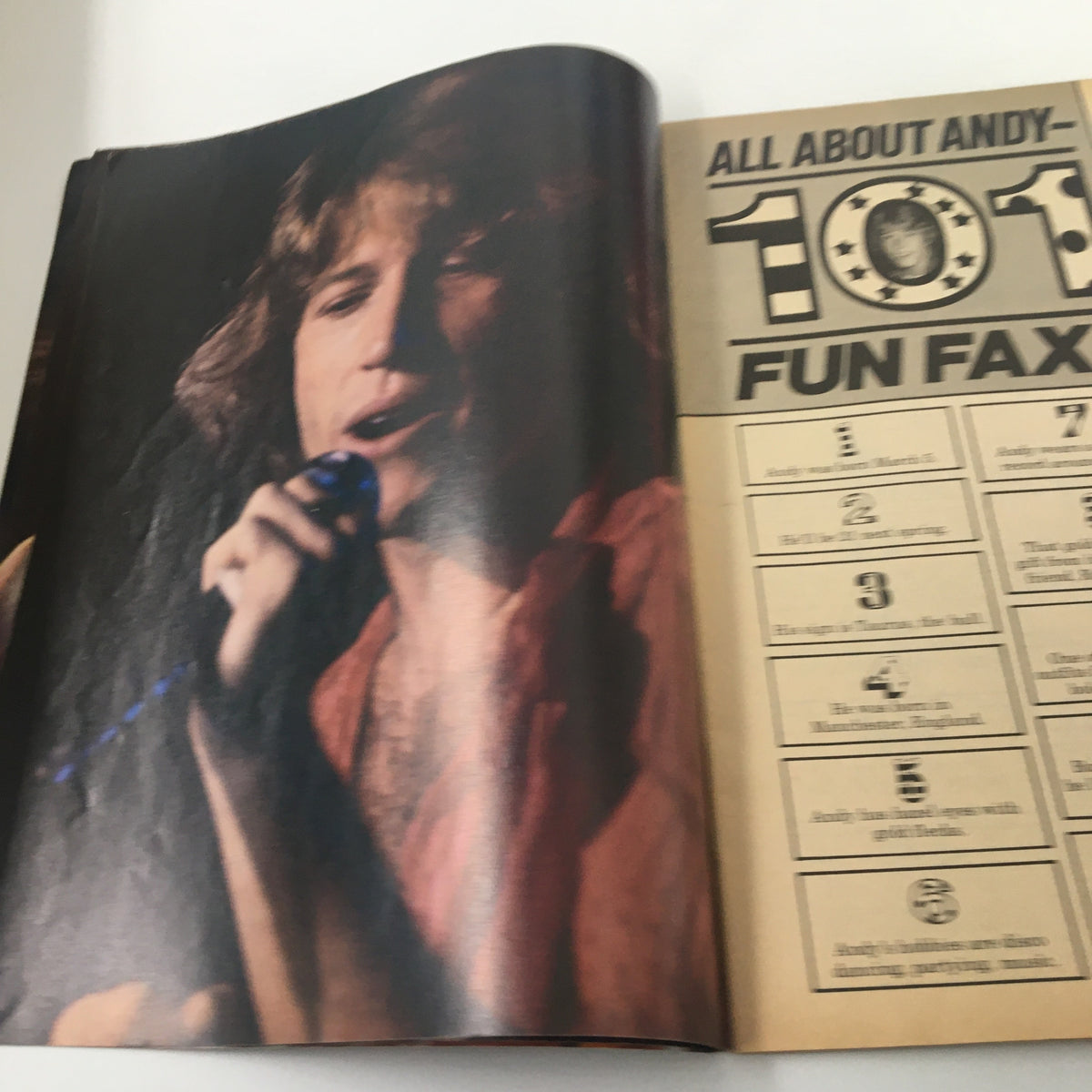


Description
Collector's Note – Why This Issue Matters
This December 1978 issue of TV Superstar arrives at the absolute peak of the Gibb family's chart dominance, a moment when Andy Gibb and his older brothers in the Bee Gees were simultaneously commanding the American pop charts in a way no family of musicians had managed since the early Beatles era. Earlier that year, Andy's single "Shadow Dancing" had spent seven consecutive weeks at number one, making him the first male solo artist in history to have his first three singles all reach the top of the Billboard Hot 100. At nearly the same time, the Bee Gees' contributions to the Saturday Night Fever soundtrack had become the best-selling soundtrack album in recording history to that point, with songs written by the Gibb brothers occupying an astonishing five of the top ten spots on the Billboard chart simultaneously in March 1978. By December, when this issue would have reached newsstands, Andy was barely twenty years old and had already achieved a level of chart success that placed him alongside his famous older brothers as one of the defining pop phenomena of the entire decade. This combination of teen idol stardom and genuine chart-topping musical achievement made the youngest Gibb brother an obvious and irresistible subject for the era's teen-focused entertainment magazines, which thrived on exactly this kind of family-spanning pop phenomenon.
The pairing of Andy Gibb with his brothers on a single magazine cover reflects the broader cultural reality of the Gibb family's unprecedented 1977-1978 run, during which the brothers wrote and performed an extraordinary share of the songs occupying the American charts at any given moment. Andy's own success was deeply intertwined with his brothers' songwriting and production work, since Barry Gibb wrote or co-wrote each of Andy's early number-one singles, and the family's combined commercial dominance made it almost impossible to discuss one Gibb without discussing the others. Teen idol magazines of this period built their entire business model around capitalizing on exactly this kind of intense, rapidly shifting pop fame, offering young readers an intimate, personality-driven window into the lives of musicians and actors who otherwise existed only through records and television appearances. A December 1978 cover built around the Gibb family arrived at a moment when readers' appetite for content on Andy and his brothers would have been at its absolute height, given the sheer scale of the family's chart success that year. This issue therefore captures a genuinely unrepeatable moment in American pop music history, when a single family of brothers held an almost unprecedented grip on the popular imagination.
For collectors, this issue offers a meaningful artifact from the height of disco-era teen idol culture, capturing Andy Gibb and the Bee Gees at the exact moment of their greatest combined commercial success before changing musical tastes and Andy's later personal struggles would alter the family's trajectory. That specificity, a magazine cover built around a chart phenomenon that has genuinely never been repeated in quite the same way, gives this issue real substance within the broader landscape of 1978 magazine collecting, where the Gibb family's singular chart dominance remains one of the most historically significant stories in American popular music.
About the Publication
TV Superstar was part of the broad ecosystem of teen idol-focused magazines that flourished throughout the 1960s, 1970s, and into the 1980s, a publishing category built around delivering personality-driven content about young musicians and television stars to a primarily teenage readership. Magazines in this category, including better-documented titles like Tiger Beat, 16, and Super Teen, shared a common format built around full-color photography, breathless feature writing, and a steady stream of content designed to make readers feel personally connected to the celebrities they idolized. Publishers in this space closely tracked shifting teen fandom, regularly updating their cover subjects to reflect whichever musicians or actors held the most cultural currency with young readers at any given moment, which made an act as commercially dominant as the Gibb family an obvious and recurring subject throughout 1977 and 1978. The genre's editorial conventions typically favored upbeat, sanitized coverage that avoided controversy or negative personal details, instead emphasizing relatable, aspirational content about its subjects' lives and romantic availability. This combination of accessible, personality-focused writing and vibrant visual presentation defined teen idol magazine publishing throughout this era, and titles within this category remain a popular and active area of collecting today, particularly for issues capturing major teen idols at their commercial peak.
Key Highlights Inside
- Cover feature on Andy Gibb and the Bee Gees, captured at the absolute peak of the family's combined chart dominance in late 1978. Andy had just become the first male solo artist in history to have his first three singles all reach number one on the Billboard Hot 100. His brothers' work on the Saturday Night Fever soundtrack had simultaneously become the best-selling soundtrack album in recording history at that point.
- Photographic and feature content characteristic of teen idol magazine publishing during this period. Magazines in this category typically combined full-color photography with personality-driven writing designed to make young readers feel personally connected to featured celebrities. This approach was central to the genre's appeal throughout the 1970s.
- Coverage tied to disco-era pop culture, reflecting the broader cultural moment when disco music and its biggest stars dominated American popular entertainment. The Bee Gees in particular had become inseparable from disco's mainstream commercial explosion following Saturday Night Fever's release in late 1977. This issue's content reflects how thoroughly that cultural moment had saturated even teen-focused entertainment media by the end of 1978.
- Additional content addressing the broader family dynamic between Andy Gibb and his older brothers. Andy's career success was closely tied to his brothers' songwriting, since Barry Gibb wrote or co-wrote each of his early number-one hits. Teen magazines of this period frequently emphasized these kinds of family and behind-the-scenes relationships as a way of deepening reader engagement with featured stars.
- Style and lifestyle content typical of the genre, addressing the look and presentation associated with the featured artists. Teen idol magazines regularly used fashion and lifestyle coverage to extend reader engagement with a featured star's image beyond music or television content alone. This kind of material was a standard component of the genre's monthly format throughout the decade.
Condition & Rarity
Surviving copies of this issue are generally evaluated using the same standards collectors apply across vintage teen idol and entertainment magazines: cover gloss and corner sharpness, spine integrity, absence of subscription labels or mailing stickers, and overall page condition free of tears, foxing, or moisture damage. A copy described as being in good condition, with minor wear and creases on the front cover, would be considered a representative survivor for a newsstand teen magazine now approaching fifty years old. A plastic protective sleeve is a standard and effective safeguard for issues of this vintage, helping prevent further handling wear, UV exposure, and humidity damage, though it has no bearing on the underlying grade of the magazine itself. As with most teen idol magazines from this era, the absence of a subscription label reflects newsstand rather than mailed distribution, and unlabeled copies are generally considered more visually desirable to collectors for this reason. Teen idol magazines were typically handled extensively by their original young readership, often torn apart for pinups or heavily creased through repeated reading, which can make well-preserved surviving copies somewhat less common than overall circulation figures might suggest. Given this issue's connection to such a historically significant chart moment in the Gibb family's career, collectors focused on Andy Gibb or the Bee Gees specifically may weigh the issue's timing and content heavily relative to minor cosmetic considerations like cover creasing. Pages free of significant brittleness, tearing, or moisture damage remain the broader benchmark for a well-preserved copy of any teen idol magazine from this period.
Looking for More Issues Like This?
A TV Superstar issue capturing Andy Gibb and the Bee Gees at the absolute height of their combined chart dominance in late 1978 represents a genuinely significant artifact of disco-era teen idol publishing. If this particular issue isn't available, it's worth browsing the full range of 1978 magazines for other issues capturing this same remarkable cultural moment alongside the broader entertainment landscape of the year. That year's magazines, taken together, offer a useful snapshot of just how completely the Gibb family and the broader disco phenomenon had come to dominate American popular culture by late 1978. Browsing by year can also be a productive way to discover related teen idol and music magazine titles from this same period that might not surface through a narrower search. For collectors specifically focused on Andy Gibb, the Bee Gees, or the broader disco era, this kind of year-based browsing tends to surface other relevant period material as well. The teen idol magazine category as a whole remains a popular and active area of collecting, particularly for issues tied to genuinely historic chart moments like the one captured in this specific issue. Whichever angle appeals most, the 1978 collection is a solid starting point for going deeper into this vibrant period of pop music and magazine history.