


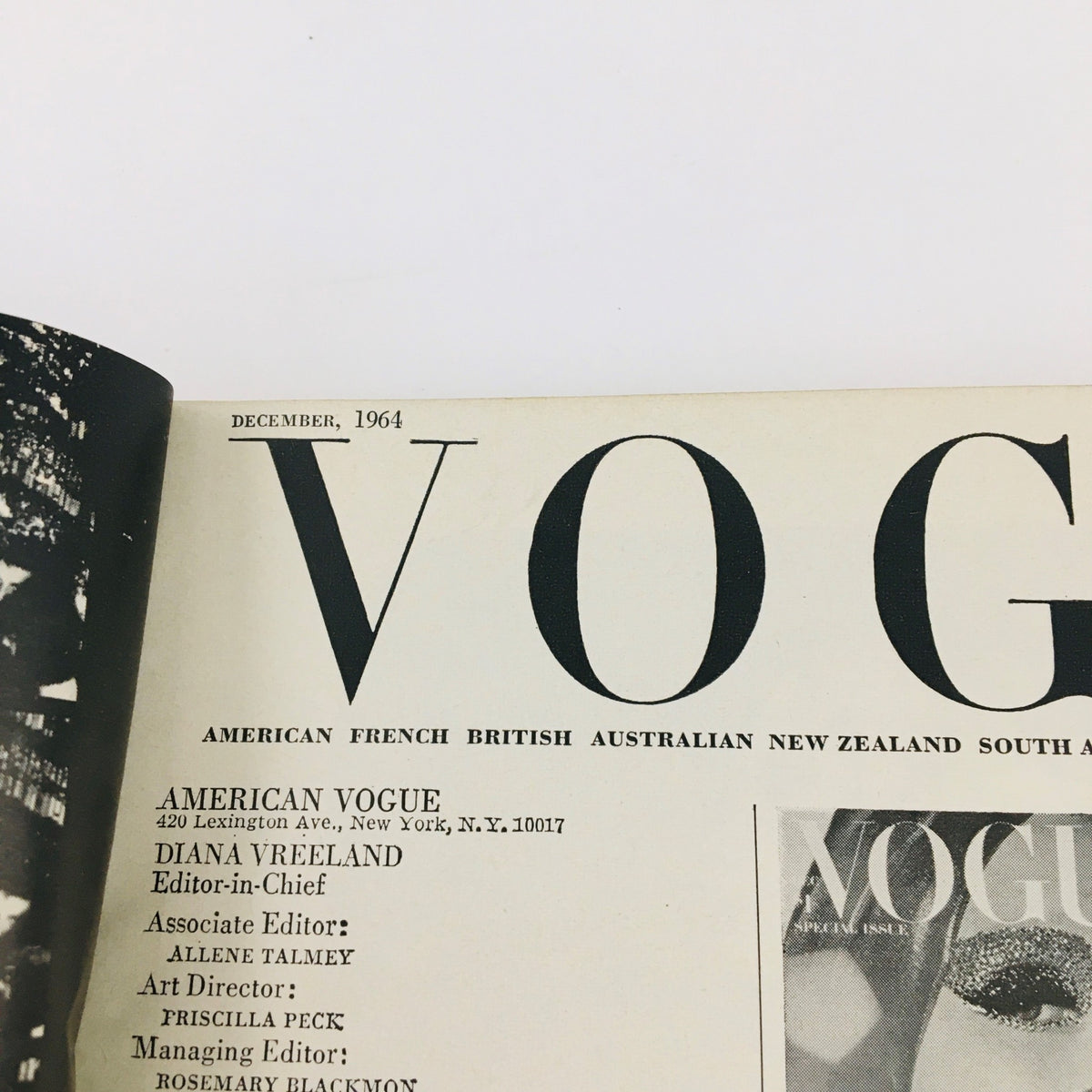


Description
Collector's Note – Why This Issue Matters
The December 1964 issue of Vogue — themed "Wonders for the Christmas Eyes" — is one of the most editorially ambitious single issues of the magazine's mid-1960s run, and the confirmed table of contents makes its historical and cultural significance unusually transparent. The "American Genius" feature alone — pairing composer Alan Hovhaness and Edgar Varèse, poet Robert Lowell and playwright Edward Albee, and visual artists Josef Albers and Jasper Johns in a single editorial package — represents a cross-disciplinary cultural survey of extraordinary range and quality. These are not marginal figures: Lowell was the defining American poet of the postwar era, Albee had just completed Who's Afraid of Virginia Woolf? (1962) and was at the height of his critical reputation, Johns was producing the work that would define the transition from Abstract Expressionism to Pop Art, and Varèse was being recognized posthumously as one of the century's most visionary composers. A December 1964 Vogue that places these figures together in a single feature under the umbrella of "American Genius" is the Vreeland-era magazine at its most culturally ambitious — making an explicit editorial argument that the arts in America in 1964 were producing something genuinely great, and that its readers' engagement with that greatness was a natural extension of their engagement with fashion. Collectors building a comprehensive record of Vogue's cultural engagement under Diana Vreeland will find the Vogue archive at OriginalMagazines.com an essential resource.
The cultural context of December 1964 is itself historically rich. The confirmed "Wonderful Year of Barbra Streisand" feature documents her at the precise moment of her emergence as a fully national celebrity — her Broadway run in Funny Girl had opened in March 1964, and by December she had become one of the most discussed entertainers in America. Zero Mostel in "Fiddler on the Roof" — which had opened on Broadway in September 1964 — is confirmed as another featured subject, placing this issue within the specific fall 1964 Broadway season that produced one of the most enduring musicals in American theatre history. Joan Didion's confirmed movie criticism column — Didion was in the early years of the career that would make her one of the most significant American writers of the twentieth century — adds literary weight to an issue already dense with cultural significance. The fashion photography in India by Henry Clarke, the Leningrad coverage by Allene Talmey and the confirmed feature by Maurice Druon, and the Jim Clark motor racing piece together document the magazine's characteristic geographic and cultural range at a moment of peak Vreeland editorial ambition. Those researching the cultural and artistic landscape of this pivotal year will find the 1964 magazines collection at OriginalMagazines.com a valuable resource across publications from this specific moment.
The no-label newsstand status is the most significant positive condition attribute for this issue. The December issue was one of Vogue's most heavily subscriber-distributed of the year, and a no-label copy preserves the cover design — itself a document of the magazine's specific visual identity under art director Alexander Liberman — in its original unobstructed state. The confirmed Rumer Godden India essay, Bruce Davidson photography, and Henry Miller piece titled "A Sense of Wonder" add further literary and photographic weight to an editorial package that is, taken as a whole, one of the more remarkable December issues the magazine produced in the 1960s.
About the Publication
Vogue was founded in 1892 and acquired by Condé Nast in 1909, developing over the following decades into the world's preeminent fashion magazine. The December 1964 issue appeared under editor Diana Vreeland, whose tenure from 1963 to 1971 represented the most theatrically ambitious and culturally expansive chapter in the magazine's modern history. Her editorial vision — that fashion was a total cultural phenomenon inseparable from art, literature, travel, and ideas — produced December issues of extraordinary breadth. The twice-monthly publication schedule in this era yielded issues of substantial editorial investment, and the confirmed contributor roster here — including Joan Didion, Rumer Godden, Henry Miller, Allene Talmey, Jean Stafford, and photographer Henry Clarke — reflects the Vreeland-era magazine's commitment to serious literary and intellectual content as a natural complement to its fashion photography.
Key Highlights Inside
- "American Genius" feature pairing Alan Hovhaness and Edgar Varèse, Robert Lowell and Edward Albee, Josef Albers and Jasper Johns — a confirmed cross-disciplinary cultural survey of six of the era's most significant American artists, representing the Vreeland-era magazine's explicit argument that serious engagement with art and culture was integral to its editorial identity.
- "The Wonderful Year of Barbra Streisand" — a confirmed feature documenting Streisand at the precise moment of her national breakthrough following the 1964 Broadway opening of Funny Girl.
- Zero Mostel in "Fiddler on the Roof" — confirmed coverage of the September 1964 Broadway opening of one of the most enduring American musicals, documented in the same season as its debut.
- Joan Didion movies column — confirmed film criticism contribution from a writer in the early years of the career that would establish her as one of the most significant American literary voices of the twentieth century.
- Fashion photographed in India by Henry Clarke — a confirmed location editorial reflecting the Vreeland-era magazine's investment in international photography at its most ambitious, alongside confirmed essays on India by Rumer Godden and Allene Talmey's Leningrad coverage.
- Henry Miller's "A Sense of Wonder" — a confirmed literary contribution from one of American literature's most controversial and consequential voices, reflecting the magazine's consistent practice of publishing significant writers alongside its fashion content.
Condition & Rarity
The noted condition describes an acceptable copy with rips, marks, binding wear, no mailing label, and a plastic protective sleeve. The rips and binding wear are the primary structural condition disclosures and should be assessed in the listing photographs for their extent and placement — rips affecting interior pages or the cover image carry different significance than those at outer edges or the spine binding area. Binding wear on a twice-monthly fashion magazine of this age is entirely expected and does not typically affect the legibility of the interior content. The no-label status preserves the cover in its original unobstructed state despite the other noted condition characteristics. The plastic sleeve confirms deliberate protective storage. For collectors whose primary interest is the extraordinary interior editorial content — the American Genius feature, the Streisand and Mostel documentation, the Joan Didion criticism — an acceptable condition copy with legible pages and intact interior content remains a fully functional research and reference artifact of one of the most culturally rich December issues in the magazine's 1960s run.
Looking for More Issues Like This?
Vreeland-era Vogue December issues with confirmed content of this editorial depth and cultural range are among the most rewarding finds for serious collectors of the magazine's 1960s run, and the December 1964 issue — with its American Genius feature, Streisand and Mostel documentation, and Joan Didion criticism — is a genuinely exceptional configuration. If this issue has already been claimed, the full Vogue archive at OriginalMagazines.com is the best place to search for other issues from the Vreeland era and the magazine's mid-1960s peak. Collectors drawn to the extraordinary cultural richness of 1964 will find the 1964 magazines collection worth exploring for period publications across fashion, theatre, music, and the arts.