



Description
Collector's Note – Why This Issue Matters
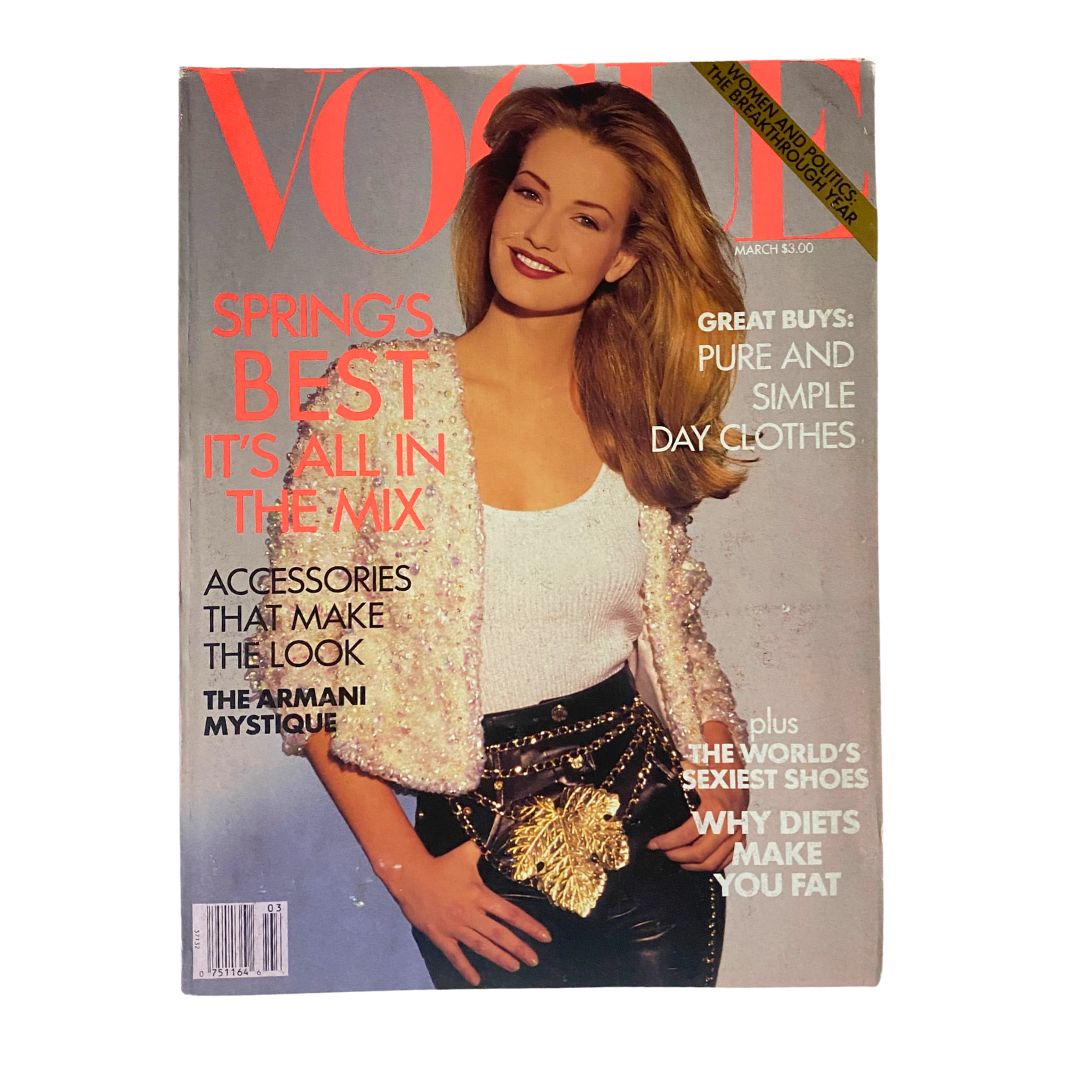
The March 1992 issue of Vogue captures American fashion media at a particularly self-assured moment, just as the supermodel era was reaching its commercial peak. The cover is built around Karen Mulder magazine covers from the early '90s, the Dutch model who, alongside her peers in the "Big Six," helped define the look of the decade through campaigns for Victoria's Secret, Chanel, and Guerlain. Her presence on a Vogue cover in this period places the issue squarely within the height of the model-as-celebrity phenomenon, when a face on the newsstand could move copies as effectively as any headline. This was an era when models themselves had become a kind of editorial content, recognizable by first name alone, and Vogue's cover choices reflected that shift toward treating the model as the story rather than simply the vehicle for the clothing.
The cover photography is credited to Marc Hispard, a French photographer known for his work across European and American fashion publications during the late 1980s and 1990s. His collaborations with Vogue throughout this period reflect the magazine's continued reliance on a small circle of trusted image-makers to maintain a consistent visual identity from issue to issue, even as fashion itself was shifting toward the more pared-down, "minimalist" aesthetic that would come to dominate the mid-90s. Hispard's approach to lighting and composition during these years tended to favor clean, polished glamour over the grittier styles that some of his contemporaries were beginning to experiment with, a tension that defines much of the photography of this transitional period.
Beyond the cover, this is an issue that sits at an interesting cultural crossroads. Its interior content spans the expected fashion reporting, including features on Giorgio Armani and shoemaker Manolo Blahnik, alongside cultural criticism touching on Merchant Ivory's film adaptation of Howards End and a major Picasso exhibition. It also reflects Vogue's longstanding habit of folding political and social commentary into its pages, with a feature on the record number of women running for Congress in the 1992 election cycle, a year that would later be remembered as the "Year of the Woman" in American politics. For researchers and collectors interested in the broader Vogue magazine archive, this issue is a useful artifact of how the publication balanced glamour with the social currents of its time. It also stands as one of many 1992 magazines documenting a year defined by economic uncertainty, a contentious presidential race, and a fashion industry in transition. Taken together, the issue offers a fuller picture of early-90s Vogue than the cover alone suggests, one where high fashion, cultural criticism, and current events were expected to coexist on equal footing.
About the Publication
Vogue has been published in the United States since 1892, evolving from a society weekly into the most influential fashion monthly in the world. By the early 1990s, it had long established its format of pairing high-fashion editorial spreads and cover photography with cultural criticism covering film, theater, books, and the arts, alongside lifestyle features on travel and food. Its audience has traditionally consisted of fashion industry professionals, designers, and consumers with an interest in style as a form of cultural commentary rather than simple clothing reference. Under the editorship of Anna Wintour, who took the helm in 1988, the magazine entered the 1990s with a sharpened focus on pairing supermodels and high-profile photographers with substantive editorial content, a formula that helped Vogue maintain its position as the industry's most closely watched title. Each monthly issue typically ran several hundred pages, with advertising and editorial content closely intertwined, reflecting the publication's dual role as both a cultural authority and a commercial engine for the fashion industry it covered.
Key Highlights Inside
- Cover feature on supermodel Karen Mulder, photographed by Marc Hispard
- A profile of designer Giorgio Armani, tracking his influence from Hollywood to Hong Kong
- An election-year report on the record number of women running for the House and Senate in 1992
- Arts coverage including a review of the Merchant Ivory film Howards End and a major Picasso still-life exhibition
- A feature on shoemaker Manolo Blahnik following his work from New York to Los Angeles to Milan
- A travel feature exploring lesser-known destinations across Europe
- A profile of playwright John Guare, author of Six Degrees of Separation, around the debut of his new work
- A food feature tracing the Tuscan roots of cucina povera, the rustic Italian cooking tradition
Condition & Rarity
Surviving copies of this issue are typically evaluated based on a few key factors common to early-1990s newsstand magazines of this kind. The absence of a subscriber address label is generally considered a mark of higher display quality, since labeled copies often show adhesive residue or tearing where the label was removed. A protective plastic covering, when present, indicates an effort to preserve the cover gloss and prevent the kind of edge wear, spine creasing, and page yellowing that periodicals of this age commonly develop. Newsstand copies without a label are often viewed as more desirable for display purposes, since the cover image remains fully intact and unobstructed, which matters considerably for an issue defined by a striking model portrait. Collectors evaluating any copy of this issue should look closely at cover sharpness, binding integrity, and the completeness of interior pages, as these factors most directly affect a copy's standing within the broader market for vintage fashion periodicals. Given that fashion magazines from this era were printed on relatively thin stock not intended for long-term archival use, copies that have retained strong color saturation and a tight binding after more than three decades are generally considered to be in above-average condition for the category.
Looking for More Issues Like This?
Issues featuring Karen Mulder on the cover don't surface often, and this particular Vogue printing is no exception. If you're drawn to her work from this era, the Karen Mulder collection is a good place to keep exploring, as it brings together other appearances of hers from the same period. For a broader look at the magazine itself, the Vogue collection spans many decades of fashion history, offering plenty of context for how the title evolved across different eras. And for those more interested in the year itself than any single cover star, the 1992 magazines collection offers a wider view of that particular year across titles, capturing how different publications were documenting the same cultural moment.