
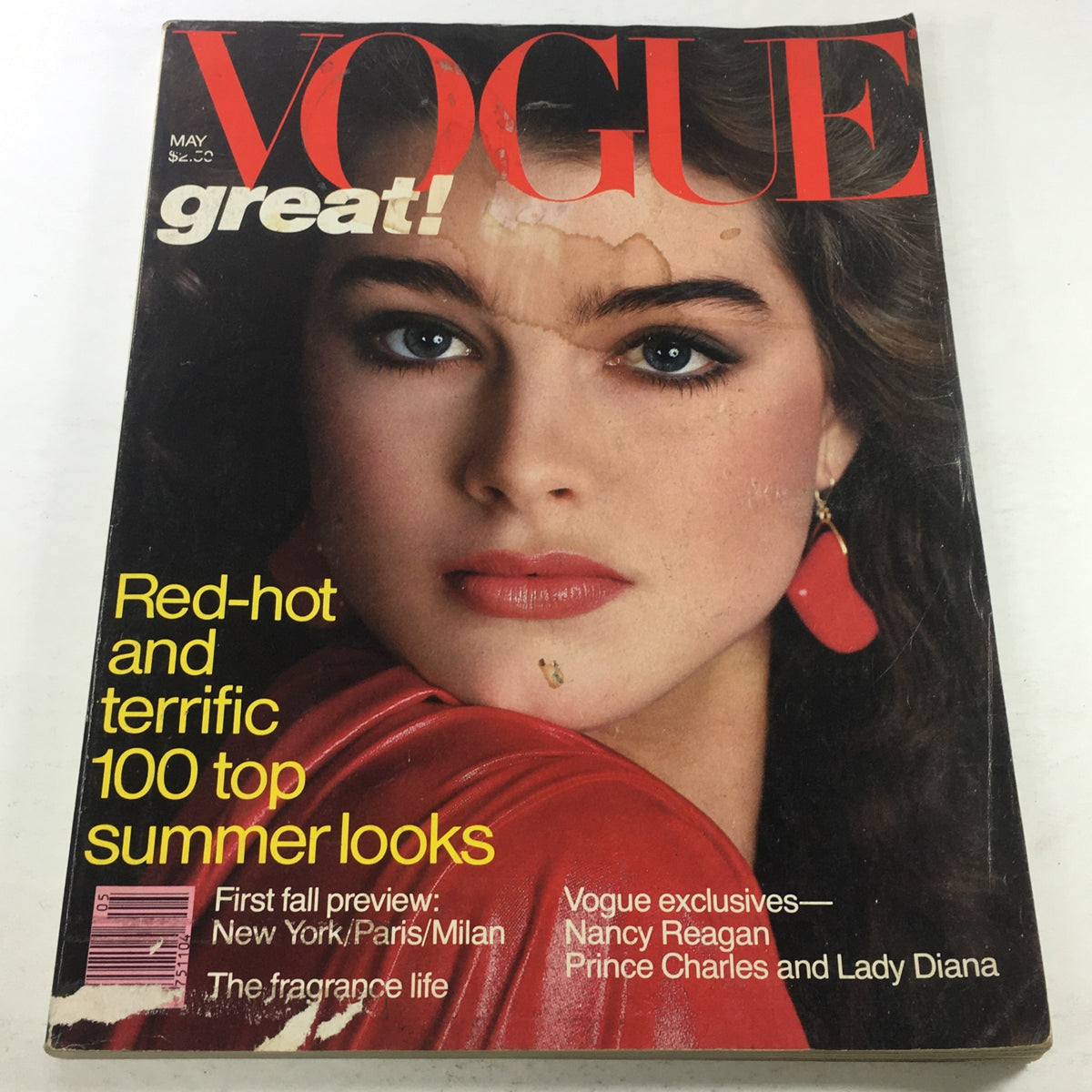


Description
Collector's Note – Why This Issue Matters
The May 1981 issue of Vogue Magazine, featuring Brooke Shields on the cover, documents one of the most culturally discussed and publicly debated modeling careers in American popular culture at the precise moment of its maximum cultural saturation. By May 1981, Shields had been a professional model since infancy and had built an extraordinary public profile through a combination of Calvin Klein jeans advertising — the "Nothing comes between me and my Calvins" campaign of 1980 had generated both enormous commercial success and significant controversy — her film work in Pretty Baby (1978) and The Blue Lagoon (1980), and the specific combination of youthful beauty and precocious celebrity that had made her simultaneously one of the most recognized faces in America and a subject of sustained cultural debate about the sexualization of young women in advertising and media. A Vogue cover in May 1981 was a significant moment in that career — the imprimatur of the most authoritative American fashion publication represented a transition from the contested terrain of Calvin Klein advertising into the more validated territory of high fashion editorial, suggesting a career trajectory that was moving toward conventional fashion legitimacy rather than remaining in the commercially successful but culturally controversial space that the jeans campaigns had occupied. For collectors building archives around Brooke Shields's magazine cover history, the May 1981 Vogue is a primary document of her career at its most culturally prominent and most publicly debated moment.
The broader context of May 1981 gives this issue its specific historical position. The early Reagan era was producing a cultural atmosphere in which the debates about youthful female sexuality in advertising that Shields's Calvin Klein campaigns had sparked were being processed alongside the decade's emerging social conservatism — a tension that gave her public image a specific cultural charge that went well beyond conventional fashion celebrity. At the same time, Vogue's decision to put Shields on its cover in May 1981 reflected the magazine's characteristic editorial instinct for recognizing genuine cultural currency rather than merely conventional fashion credentials, acknowledging that Shields's cultural presence — whatever its controversies — was real and significant enough to warrant the publication's cover endorsement. The May issue position in Vogue's annual calendar — spring fashion, a traditionally strong editorial month — gives this cover the additional weight of a publication's deliberate seasonal statement. Collectors researching Vogue's editorial history of the early 1980s will find this issue a useful primary document of the publication's celebrity cover choices at the beginning of the decade's most distinctive fashion period, and those building archives of American fashion and popular culture publishing from 1981 will recognize the Shields cover as one of the year's most culturally weighted fashion magazine moments.
About the Publication
Vogue was founded in 1892 and acquired by Condé Nast in 1909, developing over the following century into the definitive American fashion authority. By May 1981, the magazine was in the final years of Grace Mirabella's editorship — she had led the publication since 1971 and would continue until Anna Wintour's arrival in 1988 — and was operating as the primary arbiter of American fashion authority during a period when the industry was navigating significant aesthetic and commercial transitions. The Mirabella era Vogue is sometimes underappreciated in retrospective accounts that leap from Diana Vreeland's 1960s vision directly to Wintour's 1990s dominance, but the magazine's editorial engagement with the major cultural figures of the late 1970s and early 1980s — including its cover choices for figures like Shields — reflects a publication with genuine cultural intelligence and commercial authority that distinguished it from all competitors in the category.
Key Highlights Inside
- Brooke Shields appears on the May 1981 cover at the height of her cultural prominence — in the immediate aftermath of the Calvin Klein "Nothing comes between me and my Calvins" campaign controversy and the Blue Lagoon's commercial success, making this Vogue cover a primary document of the fashion establishment's formal endorsement of her mainstream fashion credentials at the most culturally charged moment of her early career.
- The May 1981 publication date places this issue within the specific early-Reagan-era cultural context that gave Shields's public image its particular charge — the debates about youthful female sexuality in advertising that her campaigns had generated were being processed alongside the decade's emerging social conservatism, giving the Vogue cover placement a cultural significance beyond routine celebrity fashion photography.
- As a May 1981 Vogue under Grace Mirabella's editorship, this issue represents the publication's spring fashion editorial statement during the early years of the decade — a period when American fashion was beginning to develop the power-dressing aesthetic and bold commercial energy that would define the decade's most distinctive visual identity.
- The confirmed address label on the front identifies this as a subscriber copy — the standard surviving format for Vogue from this era, as the magazine's subscription-based distribution model meant that labeled copies represent the majority of surviving issues from the early 1980s.
- Note: Specific article titles, named photographers, additional featured content, and detailed interior material beyond the confirmed Shields cover are unconfirmed for this issue. The highlights above are drawn from listing details and well-documented public knowledge about Brooke Shields's career and Vogue Magazine in May 1981.
Condition & Rarity
Surviving copies of this issue are graded at the Good level with light wear and a confirmed address label on the front — a condition profile that collectors should evaluate against the provided photographs to understand the wear's distribution and the label's specific placement and visual impact on the cover. For a Vogue from May 1981, Good condition with light wear is a workable survival grade: the magazine was printed on high-quality coated stock that reproduces fashion photography with excellent fidelity and retains surface quality well under careful storage conditions, and copies that survive in any readable condition after forty-four years with minimal wear are meaningful finds within the Vogue collecting community. The address label is a subscriber delivery marking consistent with Vogue's distribution model of the era — the standard surviving format for early-1980s Vogue issues. The plastic protective covering provides appropriate stabilization for a publication of this age, maintaining cover surface quality and preventing further deterioration during handling and storage. Brooke Shields Vogue covers from the early 1980s are among the more actively collected entries in both her magazine archive and in the Vogue early-Reagan-era collector category, with the cultural controversy that surrounded her public image in this period giving surviving issues a research and collector interest that extends beyond routine fashion magazine collecting.
Looking for More Issues Like This?
Brooke Shields's early-1980s Vogue appearances are among the most culturally specific and historically weighted entries in her substantial magazine archive — the period when her Calvin Klein controversy and her Vogue legitimization were occurring simultaneously is proportionally less systematically collected than either her later career or her earlier childhood modeling, making the May 1981 Vogue a particularly well-situated primary document of that specific convergence. The Brooke Shields magazine collection at OriginalMagazines.com is the most focused place to explore her cover history across multiple titles and career phases. The Vogue collection offers the broadest view of the publication's archive, and the 1981 magazines collection provides a wide cross-section of American fashion and popular culture publishing from that early-decade year.