



Description
Collector's Note – Why This Issue Matters
May 1961 is a specific and well-documented moment in the intertwined stories of both Elvis Presley and Juliet Prowse. The two had met during the filming of G.I. Blues in 1960, and their highly publicized relationship — and its equally publicized end — had made Prowse one of the most-discussed women in American entertainment press throughout late 1960 and into 1961. Elvis had returned from his Army service in March 1960 to a carefully managed career relaunch, and by May 1961 he was consolidating his position as Hollywood's most commercially bankable musical star while his rock and roll edge was being steadily softened for mainstream consumption. Prowse, meanwhile, was navigating her own rising Hollywood profile — a South African-born dancer whose film work and Frank Sinatra connection had made her a genuine celebrity independent of her association with Elvis. A Whisper Magazine cover pairing them in May 1961 is a primary document of exactly how the celebrity press was framing their story at that moment. Elvis Presley's magazine appearances across the late 1950s and early 1960s form one of the most extensively documented celebrity archives in American popular culture history, and the gossip and fan press coverage from this specific transitional period in his career is among the most historically revealing.
The publication itself — Whisper Magazine — adds a layer of historical texture that separates this issue from the mainstream fan press coverage of the same subjects. Whisper was a tabloid-style celebrity gossip monthly that operated in the tradition established by Confidential Magazine, trading in scandal, rumor, and behind-the-scenes innuendo that the more respectable entertainment press avoided. Coverage of Elvis and Prowse in Whisper would have been framed quite differently from their treatment in fan magazines like 16 or Photoplay — more transgressive, more willing to speculate, and more reflective of the underground currents of celebrity culture that the mainstream press couldn't or wouldn't address. For researchers of early-1960s celebrity media culture, the gossip press represents a distinct and important primary source category. The broader magazine landscape of 1961 captures American pop culture at a genuine generational threshold — the Eisenhower era fully concluded, the Kennedy decade beginning — and Whisper's coverage of its biggest stars documents that transition from the least sanitized available angle.
About the Publication
Whisper Magazine was an American celebrity gossip monthly published from the late 1940s through the early 1960s, operating in the market created by Confidential Magazine's mid-1950s sensational success. Like its competitors in the tabloid celebrity press, Whisper combined provocative cover subjects with inside-gossip framing, scandal-adjacent headlines, and the promise of revelations that mainstream entertainment journalism would not publish. Its readership was broadly popular rather than demographically specific — anyone interested in the private lives of Hollywood stars and pop musicians — and its editorial formula relied on the tension between celebrity glamour and transgressive suggestion. By 1961 the genre was navigating legal and cultural pressures that would eventually constrain its most sensational practices, making issues from this period documents of the gossip press at a moment of genuine institutional stress.
Key Highlights Inside
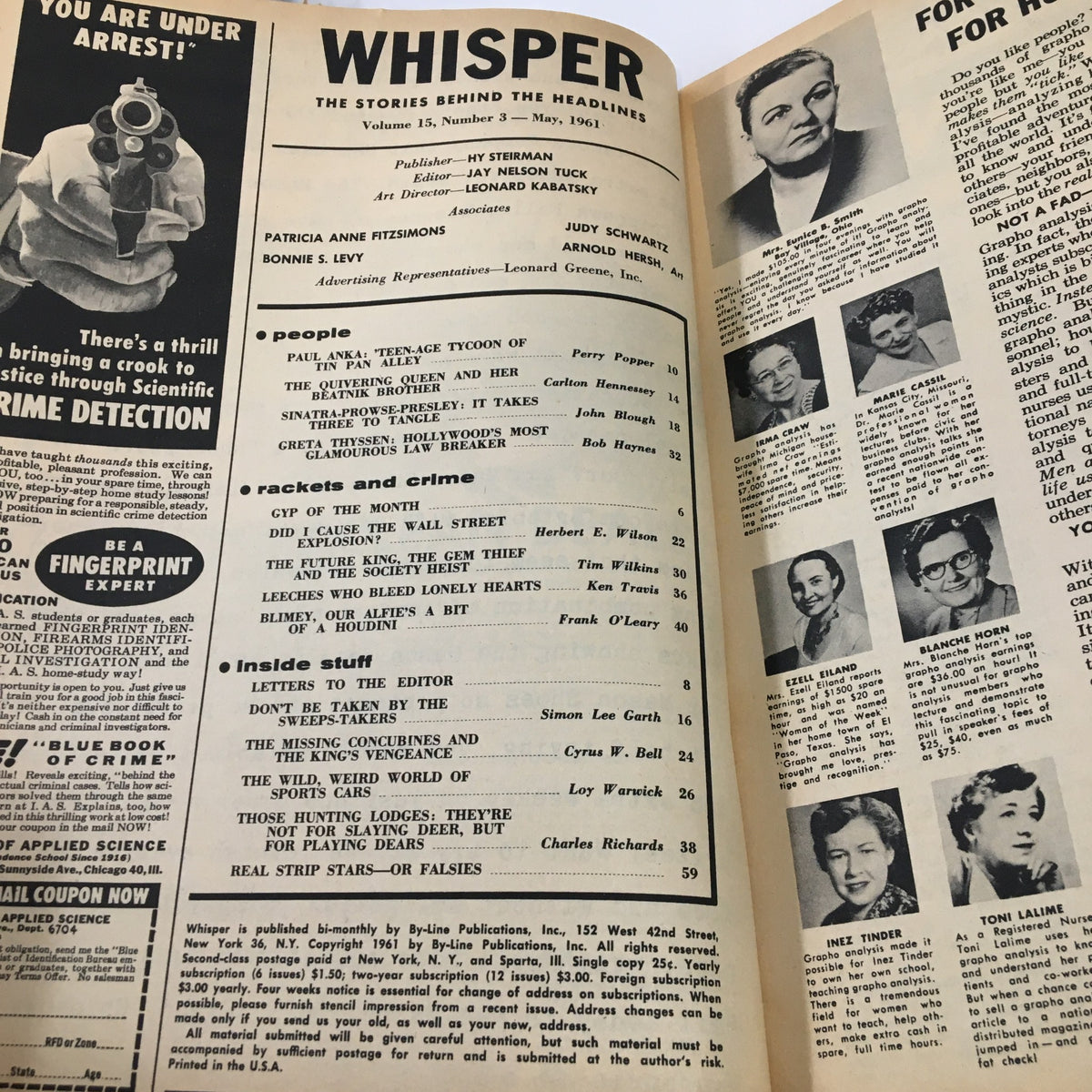
- Juliet Prowse and Elvis Presley cover feature. Coverage of one of early 1961's most discussed celebrity relationships, arriving at the precise moment their public story was at its most commercially and culturally visible — after G.I. Blues and during the period when their relationship's end was still fresh tabloid material.
- Newsstand copy, no label. Sold through retail rather than subscription, preserving the cover without address label damage — a meaningful distinction for a tabloid-format magazine whose subscription copies are far more common in the surviving market.
- Period celebrity gossip content. As a May 1961 Whisper issue, the magazine would have carried coverage of the era's major entertainment figures framed through the gossip press's characteristic lens — a primary source category for researchers of early-1960s celebrity culture that is distinct from and complementary to the mainstream fan press of the same period.
Condition & Rarity
Tabloid-format celebrity magazines from 1961 present specific preservation challenges. Printed on paper stock lighter and more acidic than the glossy stock of mainstream fashion magazines, Whisper and its contemporaries are particularly susceptible to tanning, edge brittleness, and the structural wear that accumulates over six decades of storage. The listing describes this issue as in good overall condition with minor wear throughout — an honest and representative assessment for a newsstand copy of this age. The newsstand origin and absence of any mailing label are the most significant positive condition attributes: the overwhelming majority of surviving Whisper copies from this period were subscription-delivered, and label-free newsstand copies preserve the cover image without adhesive damage or ink impression. The plastic protective sleeve indicates deliberate preservation at some point in the magazine's history. For a tabloid celebrity monthly with an originally modest cover price and no expectation of long-term preservation among its original readership, a surviving copy in good condition with an intact, clean cover represents an above-average example of what the collector market for early-1960s gossip press typically offers.
Looking for More Issues Like This?
A May 1961 Whisper Magazine with an Elvis Presley and Juliet Prowse cover in good newsstand condition is a specific find that serious collectors of early-1960s celebrity ephemera and Elvis memorabilia will recognize as genuinely uncommon. For collectors building an archive of Elvis's magazine presence across his career, the Elvis Presley magazine collection spans his appearances across mainstream and fan press from the 1950s through the 1970s and is the most comprehensive place to continue that search. For collectors interested in the broader early-1960s pop culture moment this issue documents, the 1961 magazine collection covers publications across entertainment, news, and culture from across that pivotal year.