
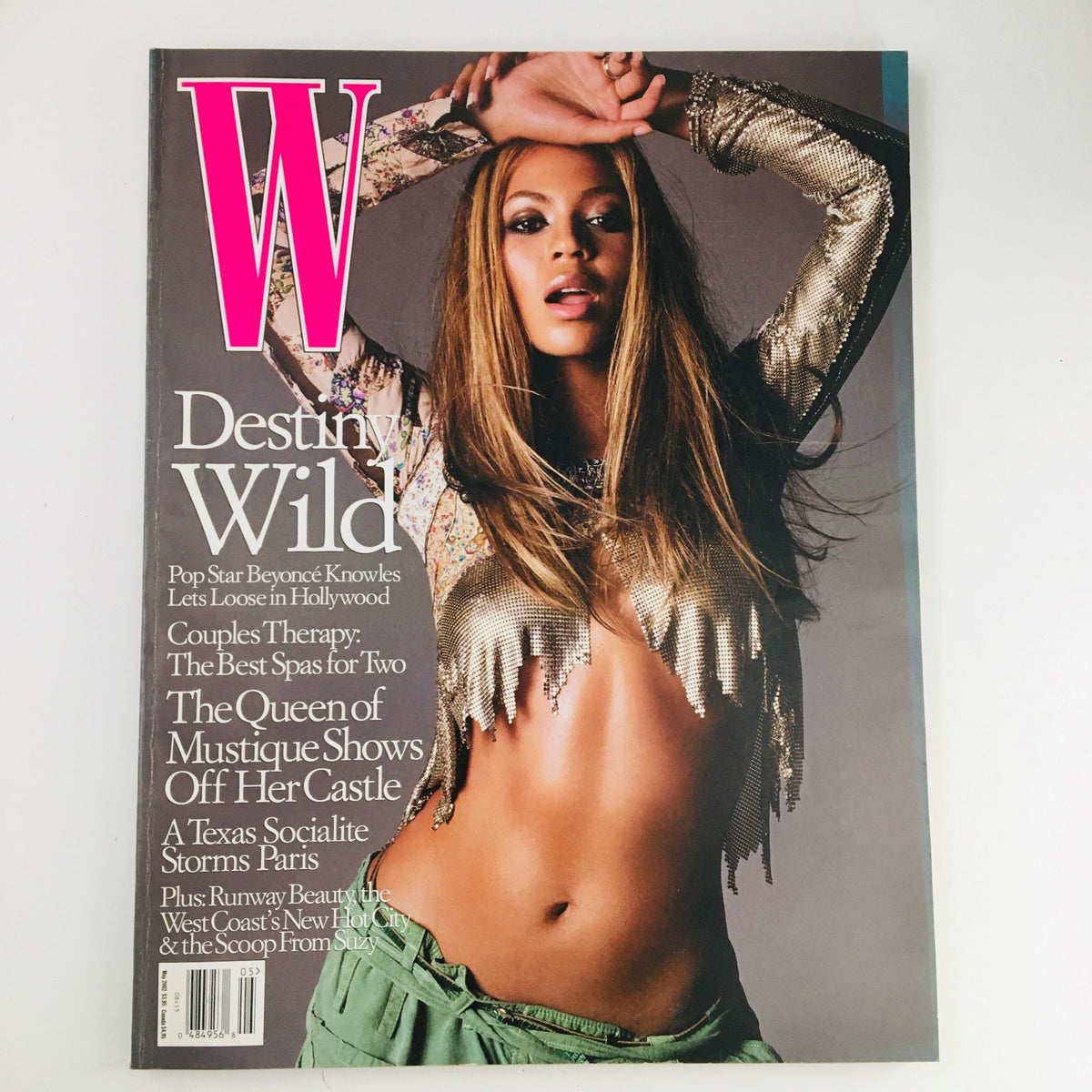

Description
Collector's Note – Why This Issue Matters
May 2002 is a historically specific and culturally significant date for a W Magazine feature on Beyoncé, and the "The Bold & The Bootyfull" title of the feature gives this issue a specific and documentable identity within one of the most consequential early-career moments in the history of American popular music. By May 2002 Beyoncé was at the precise threshold between her Destiny's Child identity and the solo career that would make her one of the most commercially dominant and culturally significant artists of the twenty-first century. Destiny's Child's Survivor album had been released in April 2001 and had produced some of the group's most commercially successful singles; the group's future was publicly uncertain; and Beyoncé's individual profile was building toward the solo debut, Dangerously in Love, that would arrive in June 2003 and establish her as an unambiguous solo superstar. A W Magazine feature on Beyoncé in May 2002 was therefore arriving at the specific transitional moment when her individual celebrity was beginning to exceed her group identity — when the fashion press, the cultural establishment, and the broader public were beginning to recognize that she was becoming something larger and more personally defined than the Destiny's Child framework could fully contain. The feature's title — "The Bold & The Bootyfull" — was a deliberate editorial statement about her specific physical and artistic presence, playing on the daytime soap opera title to make an argument about her combination of visual boldness and performative confidence that reflected W's characteristic way of engaging with celebrity through the language of fashion and aesthetic authority. For collectors researching Beyoncé's extensive print presence across the full arc of her extraordinary career, the Beyoncé magazine collection is the most concentrated resource for tracing her cover appearances and editorial work across the titles and decades that documented her rise.
W Magazine's specific choice to feature Beyoncé in May 2002 carries additional significance as a statement about where the publication saw her positioned within the broader cultural and fashion landscape at that specific moment. W had always operated at the intersection of high fashion and celebrity, addressing its readership as sophisticated observers of both worlds simultaneously, and its decision to engage with Beyoncé in 2002 — before her solo debut had fully established her as a solo superstar — reflected the fashion establishment's recognition that she was already a figure of significant aesthetic and cultural authority rather than merely a commercially successful pop act. The "Bold & Bootyfull" framing was itself a specific and historically interesting editorial choice: it engaged directly with the conversation about Black female beauty, physical confidence, and the relationship between Beyoncé's specific visual presence and mainstream fashion's historically complicated relationship with those qualities — a conversation that would only become more explicitly articulated as her career continued and her cultural significance deepened. A May 2002 W feature engaging with these dimensions of her public identity at this specific pre-solo-debut moment is therefore a more historically layered document than a routine celebrity fashion shoot, produced when the full dimensions of her eventual cultural significance were still being worked out. The W Magazine archive is essential for collectors researching the publication's celebrity and fashion coverage across its most historically significant years. The complete 2002 magazine archive provides broader context for understanding this issue within the full publishing and cultural landscape of an early-2000s moment when the music industry and the fashion world were in active and commercially consequential conversation.
The label-free newsstand provenance of this May 2002 issue adds a dimension of visual authenticity that carries particular weight for a publication as visually deliberate and as art-direction invested as W. The magazine's covers in this period were produced with the full weight of its considerable photographic and design resources, and a label-free copy means the Beyoncé cover portrait and surrounding W design elements can be appreciated exactly as the art director intended — without subscription marking interrupting the composition of what was, even by the standards of a visually ambitious publication, a specific and historically significant editorial image.
About the Publication
W Magazine was founded in 1972 as a spin-off of Women's Wear Daily and established itself across three decades as one of the most visually ambitious and most editorially distinctive fashion publications in the American market — a title that addressed its readership of fashion industry insiders, cultural sophisticates, and serious fashion consumers with the specific combination of high fashion photography, celebrity editorial, and the cultural intelligence that distinguished it from more broadly commercial fashion titles. By May 2002 the magazine was operating at the intersection of its established visual authority and an early-2000s celebrity culture that was producing some of the most commercially significant and most fashion-forward entertainers in the history of American popular music, making its engagement with figures like Beyoncé a natural and editorially consequential expression of its characteristic positioning at the intersection of fashion and celebrity culture.
Key Highlights Inside
- "The Bold & The Bootyfull" feature on Beyoncé — a confirmed W Magazine editorial engagement with one of the most significant figures in the history of American popular music at the specific pre-solo-debut transitional moment of May 2002, when her individual celebrity was beginning to exceed her Destiny's Child group identity and the fashion establishment was recognizing her as a figure of significant aesthetic and cultural authority in her own right.
- Fashion photography and editorial content produced to W Magazine's highest visual standards — a publication in May 2002 whose commitment to photographic ambition and art direction investment gave its celebrity features the specific visual quality that distinguished them from comparable coverage in more broadly commercial fashion titles.
- A label-free newsstand copy preserving the Beyoncé cover portrait and surrounding W design fully intact in their original printed state — for a cover image and feature of this specific historical and cultural significance, the absence of subscription marking means the full editorial composition can be appreciated exactly as its photographer and art director intended.
- Fashion and cultural content consistent with W's May 2002 format — the editorial range of a publication that combined high fashion coverage with the celebrity and cultural commentary that made it essential reading for its specific and sophisticated readership, produced at a specific early-2000s moment when those two worlds were in particularly active and commercially consequential conversation.
- Note: Beyond the confirmed Beyoncé "Bold & Bootyfull" feature and the general fashion and cultural content verifiable from the publication's documented format and date, specific additional article titles, interior photography credits, and full content details have not been independently confirmed for this issue. The highlights above reflect what is verifiable from the named cover subject, confirmed feature title, newsstand designation, date, and the publication's well-documented editorial approach for the period.
Condition & Rarity
Surviving copies of this issue present with the physical characteristics consistent with newsstand copies of a monthly fashion magazine that have been preserved through private ownership over more than two decades. The absence of a mailing label confirms newsstand rather than subscription origin — a positive attribute that preserves the Beyoncé cover portrait and surrounding W design fully intact in their original printed state, without subscription marking interrupting the cover composition. Minor wear at this age is the expected surface characteristic of a well-handled newsstand copy from this period, consistent with a Good grade under standard periodical collecting criteria — fully readable, completely displayable as a cultural and historical artifact, and collectible with the honest patina that distinguishes an authentic survivor. The inclusion of a protective plastic sleeve indicates conscious collectible treatment at some point in the magazine's ownership history, a circumstance that reliably correlates with better interior page condition and cover integrity than copies stored without protection. Early-2000s W Magazine issues featuring Beyoncé at the specific pre-solo-debut transitional moment of her career represent a specific and historically well-defined category within the vintage fashion magazine collector market — covers that document one of the most significant artists in the history of American popular music at the precise moment when the fashion establishment was recognizing her individual cultural authority, through the editorial lens of the publication whose visual ambition and cultural intelligence made that recognition most meaningful.
Looking for More Issues Like This?
Early-2000s W Magazine covers featuring Beyoncé at the transitional opening of her solo career are among the more historically specific and culturally resonant finds in the vintage American fashion magazine collector market — documents of a specific and consequential moment in one of the most significant careers in American popular music, covered through the editorial lens of a publication whose visual authority and cultural sophistication made its engagement with celebrity figures a meaningful institutional endorsement. If this particular May 2002 issue has already been claimed, the Beyoncé magazine collection at OriginalMagazines.com is the most comprehensive resource for finding other issues that document her extraordinary print presence across the full arc of her remarkable career. The full W Magazine archive is equally worth exploring for collectors researching the publication's celebrity and fashion coverage across its most visually and culturally significant decades, and the complete 2002 magazine archive rounds out the picture for anyone researching the early-2000s cultural moment when Beyoncé's individual trajectory was most actively and most historically consequentially in formation.