



Description
Collector's Note – Why This Issue Matters
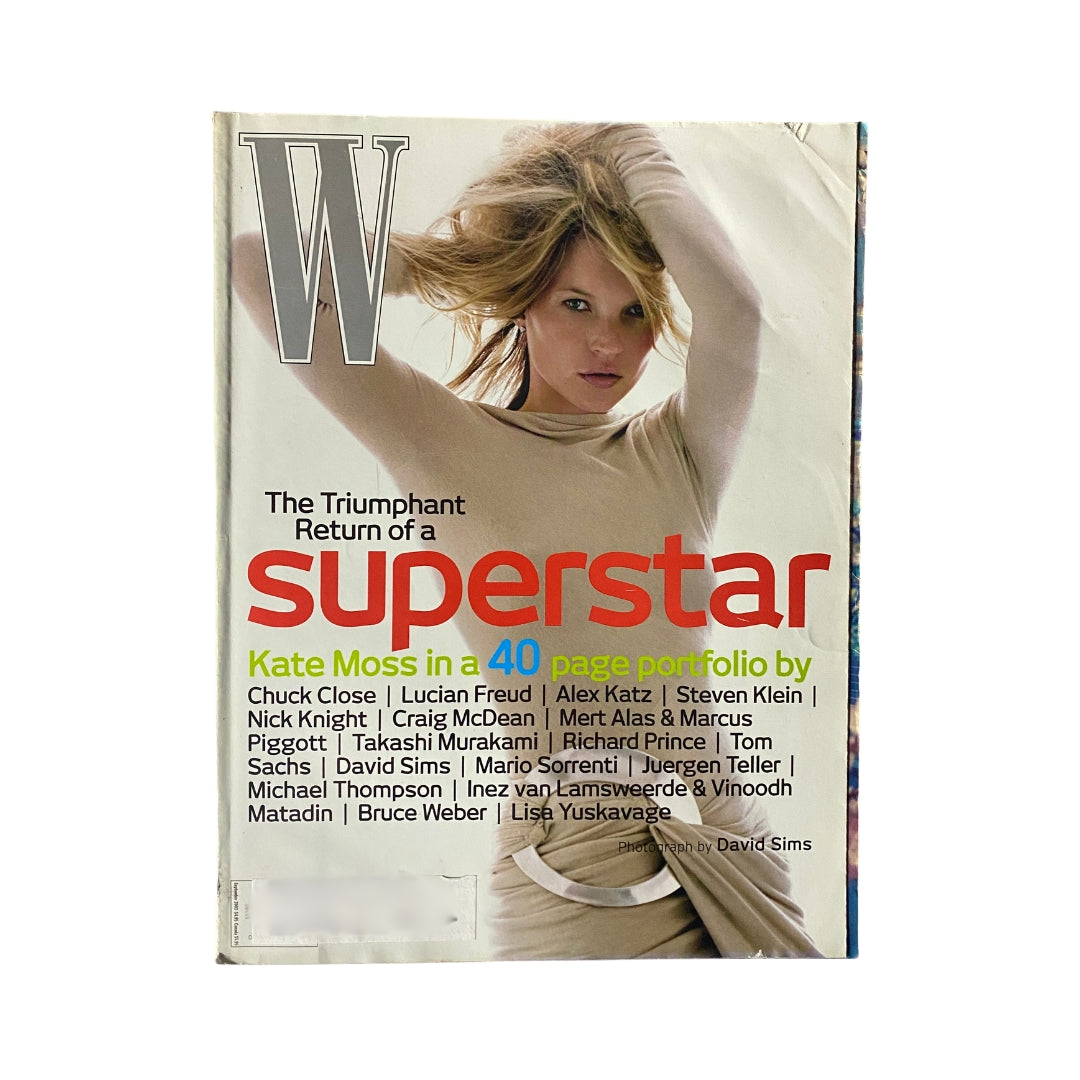
The September 2003 issue of W magazine with Kate Moss on the cover is a primary document of one of the most consequential and durably influential careers in the history of fashion modeling at a specific and revealing moment — more than a decade into her public prominence, still commanding the most editorially significant cover slot in the American fashion publishing calendar, and doing so in a cultural climate that had repeatedly attempted to frame her as transitional or temporary rather than foundational and permanent. Moss had been discovered in 1988 and had risen to international prominence in the early 1990s through her work with photographer Corinne Day and her association with Calvin Klein, where her particular physical type and visual sensibility defined a counter-aesthetic to the dominant supermodel glamour of the period with a force and specificity that reshaped the industry's understanding of what a model could look like and what a photograph could communicate. By September 2003 she had survived every cycle of critical reassessment and commercial recalibration the industry had subjected her to, and her presence on the cover of W's September issue — the most advertising-heavy, most editorially ambitious, and most industry-defining issue any American fashion magazine produces in a given year — was a statement of continued, unambiguous authority. For collectors building a serious archive of Kate Moss magazine covers across her career, this issue documents the specific quality of her staying power at a moment when that staying power had already outlasted most reasonable predictions about the longevity of any single model's dominance.
The September 2003 date situates this issue at a specific and historically interesting transitional moment in fashion culture. The logomania and maximalist luxury of the late 1990s boom — the period defined by conspicuous branding, oversized logos, and the aggressive commercial expansion of the major European houses into mass-market consciousness — was giving way to something more directional and editorially complex, and the confirmed interior features of this issue reflect exactly that cultural negotiation in progress. The James Perse T-shirt story framed around "The New Mr. T" at page 250 represents the refined basics and accessible luxury movement that was becoming one of the dominant aesthetic tendencies of early-2000s fashion — the proposition that a perfectly constructed, undecorated garment could be a more sophisticated statement than any amount of surface decoration or visible branding. The bridal editorial "Romance Language" at page 294, exploring satin, beads, and tulle, represents the couture and romantic construction tradition that continued alongside and in productive tension with that simplicity movement. That both features appear in the same September issue reflects the genuine aesthetic range that W was navigating in 2003, and the additional content addressing color-coded tights and winter accessories situates the issue precisely in its function as a seasonal transition document — the moment when the industry's editorial attention shifts from summer toward the autumn and winter collections. Collectors focused on the complete W magazine archive consistently identify the early-2000s September issues as among the most editorially substantive in the title's history, and this issue provides specific, verifiable evidence of why that reputation is warranted.
The broader context of September 2003 gives this issue a further cultural dimension worth noting for collectors approaching it as a period document rather than purely as a Kate Moss artifact. The fashion industry in 2003 was operating in the specific post-millennial atmosphere shaped by the economic disruptions of 2001 and 2002, the consolidation of the major luxury conglomerates, and the early stirrings of digital culture's challenge to print media's authority as the primary vehicle for fashion communication. None of those disruptions had yet materially altered the fundamental structure of the industry's relationship with print — September 2003 was still a moment when a W September cover could function as a definitive cultural statement in a way that would become progressively harder to claim as the decade advanced. The issue therefore documents not only a specific moment in Moss's career and in W's editorial history but a specific moment in the history of fashion publishing itself — one of the last years before digital fragmentation began to redistribute the cultural authority that September issues of major fashion magazines had accumulated over decades. Among magazines from 2003, the September fashion titles represent the year's most concentrated editorial ambition at what was, in retrospect, a historically significant late peak of print's dominance over fashion culture.
About the Publication
W is an American fashion magazine with origins in the trade newspaper Women's Wear Daily, published by Fairchild Publications, evolving into a standalone consumer magazine in 1972 and establishing itself over the following decades as one of the most visually and editorially distinctive titles in American fashion publishing. Its defining characteristics — an oversized format that gave its photography more visual authority than standard-format competitors, a commitment to extended editorial fashion stories that could run across many pages without commercial interruption, and an editorial willingness to engage with fashion as cultural and artistic commentary rather than purely as consumer guidance — gave it a specific and durable position within the fashion press that no direct competitor fully occupied. By 2003, operating under the Condé Nast umbrella following that company's acquisition of Fairchild, W maintained the editorial ambitions that had defined it since its consumer magazine origins, with its September issue consistently representing the most substantial single editorial and commercial production the title undertook in any given year. Its readership comprised fashion industry professionals, serious enthusiasts, and culturally engaged general readers whose investment in fashion as a subject of genuine intellectual and aesthetic interest distinguished them from the broader audience of mainstream fashion monthlies.
Key Highlights Inside
- Kate Moss cover — September issue, 2003 — Primary W documentation of Moss's continued preeminence in high fashion more than a decade into her career, in the publication's most editorially significant issue of the year, providing a specific and dateable reference point for collectors tracing the full arc of her magazine cover presence across the 1990s and 2000s.
- "The New Mr. T" — page 250, James Perse T-shirts — A confirmed interior feature engaging with the refined basics and accessible luxury movement that was one of the defining aesthetic tendencies of early-2000s fashion, framing a deliberately simple garment category as a statement of sophisticated taste — a proposition that reflected genuine industry-wide debates about the direction fashion was moving after the logomania of the late 1990s.
- "Romance Language" — page 294, satin, beads, and tulle — A confirmed bridal-focused editorial representing the couture and romantic construction tradition, appearing in productive aesthetic tension within the same issue as the Perse simplicity feature and documenting the full range of early-2000s fashion's simultaneous aesthetic commitments rather than any single dominant tendency.
- Color-coded tights and winter accessories editorial content — Confirmed additional fashion content functioning as a seasonal transition document, orienting readers toward autumn and winter looks and situating the issue precisely within W's September role as the primary annual vehicle for the industry's directional shift from summer toward the coming cold-weather collections.
- Advertising content — September 2003 luxury fashion market — The advertising pages of a September W from this period constitute a primary document of the luxury fashion market's commercial landscape at a specific and historically interesting moment, reflecting the brand positioning, campaign aesthetics, and marketing priorities of the major houses at a point of significant industry transition.
Condition & Rarity
Copies of this issue described as being in excellent condition with only light age-appropriate wear represent the upper tier of survivorship for a W magazine from this period — a meaningful distinction given the specific vulnerabilities created by the title's oversized format, which is more susceptible to spine stress, corner compression, and cover surface abrasion during storage and handling than standard-format magazines of equivalent age. The absence of a mailing label places surviving copies in the newsstand-origin category that collectors of fashion titles specifically prioritize, as subscription labels on W were positioned directly over cover imagery and either permanently obscure the photograph or leave adhesive residue and surface damage when removed — damage that is irreversible and that materially affects both display quality and technical grade. A protective plastic covering applied during preservation indicates deliberate archival handling at some point in the copy's history, distinguishing it from the majority of surviving examples that were stored without such protection. W's oversized format was printed on high-quality coated stock that resists yellowing and color degradation significantly better than the newsprint-adjacent papers used by lower-budget publications of the same era, meaning that well-preserved copies retain their original photographic color fidelity and visual impact to a degree that makes condition a particularly consequential variable when evaluating issues from this period. Cover flatness, spine integrity, and page completeness are the primary condition factors collectors should assess in any surviving example of this issue.
Looking for More Issues Like This?
A September issue of W with Kate Moss on the cover in confirmed excellent newsstand condition is a specific and purposeful collecting target — the format's size makes genuinely clean survivors meaningfully less common than equivalent condition copies of standard-format fashion titles from the same year, and the combination of the September editorial significance, the Moss cover, and the confirmed interior features gives this issue a specificity that serious collectors of either the title or the subject will recognize immediately. The Kate Moss magazine collection at OriginalMagazines.com is the most focused resource for collectors tracing her cover presence across publications and decades, spanning the full range of her career from her earliest major appearances through her later editorial work. For collectors building a more complete picture of the title's editorial history across its full run, the W magazine archive covers the publication's decades of production, and the 2003 magazine collection provides the wider early-2000s fashion and culture context for anyone approaching this issue as part of a broader era-focused archive.