

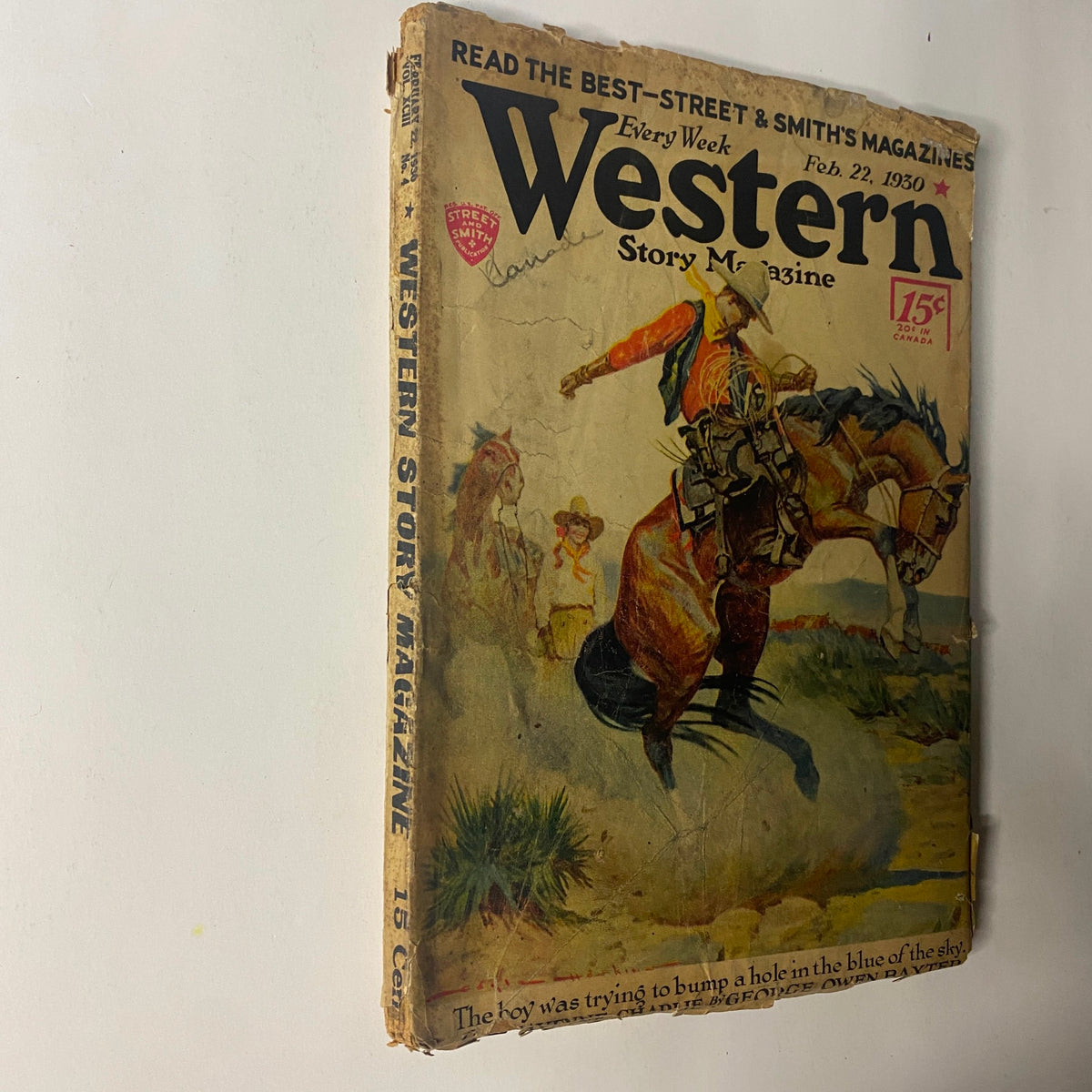


Description
Collector's Note – Why This Issue Matters
This February 22, 1930 issue of Western Story Magazine features the full-length novel "Cayenne Charlie" by George Owen Baxter, one of several pseudonyms used by the extraordinarily prolific pulp writer Frederick Faust, who is far better known to readers and collectors today under his most famous pen name, Max Brand. Notably, this same issue also credits Max Brand directly for the serialized story "Twelve Peers," appearing in its fourth installment, a detail that reflects a well-documented practice among prolific pulp authors of this era, who frequently published under multiple pseudonyms within the same magazine to avoid the appearance of dominating a single issue's contents. Faust was, by any measure, one of the most productive writers in the history of American pulp fiction, and this issue's apparent dual presence under two of his known names offers a particularly rich artifact for collectors interested in tracing his prolific output during this period.
The late 1920s and early 1930s represented a genuine high point for Western pulp fiction as a commercial publishing category, with magazines like Western Story Magazine serving as a primary outlet for an enormous volume of frontier-themed adventure fiction aimed at a broad American readership. This issue's combination of a full-length novel, two separate ongoing six-part serials, and five additional standalone short stories reflects the sheer density of fiction content these pulp magazines packed into a single weekly or biweekly issue, a format designed to offer readers substantial entertainment value at an affordable price point. The presence of established genre contributors like Frank Richardson Pierce and Russell A. Bankson alongside Faust's contributions reflects the broader roster of working pulp writers who sustained this prolific publishing category throughout the era.
Beyond its fiction content, this issue's nonfiction and miscellaneous sections offer a notably wide range of subjects tied loosely to frontier and outdoor themes, including a piece on centuries-old Pueblo ruins, an article on fur farming, and a Wyoming game census report. This breadth of content, extending well beyond pure adventure fiction into natural history and outdoor industry topics, reflects Western Story Magazine's broader editorial identity as a publication serving readers with a general interest in frontier and rural American life, not solely fans of adventure narrative fiction. A dedicated poem, "From Buckaroo to Kalamazoo," further reflects the magazine's inclusion of varied literary formats alongside its core prose fiction offerings.
Taken together, this issue offers a richly detailed cross-section of early-1930s pulp Western publishing, anchored by Faust's apparent dual-pseudonym contributions and extended by additional serialized and standalone fiction from established genre writers. It sits within the broader context of 1930 magazines, capturing a specific, well-documented moment near the height of the American pulp Western's commercial popularity. Few single issues combine this much fiction content from a writer as significant to the genre as Faust within the same set of pages. That density of specific, attributable content is precisely what gives this issue lasting reference value for collectors of vintage pulp fiction.
About the Publication
Western Story Magazine was one of the most significant and long-running pulp fiction publications dedicated specifically to frontier and Western-themed adventure fiction, serving as a primary commercial outlet for this genre throughout the early twentieth century. Its editorial format combined full-length novels, multi-part serialized stories, standalone short fiction, and nonfiction articles loosely connected to frontier, outdoor, and rural American themes, all within a single issue aimed at a broad readership seeking affordable, high-volume entertainment. The magazine relied on a roster of prolific contributing writers, several of whom, like Frederick Faust, published under multiple pseudonyms to sustain the enormous volume of content these weekly and biweekly pulp magazines required. By 1930, Western Story Magazine had established itself as one of the defining publications within the broader pulp Western genre, helping to shape much of the narrative conventions and frontier mythology that would later influence American Western fiction and film more broadly. The magazine's audience consisted of readers specifically drawn to frontier adventure narratives, though its content also extended into natural history, outdoor industry, and rural lifestyle topics reflecting a broader engagement with American frontier culture beyond fiction alone. This February 1930 issue reflects that established editorial format at a particularly active period in the magazine's publishing history.
Key Highlights Inside
- "Cayenne Charlie," a full-length novel credited to George Owen Baxter, one of several pseudonyms used by prolific pulp writer Frederick Faust, better known as Max Brand. This novel anchors the issue as its primary fiction offering. Faust's extensive use of multiple pseudonyms throughout his career adds particular historical interest to this credited byline.
- "Twelve Peers," the fourth installment of a six-part serial credited directly to Max Brand, Frederick Faust's most widely recognized pseudonym. This serial's presence alongside the Baxter-credited novel reflects a well-documented pulp-era practice of prolific authors publishing under multiple names within a single issue. Together, these two credits offer a particularly rich artifact connected to one of pulp fiction's most significant writers.
- "Riders of the Breaks," the fifth installment of a six-part serial by Russell A. Bankson. This serial reflects the issue's substantial commitment to ongoing, multi-week Western fiction narratives. Its advanced installment number situates it as a sustained storyline within the magazine's broader publishing run.
- "Dad Simms Breaks Trail," a short story by Frank Richardson Pierce, an established contributor to Western pulp fiction during this period. This piece adds further genre fiction depth to the issue's substantial fiction lineup. Pierce's broader body of pulp Western writing situates this story within a well-documented body of genre work.
- A range of nonfiction and miscellaneous content tied loosely to frontier and outdoor themes, including pieces on centuries-old Pueblo ruins, fur farming, and a Wyoming game census report. This breadth reflects the magazine's broader editorial identity extending beyond pure adventure fiction. It situates the issue within a wider engagement with American frontier and rural culture topics.
- "From Buckaroo to Kalamazoo," a poem by Harry R. Keller, reflecting the issue's inclusion of varied literary formats alongside its core prose fiction offerings. This piece adds a distinct literary format to the issue's overall content mix. Its inclusion reflects the broader variety pulp magazines of this period often incorporated alongside their primary fiction content.
Condition & Rarity
Condition for pulp fiction magazines of this age and type, now approaching a century old, is generally assessed through paper integrity, binding condition, and the overall legibility of printed text given the inherently lower-grade paper stock these publications were originally printed on. A copy described as acceptable condition with a good interior, showing creases, marks, and light surface wear on the cover along with the possible presence of small rips or blemishes, reflects wear that is genuinely typical for pulp magazines surviving from 1930, given that pulp paper stock was specifically manufactured to be inexpensive and was never intended for long-term archival preservation. The report that pages remain intact and readable despite this cosmetic wear is a meaningful positive indicator for a publication of this type and age, since pulp paper is particularly prone to brittleness and discoloration over multiple decades. A protective plastic covering plays a meaningful role in halting further deterioration, guarding against additional humidity exposure and handling wear going forward. Given the inherently fragile nature of pulp paper stock and the disposable manner in which these magazines were originally treated by their readers, surviving examples from 1930 represent a genuinely scarce category of American pulp fiction collecting, regardless of specific cosmetic condition. Collectors evaluating any surviving copy of this issue should weigh interior page legibility and overall structural completeness above purely cosmetic cover wear, given how inherently fragile this category of periodical tends to be.
Looking for More Issues Like This?
A Western Story Magazine issue from 1930 featuring contributions credited to both of Frederick Faust's known pseudonyms represents a genuinely notable category of American pulp fiction collecting, given how few periodicals from this fragile paper category have survived in readable condition over the past nine decades. If this exact February 1930 issue isn't what you're looking for, the broader 1930 magazines collection brings together printed material from across that year, spanning publications well beyond pulp Western fiction alone. Browsing by year can be a useful approach for collectors who are flexible on the specific publication but committed to a particular slice of early-1930s American periodical history. It also offers a way to see how different categories of period publishing, from general-interest magazines to specialized pulp fiction titles like this one, reflected the broader cultural landscape of the time. For those specifically focused on pulp Western fiction or the work of Frederick Faust under his various pseudonyms, items from this same general window may surface within that same yearly collection alongside other periodicals from different genres. Exploring the full range of available 1930 material is a practical way to find comparable pieces if this exact issue turns out not to be available. Either way, the 1930 collection remains the most direct path to related material from this specific era of American pulp publishing.