


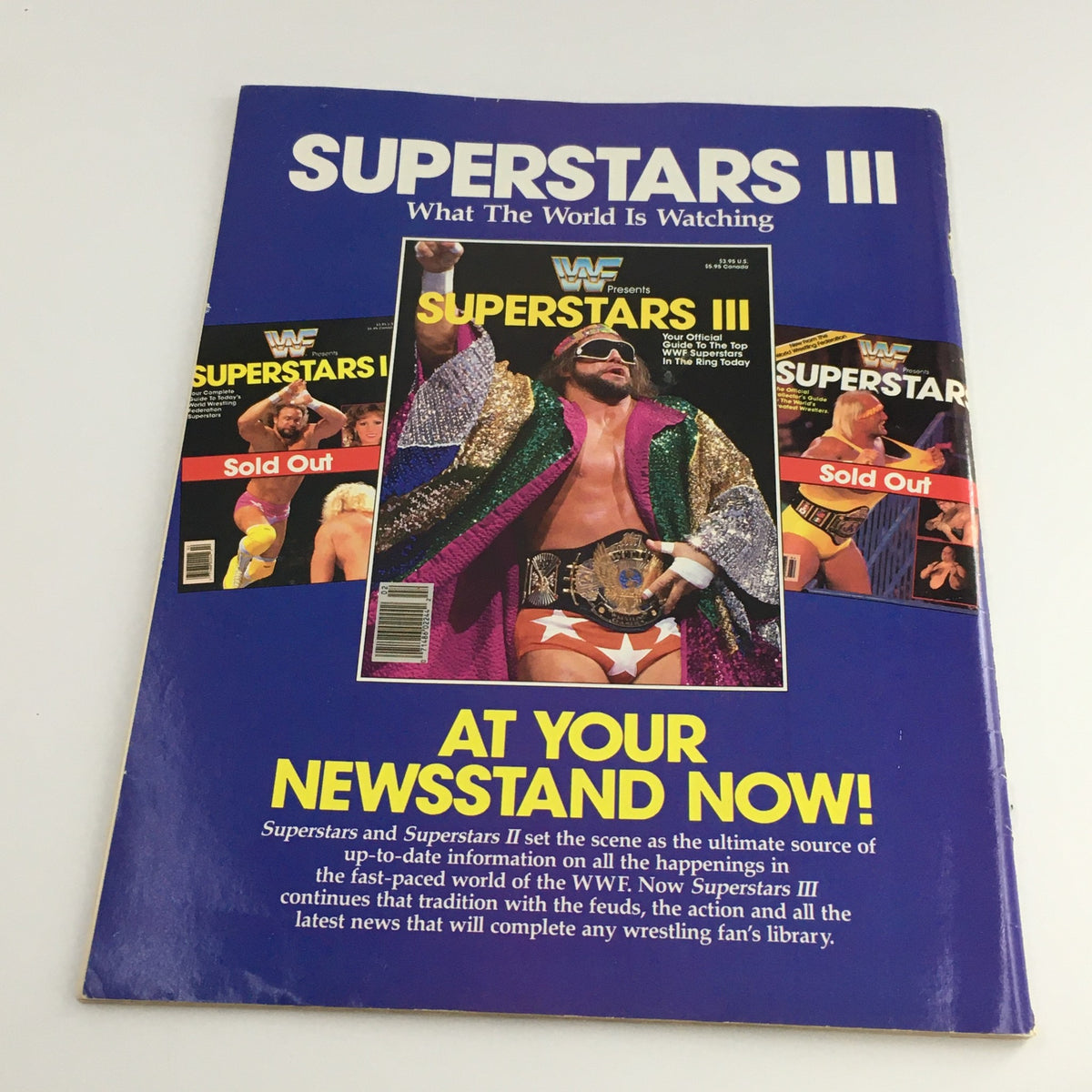


Description
Collector's Note – Why This Issue Matters
November 1988 is a date of genuine historical significance within the WWF's own institutional narrative, and an issue from this precise moment documents the promotion at one of the most commercially and creatively dynamic phases of its modern history. By the autumn of 1988 the WWF under Vince McMahon was operating at the height of the Hulkamania era's commercial infrastructure while simultaneously developing the next generation of characters and storylines that would define the promotion through the early nineties. Randy Savage — "Macho Man" — had completed his transition from the most compelling heel in the company to one of its most beloved babyface figures, having won the WWF Championship at WrestleMania III in 1987 and successfully defended it through 1988, and his presence on the November 1988 cover represents the promotion at its most dramatically engaged and narratively rich phase. The Hart Foundation — Bret Hart and Jim Neidhart — were by November 1988 among the most respected tag teams in the company's history, having been WWF Tag Team Champions and having established a working credibility that made them compelling figures whether as heels or as faces. The Rougeaus — Jacques and Raymond — were a team whose elegant heel work and French-Canadian identity gave the tag team division a specific and memorable character during this period. The convergence of these three acts in a single issue's promotional universe documents the WWF's tag team and upper-card landscape at one of its most fully developed moments. Collectors researching the complete WWF publishing history will find the WWF magazine archive the most concentrated resource for tracing the promotion's official publication across its most commercially significant years.
The specific combination of Randy Savage, the Hart Foundation, and the Rougeaus in a November 1988 WWF Magazine is also a document of a particular chapter in the careers of each act that has specific historical interest for serious collectors. For Savage, late 1988 represented the final months of his first WWF Championship reign — he would lose the title to Hulk Hogan at WrestleMania V in April 1989, completing one of the promotion's most carefully constructed long-term storylines with Miss Elizabeth at its center. For the Hart Foundation, 1988 was a transitional year in which their relationship with Jimmy Hart as manager was evolving and their positioning within the company was being reconfigured in ways that would eventually lead to Bret Hart's emergence as an individual singles competitor of the first rank. For the Rougeaus, this was the period of their most visible heel work, after their 1988 heel turn had given them a renewed promotional identity. A WWF Magazine issue from November 1988 capturing all three acts is therefore a primary document of the promotion's creative ecosystem at a specific and historically interesting moment of simultaneous transition across multiple storylines. The complete 1988 magazine archive provides essential context for understanding how this issue fits within the broader publishing and sports entertainment landscape of the year the WWF's first great commercial era was reaching its narrative conclusion.
The broader significance of WWF Magazine as a publishing artifact in November 1988 deserves appreciation from collectors who approach it as a document of sports entertainment media rather than purely as wrestling memorabilia. By 1988 the WWF had refined its official magazine into a sophisticated narrative extension of its television and pay-per-view storytelling — a publication that maintained kayfabe with the same discipline as its broadcast content while providing the kind of extended character and storyline content that weekly television couldn't always accommodate. The magazine's treatment of the Savage-Hart Foundation-Rougeaus universe in November 1988 reflects the promotion operating with full creative confidence in its own storytelling system, producing editorial content that rewarded the devoted reader's investment in the promotion's ongoing narratives with the depth and detail that defined the WWF's relationship with its most engaged fans.
About the Publication
WWF Magazine was the official publication of the World Wrestling Federation, functioning as a primary narrative extension of the promotion's television and pay-per-view storytelling beyond the broadcast schedule. By November 1988 the magazine was operating at the height of the promotion's first great commercial era, producing content calibrated to reward the most devoted segment of the WWF's fanbase with character profiles, behind-the-scenes content, and the kind of kayfabe-maintained editorial coverage that reinforced and extended the storylines driving the television product. Its issues from the late eighties are primary documents of the McMahon-era WWF's creative and promotional approach at its most fully developed, produced by a publication that understood its role as a complement to rather than a substitute for the live and broadcast experience.
Key Highlights Inside
- Coverage of Randy Savage at a historically specific point in his first WWF Championship reign — November 1988, the final months before his WrestleMania V loss to Hulk Hogan would complete one of the promotion's most elaborately constructed long-term narratives, with the Savage-Elizabeth-Hogan triangle at its dramatic center.
- Coverage of the Hart Foundation — Bret Hart and Jim Neidhart — during their 1988 positioning within the WWF's tag team and upper-card landscape, documenting a team whose combination of working credibility and promotional versatility made them among the most respected acts in the company during this period of the promotion's history.
- Coverage of the Rougeaus — Jacques and Raymond — during the heel phase that gave them their most visible WWF identity, capturing a tag team whose particular character and working style gave the promotion's tag division a specific and memorable dimension during the late-eighties period.
- Editorial content consistent with WWF Magazine's late-eighties format — the kayfabe-maintained character profiles, event coverage, and behind-the-scenes content that made the official publication a valued companion to the television product for the promotion's most engaged fans.
- Note: The listing confirms an address label on the front cover as a condition attribute. Beyond the confirmed Savage, Hart Foundation, and Rougeaus coverage, specific article titles, additional featured talent, and full interior content details have not been independently confirmed for this issue. The highlights above reflect what is verifiable from the named cover subjects, date, and the publication's well-documented editorial format and approach for the period.
Condition & Rarity
Surviving copies of this issue present with the physical characteristics consistent with subscription copies of a monthly wrestling publication that have passed through private ownership over more than three decades. The presence of an address label on the front cover confirms subscription rather than newsstand origin — a condition attribute that affects the cover face directly and that collectors evaluating any surviving copy of this issue should assess carefully against available photographs to determine the label's placement relative to the cover imagery and its impact on the visual presentation of the cover as a display object. Minor wear consistent with age is the expected surface characteristic of a well-handled subscription copy from this period, consistent with a Good grade under standard periodical collecting criteria — fully readable, completely displayable as a historical artifact, and collectible with the honest patina that distinguishes an authentic survivor. The inclusion of a protective plastic sleeve indicates conscious collectible treatment at some point in the magazine's ownership history, a circumstance that reliably correlates with better interior page condition and staple integrity than copies stored without protection. Late-eighties WWF Magazine issues from the Randy Savage championship reign — particularly those documenting the Hart Foundation and the Rougeaus in their most historically specific 1988 iterations — represent a specific and well-defined category within the professional wrestling memorabilia collector market, primary documents from the most commercially successful and narratively sophisticated phase of the WWF's first great promotional era.
Looking for More Issues Like This?
Late-eighties WWF Magazine issues from the Randy Savage championship era — and particularly those capturing the Hart Foundation and Rougeaus in their most historically specific late-eighties iterations — are among the more narratively rich and historically specific items in the professional wrestling memorabilia collector market, primary documents from the WWF's first great commercial era at its most fully developed creative phase. If this particular November 1988 issue has already been claimed, the full WWF magazine archive at OriginalMagazines.com is the most comprehensive resource for finding other issues from the promotion's most historically significant publishing years, including additional numbers from the late-eighties period when the Savage championship reign was building toward its WrestleMania V conclusion. Collectors building a wider picture of the 1988 wrestling and sports entertainment landscape will also find the complete 1988 magazine archive an invaluable reference — spanning titles across the full spectrum of that year's output and offering essential context for anyone researching the late-eighties WWF, the careers of Randy Savage, Bret Hart, and their contemporaries, and the sports entertainment media that documented and shaped the promotion's most commercially consequential era.