




Description
Collector's Note – Why This Issue Matters
The August 1981 issue of Young Miss Magazine is a primary document of American teen girl culture at a specific and culturally interesting moment — the summer between the end of the Carter years' cultural uncertainty and the early Reagan era's emerging sense of commercial confidence and aesthetic direction. Young Miss occupied a specific position in the teen magazine landscape of the late 1970s and early 1980s, targeting younger teenage girls with a mix of fashion, beauty, relationships, entertainment, and the practical concerns of adolescent life that distinguished it from the more sophisticated Seventeen or the more pop-culture-focused Tiger Beat. An August issue — back-to-school season — was editorially significant for a publication aimed at teenage girls, when fashion, beauty, and social preparation for the new school year converged in a single issue's content. The "August 1981 Countdown Calendar" feature noted in the title suggests the kind of interactive, participatory content that Young Miss excelled at — content that encouraged readers to engage with the publication as an active tool for organizing their lives rather than simply as reading material. Collectors building a comprehensive picture of early-1980s American teen culture across multiple publication types will find that 1981 magazine issues document a cultural moment that was simultaneously the tail end of the disco era's youth culture and the opening of the decade's more MTV-influenced aesthetic sensibility.
The mention of Broadway star Stephanie Mills as a featured subject in this issue adds a specific and culturally interesting dimension to what might otherwise be read as a purely fashion-and-beauty publication. Mills had become one of the most celebrated young performers on Broadway through her role as Dorothy in The Wiz — the all-Black cast production that ran from 1975 to 1979 — and had subsequently transitioned into a successful recording career with the 1979 hit "What Cha Gonna Do with My Lovin'" and the 1980 smash "Never Knew Love Like This Before," which won her a Grammy Award. Her inclusion in a Young Miss feature in August 1981 documents her visibility with a teenage female audience at the peak of her crossover success from theater to pop music, and it also reflects Young Miss's commitment to featuring Black entertainers and role models in its pages — a editorial choice that positioned the magazine as more broadly inclusive than some of its competitors. That specific cultural detail gives this issue a documentary dimension that extends beyond its fashion and beauty content into the broader landscape of early-1980s American popular culture.
August 1981 also sits at a specific moment in the broader American cultural calendar that collectors should understand as context for the issue's content. The first MTV broadcast had taken place just two weeks before this issue's approximate on-sale date — August 1, 1981 — marking the beginning of one of the most significant transformations in American youth culture of the decade. The fashion and beauty content documented in this Young Miss issue therefore represents the aesthetic sensibility of the teen girl market at the precise threshold of the MTV era, before the visual culture of music video had fully reshaped how young women consumed and understood fashion and celebrity. That transitional positioning — just before a major cultural shift — gives primary documents from August 1981 a specific historical interest for researchers and collectors working to understand how American teen culture evolved across the decade.
About the Publication
Young Miss Magazine — originally published as Calling All Girls before rebranding — was a Gruner + Jahr publication aimed at the younger end of the teenage girl demographic, typically positioned for readers aged twelve to sixteen who were considered slightly younger than the core Seventeen audience. Its editorial format combined fashion and beauty content calibrated to its readers' age and budget, relationship and social advice columns, entertainment coverage including film, television, and music, fiction, and the kind of practical how-to content — beauty tips, style guides, seasonal preparation features — that gave the magazine its utility as a regular companion through the school year. By 1981, Young Miss had established itself as a consistent and trusted voice for its specific demographic, and its August issues in particular carried the editorial weight of the back-to-school transition that was among the most commercially and editorially significant moments in the teen magazine publishing calendar.
Key Highlights Inside
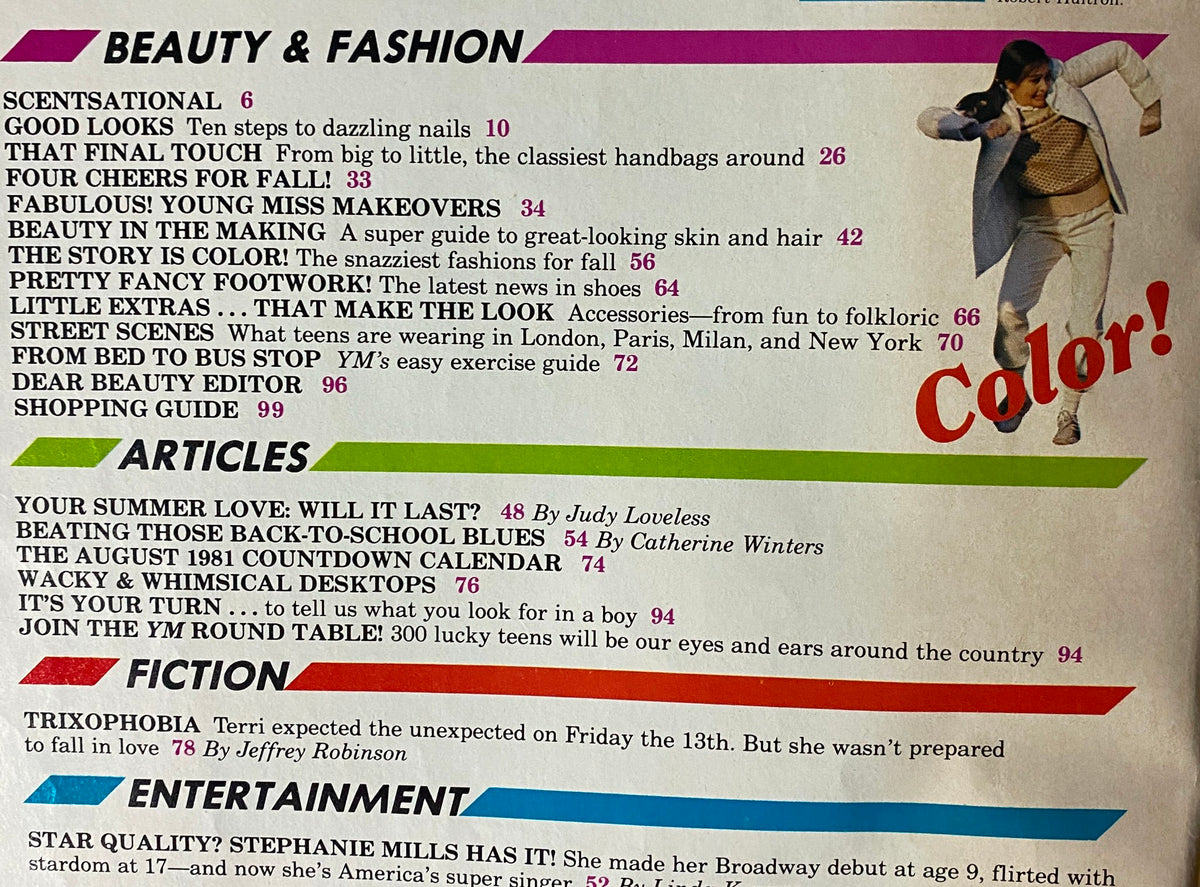
- Stephanie Mills feature — a profile of the Grammy Award-winning performer at the height of her crossover visibility from Broadway stardom in The Wiz to pop music success, documenting her presence in the early-1980s teen girl cultural landscape and reflecting Young Miss's editorial commitment to featuring Black entertainment figures in its pages.
- "The August 1981 Countdown Calendar" feature — an interactive editorial element consistent with Young Miss's approach to reader participation, providing the kind of practical, life-organizing content that distinguished the publication from more passive reading experiences.
- Beauty content covering nail trends and the latest developments in teen-oriented cosmetics — a primary document of the specific beauty aesthetics that defined early-1980s teen girl culture at the precise transitional moment between the late-1970s natural look and the more dramatically styled decade that MTV would help accelerate.
- Fashion coverage of seasonal handbags, footwear, and back-to-school style — capturing the specific aesthetic direction of the teen fashion market in August 1981, when the decade's defining visual sensibility was just beginning to coalesce.
- Exercise and wellness content consistent with Young Miss's practical life-advice format — reflecting the early-1980s fitness consciousness that was beginning to permeate teen girl culture alongside the aerobics boom and the health-and-beauty convergence that would define much of the decade's wellness messaging.
Condition & Rarity
Excellent condition with light wear typical for age is a strong and meaningful grade for a Young Miss Magazine issue from August 1981 now more than forty years old, and the specific preservation attributes noted make this a particularly well-maintained example within the surviving population of this publication. Excellent condition indicates a copy showing essentially no meaningful handling wear — light surface aging consistent with careful storage rather than active use, with overall presentation quality that reflects deliberate preservation. Teen magazines of this era were typically read actively and enthusiastically by their original audience — they were passed between friends, clipped for bedroom bulletin boards, and used as practical reference guides — and copies in excellent condition represent a genuine minority of survivors that were either preserved with collecting intent from the time of purchase or stored immediately without significant engagement. A protective plastic covering applied to a copy in this condition indicates ongoing preservation intent consistent with the excellent overall grade, providing continued protection for a publication being maintained as a collectible artifact rather than a discarded reading copy.
Looking for More Issues Like This?
Excellent-condition copies of Young Miss Magazine from the summer of 1981 — particularly those with documented celebrity features and the specific back-to-school content that made August issues editorially significant — are among the more specifically preserved examples in the collector market for this publication, and locating them requires consistent attention to what surfaces across the vintage teen magazine market. Collectors building a comprehensive picture of early-1980s American teen culture across multiple publication types will find the complete 1981 magazine collection a valuable resource for locating other titles and issues that document this particular cultural moment — standing at the threshold of MTV, the Reagan era's emerging aesthetic, and the decade's most significant shifts in how young Americans understood fashion, music, and celebrity — from the multiple perspectives that serious archival collecting rewards.