
A Dream on the Mall: Ebony Magazine and the March on Washington
How the November 1963 issue transformed history into heritage for Black America
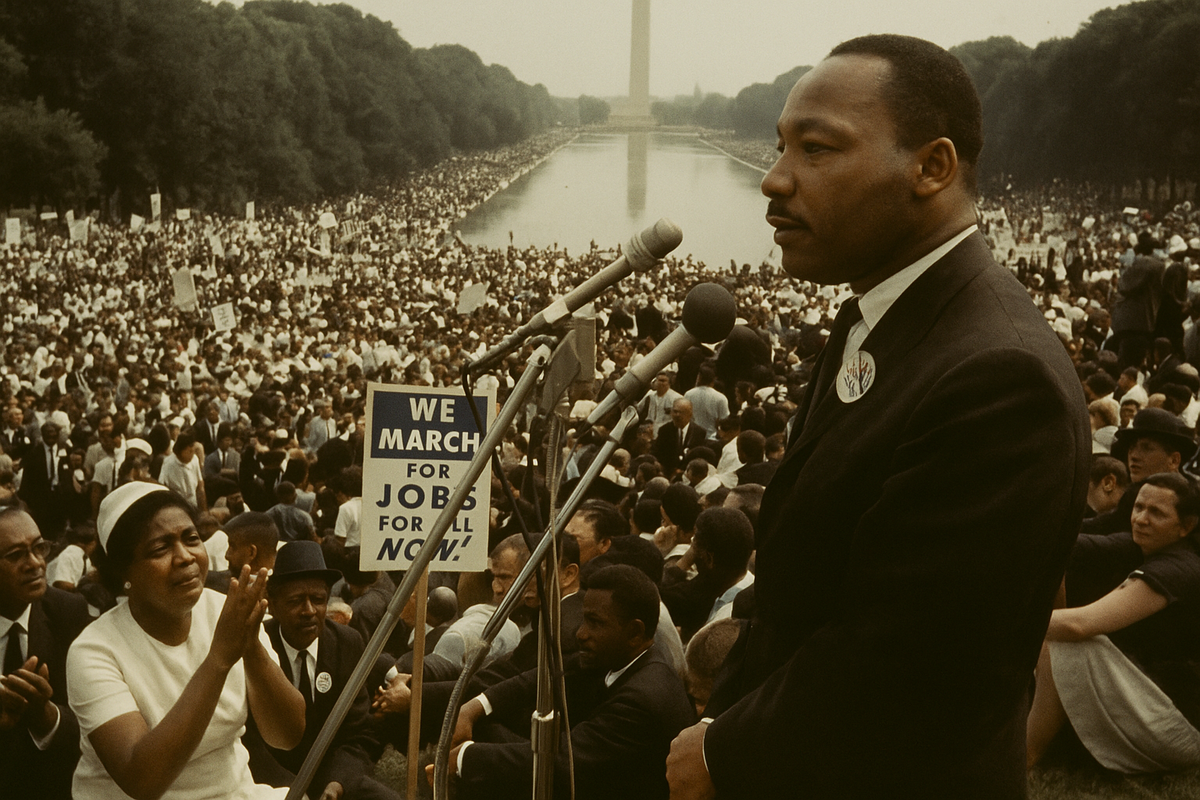
November 1963. A Black family in Chicago tears open their mailbox and pulls out the latest Ebony. No celebrity on the cover this time. No Lena Horne in evening wear, no Jackie Robinson in his Dodgers uniform. Instead: a sea of humanity stretching toward the Lincoln Memorial—a quarter million strong, and most of them look like the family holding the magazine.
This wasn't just another issue. This was proof.
For African American households across the country, Ebony had always been more than a magazine—it was a mirror, a record, a witness. But the November 1963 issue did something unprecedented: it transformed the March on Washington into an artifact families could hold, study, and pass down. When Dr. Martin Luther King Jr. delivered his "I Have a Dream" speech on August 28, most Black Americans experienced it through radio static or secondhand accounts. Three months later, Ebony gave them front-row seats.
The difference wasn't just documentation. It was ownership. This was Black America's story, told by Black journalists, photographed by Black artists, and delivered to Black living rooms where it would be saved, reread, and remembered.
The Summer That Broke Open
By August 1963, America was burning—not just in temperature, but in rage and reckoning. Birmingham's fire hoses had scalded the nation's conscience that spring. Medgar Evers had been murdered in his own driveway in June. Segregation still ruled the South with legal impunity, while Northern liberals offered sympathy without action.
The March for Jobs and Freedom wasn't spontaneous. It was strategic. More than 250,000 people—unionized laborers, clergy in robes, students in their Sunday best, sharecroppers who'd saved for months to afford the bus fare—converged on Washington to demand what should have been guaranteed a century earlier: fair employment, desegregated schools, voting rights, economic justice.
And Dr. King, already the movement's most electrifying voice, stood before the Lincoln Memorial and reimagined the nation: "I have a dream that one day this nation will rise up and live out the true meaning of its creed..."
For Ebony's readers, this wasn't political theater. It was their lives. Their children's futures. Their parents' deferred dreams finally spoken aloud on national soil.
Archive Details
Publication: Ebony Magazine
Issue Date: November 1963
Historical Event: March on Washington for Jobs and Freedom
Key Figure: Dr. Martin Luther King Jr.
Speech Delivered: "I Have a Dream" (August 28, 1963)
Publisher: John H. Johnson
Why Ebony Mattered
Founded in 1945 by John H. Johnson, Ebony had spent eighteen years doing what mainstream American media refused to do: show Black life as it actually existed—complex, ambitious, stylish, striving, and unapologetically full.
While Life and Look occasionally featured Black subjects as problems to be solved or curiosities to be observed, Ebony centered the Black experience with sophistication and pride. It profiled scientists and entrepreneurs alongside entertainers. It covered fashion and civil rights with equal gravitas. It celebrated beauty without apology and documented struggle without sensationalism.
The November 1963 issue embodied this dual mission perfectly. The March on Washington coverage wasn't detached reportage written for white audiences to understand Black grievances. It was immersive storytelling for Black readers to see themselves making history.
Full-page photographs captured raw emotion: men weeping openly, women raising their fists in triumph, children perched on their fathers' shoulders to glimpse greatness. Candid shots placed Dr. King, A. Philip Randolph, John Lewis, and comedian-activist Dick Gregory beside sharecroppers and secretaries—visual democracy in action. Marchers collapsed on the grass in exhaustion. Women cooled their feet in the Reflecting Pool. These weren't the sanitized images of protest the evening news preferred. These were real people claiming their country.
Other publications covered the march. Only Ebony made its readers feel like they'd been there.
The Cover That Chose Courage
The November 1963 cover was a calculated risk. Ebony typically featured glamour: Sammy Davis Jr. in a tuxedo, Dorothy Dandridge in diamonds. Covers sold magazines, and celebrity sold covers.
But this time, John H. Johnson chose a sweeping aerial shot of the march itself—the crowd, the banners, the sheer scale of collective action. No single face. No star power. Just democracy in motion.
For readers accustomed to seeing Black excellence through individual achievement, this was revolutionary. The cover declared: We are the story. Together.
Inside: History in Photojournalism
The photo essay titled "Biggest Protest March" unfolded like a visual symphony, each image building toward King's climactic speech.
Mahalia Jackson's Prelude
She sang "I been 'buked and I been scorned" with such spiritual force that the crowd fell silent, preparing sacred ground for what would follow. Ebony captured her mid-note, head tilted back, summoning something older than politics.
King's Dream
The article didn't just quote his words—it showed their impact. One photograph froze the moment: grown men with tears streaming, women clutching their chests, teenagers staring upward as if witnessing something holy.
Generations in Dialogue
A. Philip Randolph, who'd first proposed a march on Washington in 1941, stood alongside 23-year-old John Lewis of the Student Nonviolent Coordinating Committee. The photograph captured movements inherited, carried forward, passed on.
Coalition in Practice
White allies standing shoulder to shoulder with Black marchers. Union members from Detroit, rabbis from New York, students from Berkeley—all bound by a shared vision of justice.
The Human Texture
A young couple sharing a sandwich on the grass. An elderly woman fanning herself in the August heat. Teenagers debating next steps. History made in the decision to show up, to stay, to endure.
Signs of Resistance
Protesters carried signs reading "We March for Jobs for All Now!" linking civil rights to economic justice. Each placard a declaration, each slogan a demand for America to become what it claimed to be.
Each photograph worked like evidence in a trial. Together, they argued: We were there. We mattered. We moved the nation.
The Collector's Reckoning
Historical Proximity
Released just three months after the march, this wasn't retrospective analysis. It was immediate history, captured while the nation's attention still burned hot. Readers in 1963 weren't looking back—they were processing the present and imagining the future.
Iconic Imagery
The photographs inside—King at the podium, Randolph among the leadership, the quarter-million-strong crowd—became the visual archive of the movement. These weren't borrowed from wire services. They were Ebony's own.
Cultural Inheritance
For thousands of African American families, this issue sat on coffee tables, in basement storage boxes, in attics wrapped in plastic. It was kept because it meant something. To own it now is to hold what someone else deemed sacred enough to preserve.
Institutional Demand
Museums, universities, and research libraries actively seek milestone Ebony issues. From Brown v. Board coverage to King's assassination memorial issue, these magazines document the Black experience in ways conventional archives overlooked.
This issue isn't paper and ink. It's testimony.
Why This Still Matters
In an age of infinite scroll and algorithmic news feeds, these printed magazines offer something increasingly rare: permanence. Ebony's coverage of the March on Washington was meant to be held, studied, discussed at kitchen tables, and saved for children to inherit. It was journalism as family heirloom.
The stories were read slowly. The photographs were examined, revisited, debated. Nothing disappeared after 24 hours. Nothing got buried under the next crisis. The magazine existed in time—and because it existed in time, it still exists for us.
For Collectors and Historians
If you're searching for Civil Rights milestones, cultural documentation, or the artifacts your ancestors read during America's most pivotal decade, vintage Ebony magazines offer something beyond nostalgia. They offer connection.
Browse Ebony Magazine CollectionWhether you're hunting for the March on Washington issue, celebrity profiles, or the magazine's unflinching coverage of Birmingham, Selma, and Memphis—these are primary sources waiting to be rediscovered.
The Final Word
The November 1963 issue of Ebony Magazine didn't just cover the March on Washington. It elevated it. Through masterful photojournalism and narrative authority, Ebony transformed a political rally into a cultural monument—one that Black readers could claim as their own.
To hold this issue sixty years later is to hold a crossroads moment: when ordinary citizens and courageous leaders gathered on the National Mall and demanded that America live up to its promises. Ebony ensured that moment wouldn't be forgotten, diluted, or whitewashed.
For collectors, historians, and anyone who believes that how we remember the past shapes how we build the future—this magazine isn't just reading material.
It's a reckoning, preserved.