
A Letter from Birmingham Jail: The August 1963 Ebony That Changed America
How one magazine transformed a jailhouse essay into a living document of resistance
When Dr. Martin Luther King Jr. sat down to write in a narrow Birmingham jail cell that April, he had no idea his words would reach millions by summer. But when Americans opened their August 1963 issue of Ebony Magazine, there it was—the complete text of what would become one of the twentieth century's most searing moral documents, published in full between pages devoted to family life, entertainment, and Black excellence.
This wasn't philosophy delivered from an ivory tower. For Ebony's readers, this was a blueprint for survival. A manual for dignity. And proof that the Black freedom struggle had found a platform that refused to be silenced.
Archive Details
Historical Figure: Dr. Martin Luther King Jr.
Issue Date: August 1963
Archive Source: Ebony Magazine
Featured Document: Letter from Birmingham Jail (complete text)
Cover Subject: Nat King Cole and Family
Birmingham Burns, King Writes
The spring of 1963 had turned Birmingham, Alabama—then America's most segregated city—into a battlefield. Black children and adults marched through downtown streets demanding equal access to schools, lunch counters, and basic human dignity. The city's response was medieval: police dogs, fire hoses turned on full blast, mass arrests, and brutality so vicious it shocked even hardened observers.
King was arrested for leading demonstrations without a permit. While confined, he received a published statement from eight white Alabama clergymen urging "patience" and condemning the protests as "unwise and untimely." His response, scrawled in the margins of newspapers and on scraps of paper, became the Letter from Birmingham Jail—a document that would rank alongside the Federalist Papers and Lincoln's speeches in American political thought.
"Justice too long delayed is justice denied," King wrote. He dismantled the moderates' calls for patience, argued that unjust laws carried no moral authority, and declared that silence from the comfortable was more dangerous than violence from the extreme. By August, when Ebony published the letter in its entirety, the nation stood at a crossroads. The March on Washington loomed weeks away. Civil Rights legislation hung in the balance. And King's words landed like thunder.
Why Ebony Mattered
By 1963, Ebony was the most influential African American magazine in the country—and it wasn't close. Founded by John H. Johnson in 1945, it had spent nearly two decades building something unprecedented: a publication that treated Black life with the dignity, sophistication, and cultural breadth that white-owned media refused to provide.
Where mainstream outlets relegated Black voices to crime blotters and problem pieces, Ebony showcased them with pride. Where others saw a "Negro problem," Ebony documented Black achievement, family life, fashion, and political struggle as equally worthy of celebration.
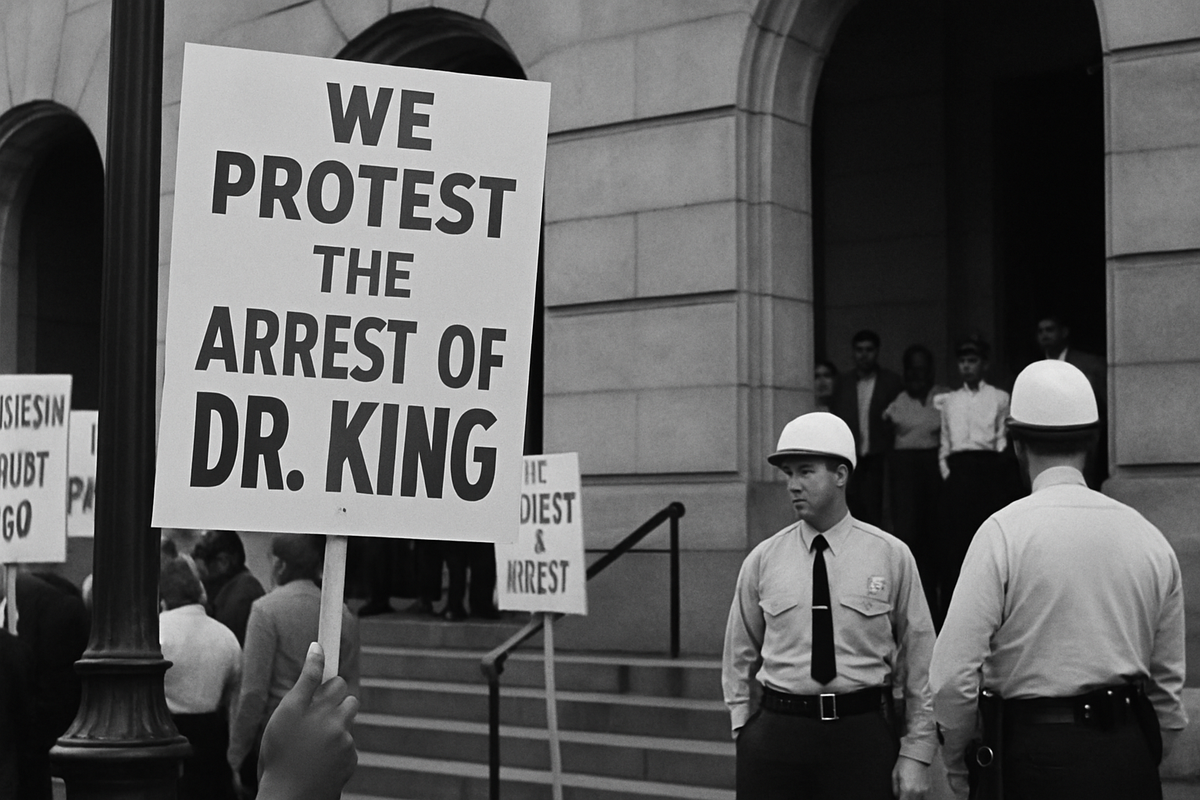
The August 1963 issue embodied this vision. Its pages showed King leaving jail, Coretta Scott King supporting the movement from the shadows, and demonstrators holding "We Protest" signs in cities from Birmingham to St. Louis. Readers saw King not as a distant icon but as a husband, minister, and fellow struggler whose courage came at real cost.
The Power of the Image
The cover featured Nat King Cole and his family—an image of Black success, elegance, and stability. Then readers turned the page and encountered the raw reality of Birmingham. This wasn't contradiction. It was editorial genius. Ebony insisted that African American life couldn't be reduced to struggle alone. It was Sunday dinners and freedom marches. Fashion spreads and jail cells. Normalcy and resistance.
The photojournalism was visceral and documentary-driven:
Dr. King escorted by police, showing how the state criminalized peaceful protest.
Mass protests in St. Louis, proving Birmingham was part of a national uprising.
Coretta Scott King leaving jail with Juanita Abernathy, revealing the families who bore the movement's burden.
Strategy sessions where an exhausted King held his head in his hands between planning the next action.
Protesters with homemade signs reading "We Protest the Arrest of Dr. King"—grassroots solidarity made visible.
Unlike mainstream magazines that presented Civil Rights as distant politics, Ebony's images were intimate and communal. They showed resistance from the inside, giving readers both pride and responsibility.
The Letter's Moral Architecture
Ebony preserved King's argument in full, ensuring readers could engage with the intellectual and moral core of the movement:
King rejected calls to "wait for a more convenient season," insisting that three centuries of waiting was enough.
His most devastating critique targeted white moderates who preferred "negative peace" (the absence of tension) over "positive peace" (the presence of justice).
He drew a sharp distinction: laws that uplift human personality are just; laws that degrade it are unjust and must be resisted.
Accused of being an extremist, King embraced the label and placed himself in the company of Jesus, Amos, Paul, and Lincoln.
He honored ordinary people—children facing dogs, elderly women walking to work during the bus boycott, ministers risking their lives—as the true heroes of the movement.
Each passage was reinforced by Ebony's photographs, making clear these weren't abstractions. They were lived realities.
A Living Document
The endurance of 1960s Ebony magazines stems from their dual role as news and heritage. They were consumed as monthly reading, then saved, treasured, and passed down. Today they remind us of the urgency, hope, and sacrifice that defined an era.
Where newspapers focused on breaking events, Ebony provided context. Where television showed shocking images, Ebony preserved meaning. Its fusion of lifestyle and politics made it accessible to families while advancing the most pressing moral questions of the time.
This is why issues like August 1963 transcend collecting. They are bridges between generations.
Why Collectors Seek This Issue
Published weeks before the March on Washington, it captures King's voice at the exact moment the Civil Rights Movement reached peak national visibility.
It contains the complete Letter from Birmingham Jail, one of the most important American documents of the twentieth century.
The photographs preserve protests, arrests, and community resilience that might otherwise have been lost.
It documents how Black media shaped public consciousness during the movement's defining year.
Like milestone issues featuring athletes and entertainers, Civil Rights documentation holds permanent demand among collectors, educators, and families preserving their heritage.
Owning this issue means holding an artifact of courage, conscience, and cultural memory.
For Collectors and Historians
If you're searching for original issues from this era—whether you collect vintage Ebony magazines, study 1960s Civil Rights documentation, or preserve family history—the August 1963 issue represents the intersection of culture and conscience that defined a generation.
From the 1940s through the 1990s, Ebony chronicled Black achievement, culture, struggle, and joy. Whether you're a seasoned collector or exploring your heritage, each issue is an artifact of pride and progress.
Browse Ebony Magazine CollectionThe August 1963 Ebony Magazine featuring Martin Luther King Jr.'s Letter from Birmingham Jail stands as one of the most significant publications of its era. Its words, urgent and eloquent, called the nation to moral action. Its images, intimate and unflinching, showed the human cost of freedom.
To hold this issue today is to hold a piece of history—a reminder that justice was fought for in streets, jails, pulpits, and homes, and that the voices preserved in its pages still call us to conscience.