
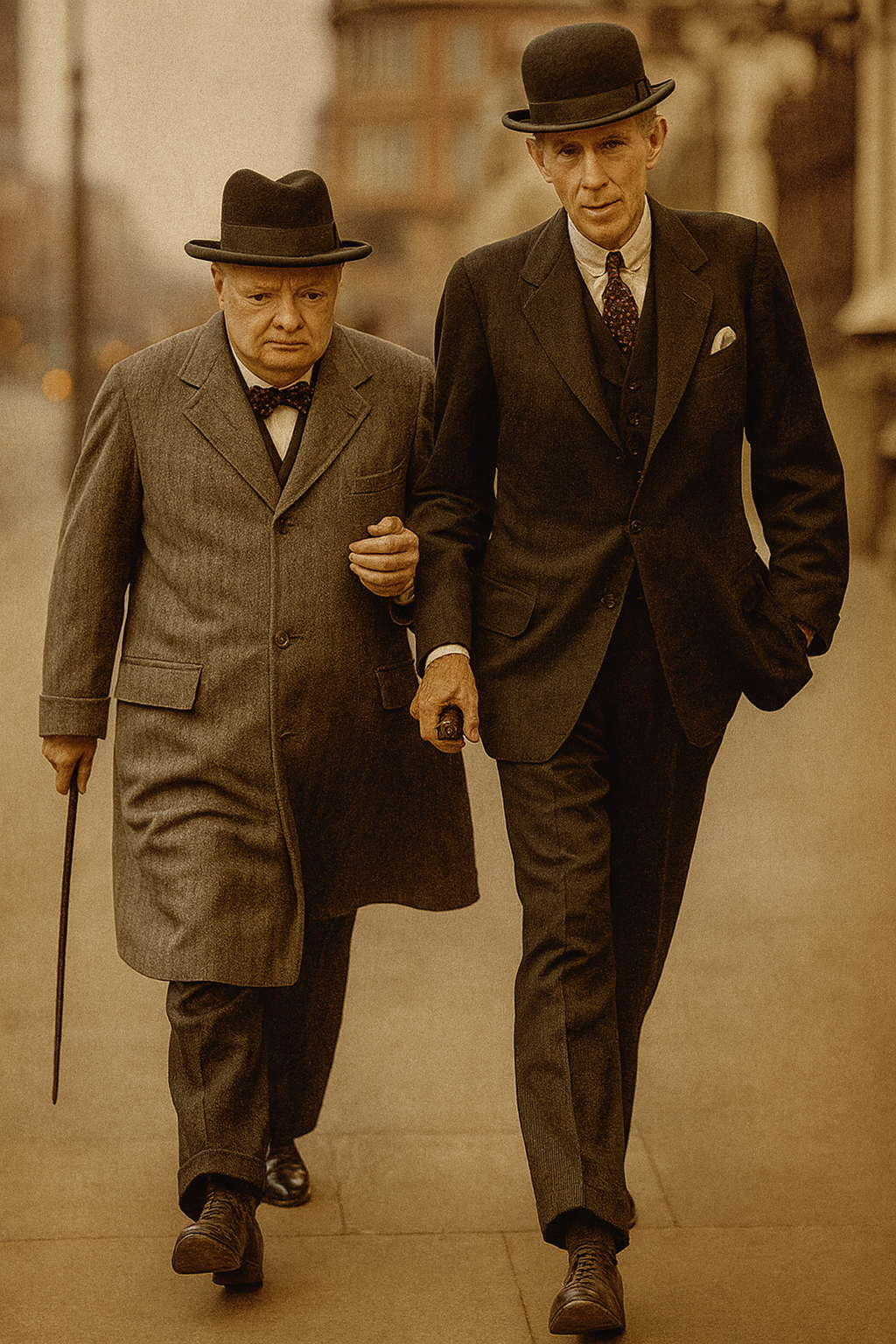
The Man Britain Didn't Trust
How Life Magazine Introduced America to Churchill Eight Months Before War
On January 9, 1939, American families opened their mailboxes to find Winston Churchill staring back at them—not from the cover of Life Magazine, but from an sprawling interior feature that would prove unnervingly prescient. The headline called him "The Peter Pan of British Politics," a barb disguised as whimsy. Eight months before Hitler invaded Poland, Life delivered a portrait of a man his own country considered washed up, dangerous, and politically toxic.
History would prove them catastrophically wrong.
The article by George Dangerfield captured Churchill at his lowest ebb: a 64-year-old backbencher shouting warnings about Nazi Germany that his Conservative colleagues refused to hear. He had burned too many bridges, switched parties twice, and presided over the Gallipoli disaster that killed thousands. The establishment wanted him gone. Life wanted to know why he wouldn't leave.
What American readers encountered that winter morning was something rarer than prophecy—a document that showed exactly what a future legend looked like before the legend began.
Archive Details
Historical Figure: Winston Churchill
Issue Date: January 9, 1939
Archive Source: Life Magazine
Article Author: George Dangerfield
Historical Context: Eight months before World War II began in Europe
The Photograph That Told a Different Story
Life Magazine revolutionized journalism by making one simple bet: that images could carry truth more powerfully than words. The Churchill feature vindicated that gamble spectacularly.
While Dangerfield's text catalogued failures and opportunism, the photographs told a counter-narrative. Here was Churchill captured by Boers during the South African War, then pulling off an escape that made him famous across the British Empire. Here he was piloting his own airplane in the 1920s, painting on the Riviera, playing polo well into middle age. Here was the aristocrat laying bricks at Chartwell, his hands in mortar, building garden walls with the methodical patience of a craftsman.
The magazine included early portraits of his father, Lord Randolph Churchill—the Tory politician whose early death haunted Winston—and his American-born mother, Jennie Jerome, whose trans-Atlantic bloodline would later matter more than anyone imagined. Readers saw wedding day photographs with Clementine Hozier, family scenes at Chartwell, images from his service as First Lord of the Admiralty during World War I.
Then came the spread that crystallized everything: "The Hats of Churchill." A visual catalog of his many identities—Hussar's helmet, silk top hat, homburg, naval cap—each one marking a different incarnation, a different gamble, a different comeback. The man refused to be one thing. He refused to stay down.
For Americans unfamiliar with the complexities of British politics, these photographs did more than illustrate—they argued. They showed someone too vital, too restless, too convinced of his own destiny to accept exile.
Why This Moment Mattered
January 1939 was not a random date. It was the last moment of relative peace before the machinery of war became inevitable.
Hitler's Germany had already annexed Austria. Czechoslovakia was being carved apart. Mussolini had invaded Ethiopia. Japan was extending its campaign of brutality across China. The democracies were paralyzed, and Britain's policy of appeasement had become an international embarrassment.
Churchill had been warning about Hitler since 1933. He had been right about German rearmament, right about the Rhineland, right about the cowardice at Munich. Being right had made him more isolated, not less. His own party considered him a warmonger. Prime Minister Neville Chamberlain wouldn't take his calls.
Yet Life chose this moment to profile him at length—to introduce American readers to a man who seemed destined for irrelevance. The magazine's editorial instinct was impeccable. Within eight months, Britain would be at war. Within sixteen months, Churchill would be Prime Minister.
This issue captured the exact instant before transformation, when the future was still unwritten but the pieces were already in motion.
The "Peter Pan" Paradox
Dangerfield's characterization was damning and accurate. Churchill was the Peter Pan of British politics—a man who refused to age out of relevance, who staged comeback after comeback, who never learned the proper lessons about staying quiet and accepting defeat.
The article opened with Churchill's fiery speech during the 1936 Abdication Crisis, when King Edward VIII gave up the throne for Wallis Simpson. Churchill had defended the King with theatrical passion and been shouted down in Parliament—another miscalculation, another humiliation. Life documented them all: the Boer War heroics that launched his career, the Gallipoli catastrophe that nearly ended it, the party-switching that made him perpetually suspect, the brilliant speeches that never quite translated into power.
But the Peter Pan label contained an accidental insight. Peter Pan doesn't grow up because he inhabits a different kind of time—mythic time, where the rules of ordinary aging and consequence don't apply. Churchill operated in that same register. He didn't just survive political death; he seemed to draw energy from it.
The photographs captured this quality. Churchill painting, Churchill building walls, Churchill surrounded by family—these were not images of a man accepting retirement. They showed someone storing up energy, waiting for the call that conventional wisdom said would never come.
What Made This Issue Collectible
Historical Timing
Published eight months before World War II began in Europe, this issue preserves the last moment when Churchill could plausibly be dismissed as a has-been. Every page carries the dramatic irony of hindsight.
Unique American Perspective
Few American publications profiled Churchill so extensively before the war. Life gave U.S. readers their first sustained look at a figure who would soon become indispensable to the Allied cause.
Photography as Primary Source
The visual timeline—from India and Cuba to World War I to his hobbies and family life—provides researchers with an extraordinary photographic record.
The Dangerfield Text
George Dangerfield's essay is sharp, skeptical, and devoid of the hagiography that would later surround Churchill. It captures contemporary British opinion with unflinching honesty.
Vintage Life magazines from the 1930s are among the most sought-after items in the magazine collecting world. Milestone issues—those that document world leaders on the eve of transformation—carry particular weight. They are not reprints or digital scans. They are original artifacts, physical witnesses to history that can still be held, studied, and preserved.
The Portrait That Aged Into Truth
The enduring power of Life's Churchill feature lies in its refusal to simplify. The magazine didn't present a hero or a villain—it presented a human being whose flaws and virtues were so entangled they couldn't be separated.
Churchill was opportunistic. He had made catastrophic mistakes. He was difficult to work with, often wrong, frequently arrogant. Life documented all of it. But the photographs—of his energy, his defiance, his compulsive activity—suggested something else. They showed a man who couldn't stop, who wouldn't quit, who believed he was meant for something larger than his contemporaries could see.
In January 1939, that belief looked like delusion. By June 1940, when Churchill stood in Parliament and promised to fight on the beaches, it looked like prophecy.
This is what makes the issue so compelling for modern readers. It captures the raw materials of greatness before history had decided what to do with them. It shows us the Churchill who didn't yet know he would be Churchill.
Collecting the Moment Before
For those who value primary historical documents, vintage Life magazines offer something increasingly rare: unmediated access to how events were understood before their outcomes were known. The January 9, 1939 issue is a perfect example—it documents not what happened, but what people thought was happening at the time.
That kind of perspective is impossible to recreate. No historian writing today can fully capture the uncertainty, the skepticism, the failure to see what was coming. But this magazine can. It freezes that moment of not-knowing and preserves it.
Whether you collect World War II history, 20th-century journalism, or the cultural artifacts of American life between the wars, this issue belongs in the archive. It is biography, journalism, and prophecy—all contained in pages that were meant to be read once and discarded, but have instead become witnesses to one of history's great turning points.
Why Collectors Value This Issue
Before the Legend
This issue documents Churchill before his wartime apotheosis—when he was still controversial, still doubted, still fighting for relevance. It's a rare glimpse at greatness before the world recognized it.
Photographic Archive
The extensive photo spreads—including the famous "Hats of Churchill" feature—provide visual documentation unavailable in most other sources from this period.
Contemporary Opinion
George Dangerfield's skeptical assessment captures how Churchill's peers actually viewed him in 1939, offering invaluable perspective for historians and researchers.
Material History
As an original artifact from January 1939, this magazine is a physical connection to the last moment of peace before World War II—a tangible piece of that pivotal era.
Explore the Archive
If you're drawn to this era—to the moment when photojournalism transformed how Americans understood the world—our collection of original Life magazines spans from the 1930s through the 1970s.
Browse Life Magazine CollectionFor collectors, historians, and anyone preserving the material culture of the 20th century.
Final Thoughts
The January 9, 1939 Life Magazine captured Winston Churchill at the most precarious moment of his career—distrusted, isolated, and seemingly finished. Yet Life's photographers and writers preserved something essential: the restless energy of a man who refused to accept history's verdict.
Within months, history would revise that verdict. Churchill would become Prime Minister. Britain would stand alone. The man they called Peter Pan would deliver the speeches that defined an era.
But in January 1939, none of that had happened yet. This magazine shows us the before—the moment when greatness was still just stubbornness, genius was still just contrarianism, and destiny was still just an old man's delusion.
That's what makes it invaluable.