
The Last Moment Before America Knew
Life Magazine's June 12, 1964 Issue and the First Mass-Circulation Evidence of Vietnam's Reality
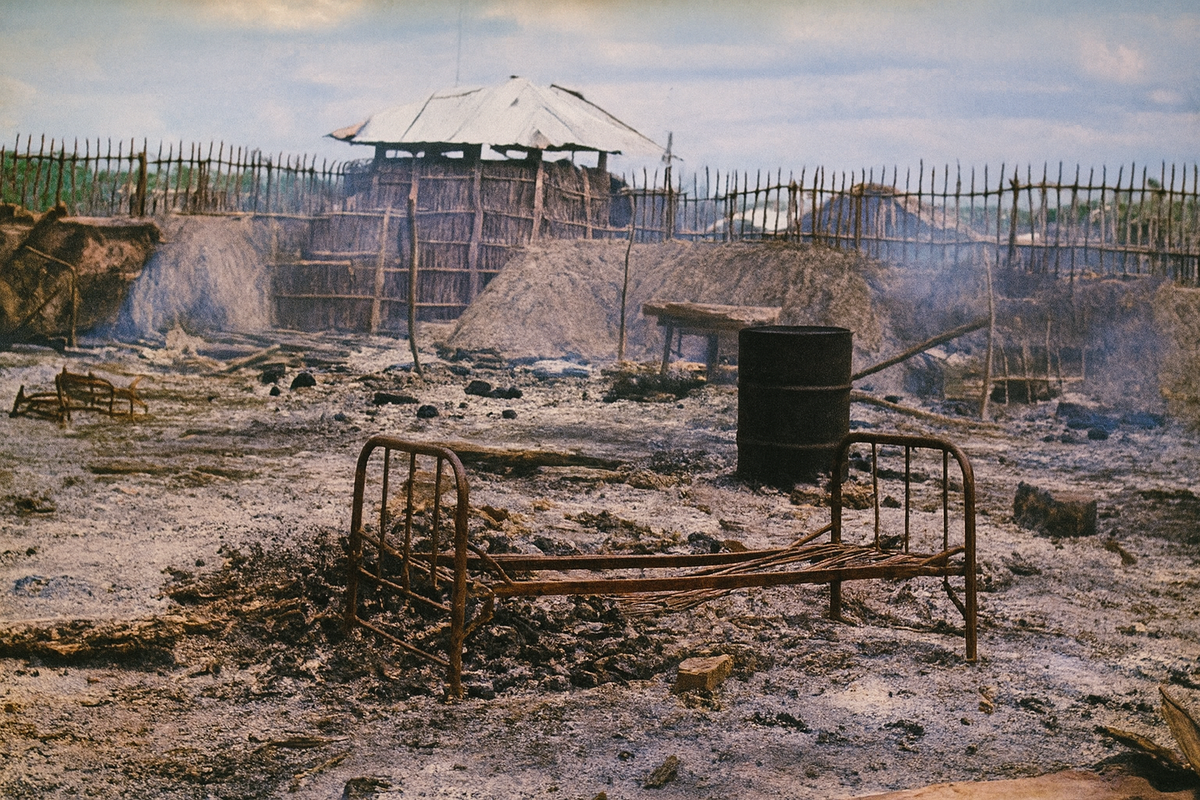
On June 12, 1964, Life Magazine placed a photograph on millions of American coffee tables that the nation wasn't ready to see. A Vietnamese village, still smoking. Homes reduced to carbon. A gasoline dump that had exploded, "shredding homes and people," as the caption stated with surgical brevity.
Most readers that morning had never heard the word "Vietcong." Within eighteen months, it would be spoken in every household in America.
This issue marks the razor's edge between ignorance and reckoning. It arrived when Vietnam was still being called "a little war, far away"—a phrase Life used without irony, reflecting the casual distance most Americans felt toward Southeast Asia. Japanese photographer Akihiko Okamura had embedded himself with South Vietnamese forces to capture what he called the "smell of war." What he brought back was the first mass-circulation evidence that America's "advisory" mission was already a shooting war, and that the official story bore no resemblance to the truth on the ground.
Life didn't editorialize. It showed. And what it showed changed everything.
Archive Details
Publication: Life Magazine
Issue Date: June 12, 1964
Photographer: Akihiko Okamura
Historical Context: Published 14 months before major U.S. combat deployment
Significance: First widely circulated graphic photo-essay on Vietnam War
The Geopolitical Precipice
June 1964 sits at a hinge point in Cold War history. The United States had 16,000 personnel in South Vietnam—officially as "advisers" training the Army of the Republic of Vietnam against communist insurgency. In practice, American soldiers were already dying in combat.
President Lyndon Johnson, barely seven months into office after Kennedy's assassination, was caught between competing imperatives. The domino theory demanded intervention: if South Vietnam fell, the thinking went, Laos, Cambodia, Thailand, and eventually the entire region would collapse into the communist bloc. But full-scale war remained politically unthinkable.
Two months after this Life issue hit newsstands, the Gulf of Tonkin incident would shatter that hesitation. By 1965, combat troops would pour into Vietnam by the tens of thousands.
This magazine, then, is the last artifact of American innocence—or perhaps willful blindness. It documents the moment when the war was still containable, still reversible, still someone else's problem. The images inside prove otherwise.
When Photojournalism Carried the Weight of Truth
By 1964, Life had become the visual conscience of America. Its photo-essays didn't merely illustrate news; they were the news. In an era before 24-hour cable coverage or embedded war correspondents became routine, Life gave middle-class families their most intimate view of global events.
Okamura's Vietnam essay refused to sanitize. The captions read like field notes from an autopsy:
"The attackers… came in nearly naked and hung with grenades. The next day these three, hit by defending fire, were floating in a protective moat."
"A survivor… a child is treated for burns from ankle to forehead."
"The American tried to save a friend."
"Defiant enemy… still he would not talk."
No euphemism. No spin. The magazine presented guerrillas floating dead in water, a widow collapsed over her husband's body, a burned child being fanned by his mother, an American lieutenant killed in action. One spread showed South Vietnamese troops waterboarding a captured fighter—described in the caption as the soldier doing his "duty," but photographed with enough clarity to reveal the moral abyss opening beneath U.S. policy.
What made these pages explosive wasn't graphic content alone. It was context. Television news in 1964 remained tightly controlled, government briefings painted the conflict as manageable, and newspapers rarely ran disturbing photographs above the fold. Life broke that consensus. It forced Americans to confront what "advisory support" actually meant: villages incinerated, children maimed, torture conducted by allies, young Americans dying for a cause most readers couldn't articulate.
The Architecture of Witness
The issue unfolds as visual testimony. After the scorched village on the cover, the interior pages read like grim chapter headings in an unfolding tragedy:
"A Little War, Far Away"
The framing device. Vietnam as distant curiosity, not yet national obsession.
"They Leave Behind a Night's Wreckage"
Three Vietcong corpses floating in a moat, bodies exposed and bloated. The ferocity of small-unit combat made visceral.
"They Are Few, But They Keep the Fight Going"
U.S. advisers and South Vietnamese soldiers. The mythology of competent, limited intervention.
"The American Tried to Save a Friend"
The young lieutenant, dead. American blood already being spilled for a government most citizens couldn't locate on a map.
"'My Duty,' Explained a Soldier"
A Vietcong prisoner, mud-covered and defiant, after being beaten and tortured. His refusal to break captured in a single photograph that indicts both sides.
Moments of Humanity
Soldiers playing with Vietnamese children near helicopters—juxtaposed against waterboarding and corpses.
Okamura's images carry a particular power because they resist narrative tidiness. There are moments of humanity—soldiers playing with Vietnamese children near helicopters—juxtaposed against waterboarding and corpses. The essay doesn't conclude. It simply ends, leaving readers with the sickening sense that this "little war" has no exit strategy, no moral clarity, no conclusion except more of the same.
The Artifact as Memory
Life magazines function differently than newspapers or broadcasts. They were designed to be kept. Families archived them in basements and attics, creating unintentional historical records. The Vietnam issues especially refused to fade. Their refusal to sanitize horror gave them permanence.
That permanence is why these magazines remain prized by historians, educators, collectors, and descendants of veterans. They are not reproductions or retrospectives. They are the original transmission—the first time America saw itself implicated in a war it didn't yet understand.
Why This Issue Endures
Historical Timing
This issue documents the "advisory phase" that would be erased from memory once the war escalated. It captures American involvement at the moment of deniability—when officials could still claim limited engagement while the evidence of something far darker already existed in print.
Iconic Photography
Okamura's images rank among the earliest graphic Vietnam photographs published to a mass American audience. They prefigure the war photography that would define the next decade—Larry Burrows, Eddie Adams, Nick Ut—but arrive before the visual language of Vietnam protest had been established.
Cultural Impact
Millions of readers encountered these pages before the antiwar movement, before the draft lottery, before Tet and My Lai. This is the documentary record of American perception at the inflection point—what the nation saw before it understood what it was looking at.
Condition and Rarity
While the issue circulated widely in 1964, high-grade copies have become scarce. Collectors, historians, and families have preserved individual issues, but pristine examples are increasingly difficult to locate.
Owning this issue means holding a time capsule from June 1964—when the future was still uncertain, when escalation seemed like a choice rather than an inevitability, when "a little war, far away" was about to become the defining catastrophe of a generation.
For Collectors and Historians
If you study Vietnam War media, Cold War America, or the golden age of photojournalism, this issue deserves a place in your archive. It bridges the gap between official narrative and documented reality, between policy abstraction and human cost.
Search for "Life magazine June 12 1964," "Vietnam War Life magazine cover," "1960s Life magazines," or "collectible Life magazines from the Vietnam War era" and you'll find this issue referenced consistently—not because it's rare in the conventional sense, but because it's irreplaceable in the historical sense.
This issue matters because it connects past to present. In an age when war remains mediated through screens and official statements, these original pages remind us of a time when print photojournalism carried the burden of witness. When one magazine could force a nation to see what it preferred to ignore.
Explore the Archive
To view this issue or discover thousands more spanning every decade of American life, browse our full collection of original Life magazines.
From the 1930s through the 1970s, Life chronicled wars, political upheavals, cultural revolutions, and ordinary moments that defined modern history. These are not reprints or digital facsimiles. They are authentic artifacts—ink on paper, preserved across decades, each one a direct transmission from the past.
Browse Life Magazine CollectionThe June 12, 1964 issue of Life Magazine stands as one of the most significant early windows into the Vietnam War. Through Okamura's lens, Americans witnessed village destruction, civilian suffering, American sacrifice, and the brutality of a conflict their government insisted was under control.
Holding this issue today is holding a turning point. It was published at the exact moment when Vietnam was still "a little war, far away"—just before it consumed a generation, toppled a presidency, and fractured the American consensus.
For those who collect history, this issue is more than a magazine. It is proof that truth, once printed, cannot be unprinted. That images, once seen, cannot be unseen. That the past, when preserved, continues to speak.