
When America's Marriage Crisis Came to Breakfast
The September 1955 Ladies' Home Journal That Changed Everything
September 1955. Across suburban America, women sat at kitchen tables with their coffee and opened Ladies' Home Journal to find something unsettling: a marriage falling apart in print.
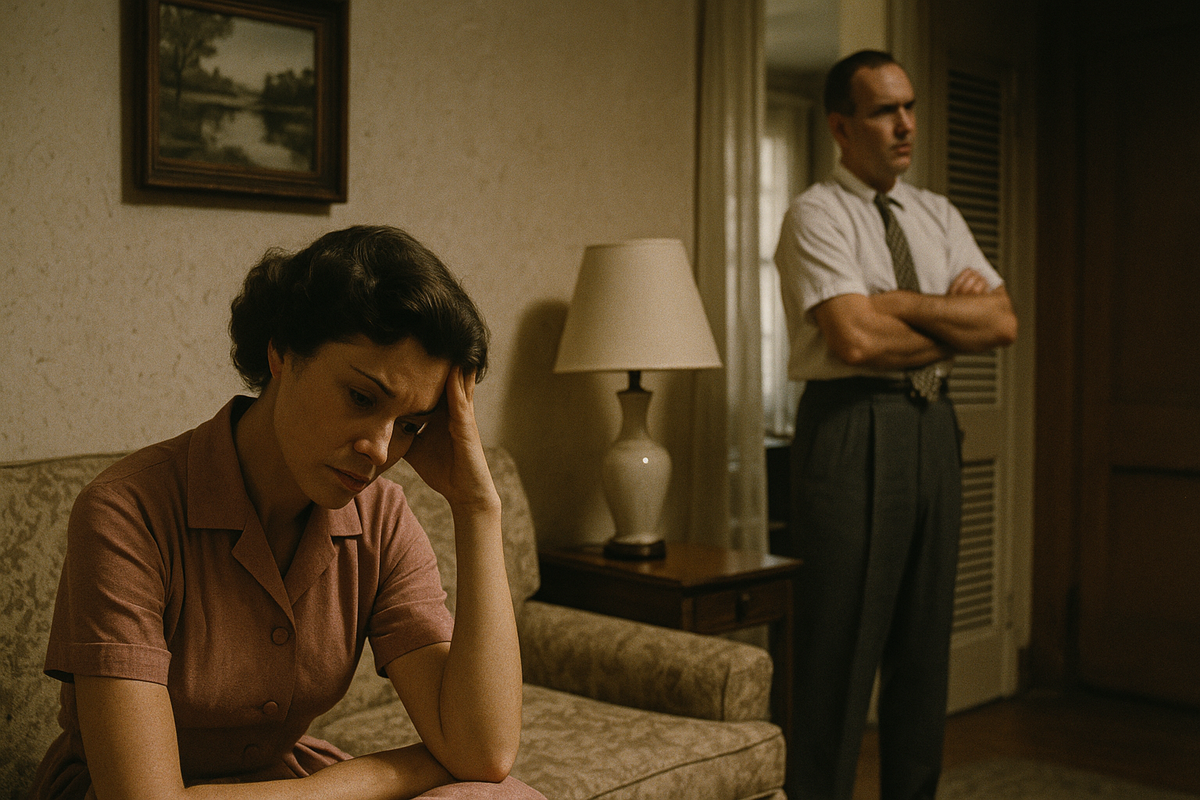
"Trudy and Dick" weren't characters in a soap opera. They were real—a couple whose criticism, resentment, and miscommunication had become so corrosive that Dr. Paul Popenoe, the magazine's consulting counselor, had laid their entire conflict bare for millions to witness. The feature was called "Can This Marriage Be Saved?"
And the answer wasn't simple.
For readers in 1955, this wasn't voyeurism. It was recognition. Behind every perfect lawn and gleaming kitchen, real marriages were buckling under the weight of rigid gender roles, unspoken resentments, and the crushing expectation that divorce was failure. Ladies' Home Journal had cracked open the facade—and readers couldn't look away.
The Postwar Dream and Its Discontents
The mid-1950s promised prosperity. Suburbs sprawled. Families grew. Television sitcoms projected an image of domestic harmony so polished it practically gleamed. But inside those ranch houses, the script often broke down.
Husbands were expected to provide, decide, and remain emotionally bulletproof. Wives carried the invisible labor of homemaking and emotional caretaking—often without recognition, rarely with gratitude. Divorce remained taboo, so when marriages fractured, couples turned not to therapists but to magazines.
Ladies' Home Journal understood this. By publishing real marital conflicts analyzed by Dr. Paul Popenoe—a figure who brought psychological authority to the page—the magazine created a space where private pain could be publicly acknowledged. The unspoken bargain: we'll validate your struggle, but the goal is always preservation, not escape.
Archive Details
Publication: Ladies' Home Journal
Issue Date: September 1955
Featured Column: "Can This Marriage Be Saved?"
Consulting Counselor: Dr. Paul Popenoe
Primary Subjects: "Trudy and Dick" (pseudonyms)
Historical Context: Early years of the groundbreaking marital advice series
The Magazine That Became America's Marriage Counselor
By 1955, Ladies' Home Journal commanded an audience in the millions. It delivered fashion, fiction, and homemaking advice—but "Can This Marriage Be Saved?" stood apart. The structure was deceptively simple and devastatingly effective:
His Side – Dick presented himself as rational, exhausted by Trudy's emotional volatility and constant failures to meet his standards.
Her Side – Trudy described a woman drowning. Criticized relentlessly. Confidence eroded. So drained by judgment that she sometimes fled her own home in despair.
The Counselor's Notes – Dr. Popenoe dissected the destructive loop both had created, pushing Dick to soften his criticism and Trudy to reclaim her self-worth.
The genius was in the format itself. Readers weren't just absorbing advice—they were witnessing an autopsy of a marriage, performed with surgical precision.
The Visual Language of Crisis
The September 1955 cover followed the magazine's formula: feminine beauty, aspirational elegance, domestic grace. Nothing hinted at the emotional battlefield inside.
But turn the pages, and the tone shifted. "Can This Marriage Be Saved?" was illustrated with stark black-and-white photographs—no glossy illustrations, no softening. The images anchored the text in reality, signaling that this content demanded to be taken seriously.
Then came the magazine's most surreal juxtaposition: alongside Trudy and Dick's marital collapse, advertisements for baby lotion, stockings, and household goods. The message was unmistakable—even in crisis, consumer culture offered comfort, distraction, perhaps even solutions. The personal and the commercial existed side by side, inseparable.
What Trudy and Dick Revealed About America
The September 1955 story delivered more than marital advice. It exposed the fault lines of an entire cultural moment:
Dick believed providing financially absolved him of emotional responsibility. Trudy felt invisible, her labor unacknowledged, her feelings dismissed.
Trudy's testimony was searing: her husband's constant nagging had become so destructive she sometimes fled the house, desperate for respite from his judgment.
Trudy struggled to maintain a spotless home, please her husband, and raise children—trapped by perfectionism that no human could sustain.
The story laid bare the imbalance: Dick's frustrations were treated as legitimate grievances, while Trudy's emotional needs were framed as instability.
Dr. Popenoe traced both partners' destructive patterns to childhood, showing how generational dysfunction perpetuated itself.
Trudy and Dick represented countless unnamed households, all struggling with conflicts they'd been taught not to speak aloud.
This wasn't just one couple's story. It was a diagnostic snapshot of marriage as a pressure system—one that many women were expected to hold together alone.
Why It Still Matters
Ladies' Home Journal endures in the cultural memory not despite its contradictions but because of them. These stories captured real struggle while reinforcing the expectation that marriage must be saved at all costs. They validated women's pain while offering few paths to real autonomy.
Today, when therapy is accessible and gender roles have shifted—though not dissolved—the September 1955 issue offers something rare: perspective. We can see how far we've come. We can also see how much of the emotional landscape remains painfully familiar.
The questions Trudy and Dick faced—about respect, recognition, and balance—haven't disappeared. They've just found new language.
Why Collectors Covet the September 1955 Issue
This issue captures the early years of "Can This Marriage Be Saved?", a series that would run for decades and influence how Americans understood marital conflict.
The magazine preserves the expectations, anxieties, and contradictions of 1950s domestic life with startling clarity.
The ads aren't just period charm—they're artifacts of consumer culture, revealing what women were told they needed to buy, use, and become.
Holding this issue means touching the same pages a grandmother might have read at her kitchen table, searching for answers she couldn't find anywhere else.
For historians, educators, and serious collectors, these issues aren't memorabilia. They're original source material.
Own a Piece of This History
The September 1955 Ladies' Home Journal isn't just readable history—it's holdable history. It connects you directly to the lived experiences of postwar America, where glossy ideals collided with grinding realities.
Browse Ladies' Home Journal Magazine CollectionEach issue documents decades of women's lives, literature, fashion, and cultural evolution. For collectors who value authenticity, these aren't replicas or reprints—they're the real thing.
The Question That Lingers
The "Can This Marriage Be Saved?" feature from September 1955 was groundbreaking—not because it offered easy answers, but because it asked the question at all. It made visible what had been private. It validated struggles that women had been told to endure silently.
For modern readers, it's both historical record and mirror. The dynamics may have shifted, but the fundamental questions about love, respect, and who carries the emotional labor remain.
In 1955, readers asked: "Can this marriage be saved?"
Today, we ask: "What does this story reveal about who we were—and how much of that we're still carrying?"