
The Man Who Crossed the World in a Steel Coffin
How Life Magazine documented Fred Snite Jr.'s impossible 12,000-mile journey inside an iron lung—and captured America's terror of polio in 1937
On June 2, 1936, Frederick B. Snite Jr. stopped breathing.
Not suddenly—polio doesn't grant that mercy. The virus crept through his nervous system while he traveled through Shanghai, systematically shutting down the muscles that controlled his lungs. Within days, the 26-year-old Chicagoan faced a binary choice: climb inside a 1,500-pound steel cylinder that would breathe for him, or die.
He chose the machine. Then he chose something no one had attempted before: he decided to go home.
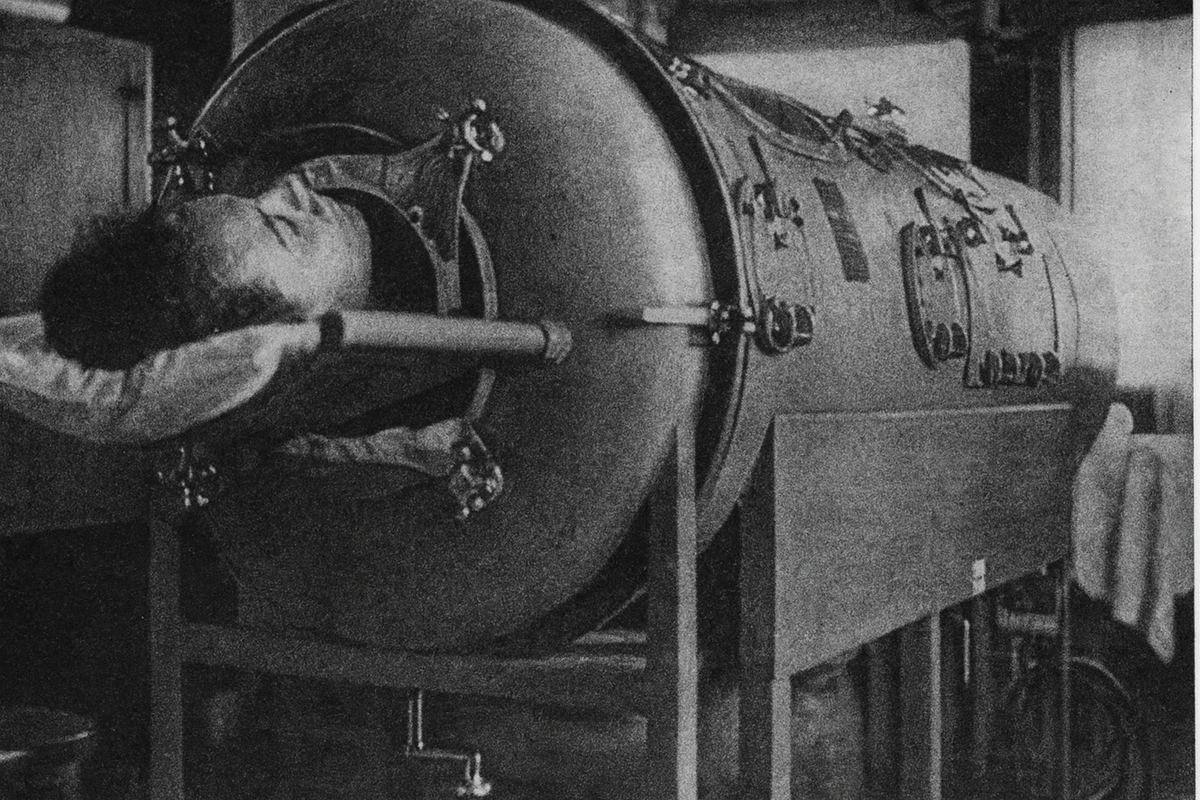
When Americans opened the June 14, 1937 issue of Life Magazine, they encountered the photographic evidence of what that decision cost. Fred Snite Jr., paralyzed from the neck down, had just completed a 12,000-mile journey from Peiping to Chicago—entirely sealed inside an iron lung. The trip required a dozen rotating medical staff, specially retrofitted trains and ships, and $50,000 in Depression-era currency. His father paid it without hesitation.
The photographs were clinical and devastating. Snite's head protruded from a rubber collar, the only part of him visible while his body remained entombed in steel. The images showed a Chinese barber administering a sterile shave. A nurse feeding him by hand, angling a mirror so he could watch. Chess pieces positioned near his eye line. A booklet propped for reading. Each frame documented not merely survival, but the Sisyphean task of maintaining human dignity inside a machine.
This wasn't medical reporting. It was a dispatch from the front lines of a war America was losing.
The Disease That Terrorized a Generation
By the mid-1930s, polio had become the nightmare that stalked American summers. Outbreaks surged with the heat, striking with brutal randomness—children at swimming pools, teenagers at summer camp, young adults like Snite on business trips abroad. The virus paralyzed thousands annually and killed many more. There was no vaccine, no cure, no reliable theory for how it spread. Wealthy families fled cities for rural quarantine. Public pools closed. Parents kept children indoors, terrified of invisible contagion.
The iron lung, invented in 1928, represented the desperate edge of medical technology. It was a pressure chamber—a coffin-sized tube that used mechanical pumps to expand and contract a patient's chest cavity, forcing passive respiration. For most patients, it served as temporary life support until paralyzed muscles regained function. For Fred Snite Jr., it became permanent.
When the poliovirus struck him in Shanghai, his father faced an impossible calculus. Leave his son to die in China, or engineer the most expensive medical evacuation in history. Frederick B. Snite Sr. chose the latter, and in doing so, transformed his son into a symbol—of privilege, yes, but also of the lengths to which love and money could bend the limits of 1930s medicine.
Historical Record
Subject: Frederick B. Snite Jr., polio patient and medical pioneer
Publication: Life Magazine, June 14, 1937
Journey: 12,000 miles from Peiping, China to Chicago, Illinois
Cost: $50,000 (approximately $1 million in 2025 dollars)
Medical Equipment: 1,500-pound iron lung respirator
Archive Source: Original Life Magazine Collection
Life Magazine's Revolutionary Lens
Life had been reborn only months earlier, in November 1936, as Henry Luce's bold experiment in photojournalism. The magazine's mandate was radical for its time: let images carry the narrative weight that words traditionally bore. Show, don't just tell. Make readers see the world's stories, not merely read about them.
The Snite feature exemplified this philosophy with uncomfortable intimacy. Where newspapers might have buried a wire-service paragraph about a wealthy invalid's return, Life devoted a full spread to the visceral reality of his existence. The photographs were unflinching: Snite's face, perpetually framed by the iron lung's porthole. The tangle of tubes and gauges. Medical staff performing the mundane rituals—feeding, shaving, turning pages—that sustained a life reduced to complete mechanical dependence.
One image captured the full absurdity and tragedy: Snite attempting to play chess, his eyes following the board while nurses moved pieces at his direction. Here was a mind fully intact, imprisoned in a body that could do nothing but breathe mechanically and wait.
Life understood something profound about visual storytelling: that the iron lung itself was a character in this drama. Every photograph juxtaposed cold steel against vulnerable flesh, medical apparatus against human fragility. The machine dominated each frame, yet never obscured the man inside it. This was the genius of early Life—the ability to make technology's triumph over death feel simultaneously miraculous and horrifying.
The $50,000 Question
"On June 2, Frederick B. Snite Jr., 26, started history's most expensive medical journey by ambulance, train and ship when he left Peiping for Chicago, 12,000 miles away."
Life's opening salvo was characteristically blunt. Fifty thousand dollars in 1937—the equivalent of roughly $1 million today—purchased not comfort but basic survival. The logistics were staggering. The iron lung required constant electricity; backup generators had to travel with the convoy. A dozen doctors, nurses, and technicians worked rotating shifts to monitor Snite's breathing, adjust pressure settings, and guard against the real killer: infection.
Paralysis wouldn't kill him. A common cold might.
The journey itself became a feat of engineering choreography. Ambulances transported the iron lung to trains specially modified to accommodate its weight. Ships reinforced cargo holds to secure the machine against ocean swells. At every transition point, medical teams rehearsed emergency protocols for power failures. One mechanical breakdown, one extended blackout, and Fred Snite would suffocate in minutes.
Yet the article's clinical details were laced with small human moments: Snite smiling during his shave. His concentration during chess. The determination in his eyes while reading. Life refused to let readers forget that inside the machine was a man who still wanted to live, not merely survive.
This tension—between the cold mechanics of staying alive and the warm insistence on remaining human—gave the story its emotional architecture. Readers in 1937 weren't just witnessing a medical case study. They were watching someone fight to preserve selfhood in the face of total physical obliteration.
Living History: Why This Issue Endures
The June 14, 1937 Life remains collectible not despite its age but because of what it captured: a civilization caught between pre-modern vulnerability and modern technological dependence. Several factors elevate this particular issue to artifact status:
What Original Issues Reveal
Vintage Life magazines offer something digital archives cannot: the experience of history as it was first consumed. The June 14, 1937 issue sat on coffee tables and barbershop counters across America. Families discussed it over dinner. Children stared at the photographs, perhaps for the first time understanding that catastrophe could strike anyone, anywhere.
The physical magazine preserves not just content but context. Flip through the issue and you encounter the other stories that shared space with Snite's ordeal: political coverage of a world sliding toward war, advertisements for products long extinct, cultural assumptions embedded in every caption and headline. This is history without retrospective editing, without the luxury of knowing what came next.
For collectors, medical historians, and anyone fascinated by the pre-vaccine era's existential dread, this issue is irreplaceable primary source material. It shows Americans confronting a disease they couldn't prevent, couldn't cure, and barely understood—armed only with expensive machinery and desperate hope.
Why Collectors Prize This Issue
Explore the Collection
Our archive contains thousands of original Life magazines spanning the 1930s through the 1970s. From the Depression through World War II, the Cold War through the Space Race, these issues documented the century as it unfolded.
Browse Life Magazine CollectionEpilogue
Fred Snite Jr.'s iron lung journey wasn't just a medical evacuation. It was a preview of the choices medicine would force upon us—questions about what interventions are worthwhile, what costs are acceptable, what constitutes a life worth living when biology fails but technology persists.
The June 14, 1937 Life captured that moment with unforgettable clarity: one man, sealed in steel, crossing an ocean to get home. It's a story about money and privilege, certainly. But it's also about the universal human refusal to surrender, even when surrender seems like the only rational option.
That image of Snite—head emerging from the iron lung, eyes focused on a chess game he couldn't physically play—remains one of the most powerful photographs Life ever published. It shows us what survival looked like before we learned to prevent the disease that made it necessary.
History isn't abstract. It's printed on aging paper, stored in attics and archives, waiting to be rediscovered. This is one of those pieces worth finding.