
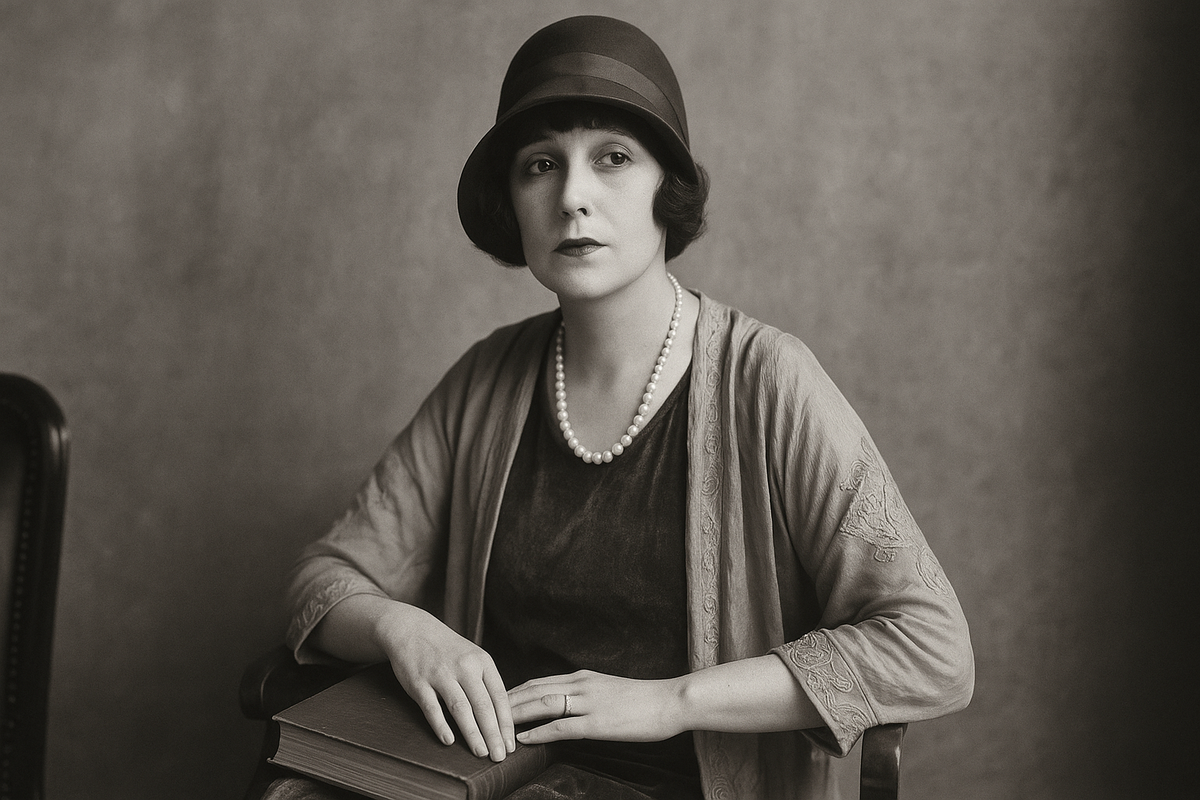
The Night Anita Loos Conquered Manhattan
Inside the November 6, 1926 New Yorker and the moment Hollywood became America's cultural conscience
On a crisp November evening in 1926, New York's literati gathered in speakeasies and drawing rooms, passing around the latest issue of a brash young magazine that promised to chronicle their world with unflinching wit. Inside, sandwiched between cartoons of Park Avenue society and advertisements for French perfume, was a profile that captured something remarkable: the moment when Hollywood stopped being mere spectacle and became America's most powerful cultural engine.
The subject was Anita Loos—screenwriter, satirist, and the woman who had just published the most scandalous bestseller of the decade. At four feet eleven inches tall, she had somehow managed to tower over an entire industry.
Archive Details
Historical Figure: Anita Loos (1889-1981)
Issue Date: November 6, 1926
Profile Title: "The Child Wonder"
Archive Source: The New Yorker Magazine
Cultural Context: Jazz Age America, Hollywood's Golden Age, Post-WWI modernization
When Cinema Found Its Conscience
The First World War had ended eight years earlier, and America was drunk on possibility. Jazz poured from Harlem into every corner of the nation. The 19th Amendment had given women the vote, and they were using their newfound power to smoke in public, cut their hair, and demand seats at tables previously reserved for men. Prohibition had made criminals of cocktail drinkers and millionaires of bootleggers.
But the real revolution was happening in the dark.
Silent films had evolved from carnival novelties into the nation's defining art form. Clara Bow smoldered on screens from New York to Los Angeles. Rudolph Valentino made women swoon without uttering a single word. Douglas Fairbanks performed impossible feats of athletic grace. Yet behind every memorable scene, every perfectly timed gesture, every intertitle that made audiences laugh or gasp, were the writers who understood that silence demanded precision.
Anita Loos was the best of them.
She had started writing scenarios for D.W. Griffith as a teenager, learning to craft stories that communicated through pure image and movement. By 1926, she had worked with every major star in Hollywood and commanded fees that rivaled the actors themselves. Then she did something unexpected: she wrote a novel.
Gentlemen Prefer Blondes detonated across American culture in 1925. Disguised as the diary of a gold-digging flapper named Lorelei Lee, it was actually a surgical dissection of how money, sex, and power operated in Jazz Age America. Edith Wharton adored it. H.L. Mencken called Loos the wittiest woman in America. The book sold hundreds of thousands of copies and made its author as famous as the movie stars she had spent years making famous.
The Magazine That Understood Irony
The New Yorker was barely eighteen months old when it profiled Loos, but it had already established the voice that would define American sophistication for the next century. Founded by Harold Ross in 1925, the magazine positioned itself as the antidote to provincial American journalism—a publication written by New Yorkers, for New Yorkers, about the ideas and personalities that mattered to people who considered themselves intellectually serious and culturally literate.
Ross wanted something different from the breathless celebrity coverage that dominated other magazines. His "Profiles" series offered character studies rendered with literary craft and psychological insight. These were not puff pieces. They were examinations—sometimes admiring, sometimes skeptical, always intelligent.
The Loos profile, titled "The Child Wonder," exemplified this approach. It acknowledged her achievements while gently mocking the contradiction she embodied: a woman who looked like a child but wrote with the cynicism of someone who had watched human nature at its most calculating. The piece celebrated her while simultaneously questioning whether Hollywood could produce anything truly lasting.
This was The New Yorker at its essence—urbane enough to recognize talent, skeptical enough to question its own enthusiasms.
What Made This Issue Collectible
The November 6, 1926 cover carries the magazine's signature restraint: an elegantly stylized figure against muted green, hinting at sophistication without announcing it. Inside, illustrations accompany the Loos profile—sketches that suggest Hollywood's glamour while maintaining the magazine's commitment to art over photography.
Every element marks this as an artifact from a specific cultural moment. The advertisements speak to readers who bought imported champagne (legally or otherwise), attended Broadway premieres, and cared intensely about which restaurants served the best oysters. The cartoons assume familiarity with Park Avenue social rituals and the subtle gradations of Manhattan status.
But the Loos profile itself makes this issue historically significant for three reasons:
Historical Timing
This appeared just as The New Yorker was discovering its voice—sophisticated enough to take Hollywood seriously, skeptical enough to question its artistic legitimacy. The magazine was still young enough to be figuring out how to balance respect with irony.
Representation
In 1926, women writers rarely received this kind of serious treatment in major publications. Loos was profiled not as a curiosity or a society figure, but as a professional whose work deserved critical attention. The piece acknowledged her gender without reducing her to it—a rare achievement for the era.
Hollywood's Arrival
By choosing Loos as a subject, The New Yorker was implicitly acknowledging that cinema had become culturally important enough to warrant serious analysis. This was no longer just entertainment for the masses. It was art that could be discussed alongside literature and theater.
Cultural Intersection
The profile captured the precise moment when Hollywood, literature, and New York sophistication converged. Loos belonged to all three worlds, and this issue documents that unique intersection before it became commonplace.
The Archive as Artifact
Collectors seek early New Yorker issues for the same reason museums preserve Civil War correspondence—they capture the texture of a specific historical moment better than any retrospective analysis can. The advertisements reveal what readers valued. The cartoons show what they found funny. The essays demonstrate what they found troubling.
Reading the November 6, 1926 issue is like overhearing a conversation in a 1920s Manhattan drawing room. You learn what educated Americans knew, what they cared about, what they feared. You discover that they worried about many of the same things we do—the relationship between art and commerce, the role of women in professional life, whether new forms of media would corrupt or elevate public taste.
Anita Loos herself understood this preservation instinct. She spent decades in Hollywood watching silent films give way to talkies, watching the studio system rise and eventually crumble, watching generation after generation of stars burn bright and fade. She knew that cultural moments were fleeting, and that the only way to hold onto them was through careful documentation.
This magazine did that work.
Why This Issue Matters Now
Cultural historians study the November 6, 1926 New Yorker to understand how Americans in the 1920s thought about celebrity, gender, and the relationship between entertainment and art. Literary scholars examine it for insights into how The New Yorker developed its distinctive editorial voice. Collectors prize it because early issues from significant magazines command substantial value, particularly when they feature profiles of figures who remain culturally relevant.
But the deepest reason to own this issue is simpler: it captures a woman at the precise moment when she had mastered two different art forms and become famous for both. Loos would go on to write screenplays for decades, would see Gentlemen Prefer Blondes adapted multiple times (most famously as a vehicle for Marilyn Monroe), and would remain a Hollywood fixture until her death in 1981. But November 1926 was her moment of perfect cultural balance—celebrated by Hollywood, embraced by New York's literary elite, neither fully belonging to nor fully rejected by either world.
The magazine that profiled her was similarly poised between identities—no longer a startup, not yet an institution. Both Loos and The New Yorker were figuring out how to be taken seriously without losing the irreverence that made them interesting.
That negotiation is preserved in these pages.
Collector Significance
Rarity & Condition
Early New Yorker issues from 1926 are increasingly scarce in collectible condition. This issue's significance—featuring one of the decade's most important cultural figures—makes it particularly sought after by institutions and private collectors.
Historical Value
This issue documents a pivotal moment in American cultural history when Hollywood transitioned from entertainment to art, when women writers gained recognition in major publications, and when The New Yorker established its lasting editorial voice.
Research Importance
For scholars of 1920s culture, women's history, Hollywood studies, or magazine journalism, this issue serves as a primary source document—irreplaceable for understanding how contemporaries viewed these cultural shifts as they happened.
Investment Potential
Original vintage magazines from prestigious publications featuring historically significant figures continue to appreciate in value, particularly as digital archives make collectors more aware of what they're seeking.
Explore the Complete Archive
For collectors, scholars, and enthusiasts of American cultural history, original New Yorker magazines from the 1920s represent primary sources of exceptional value. Each issue documents not just individual personalities but entire ecosystems of taste, humor, and social observation.
Browse The New Yorker Magazine Collection