
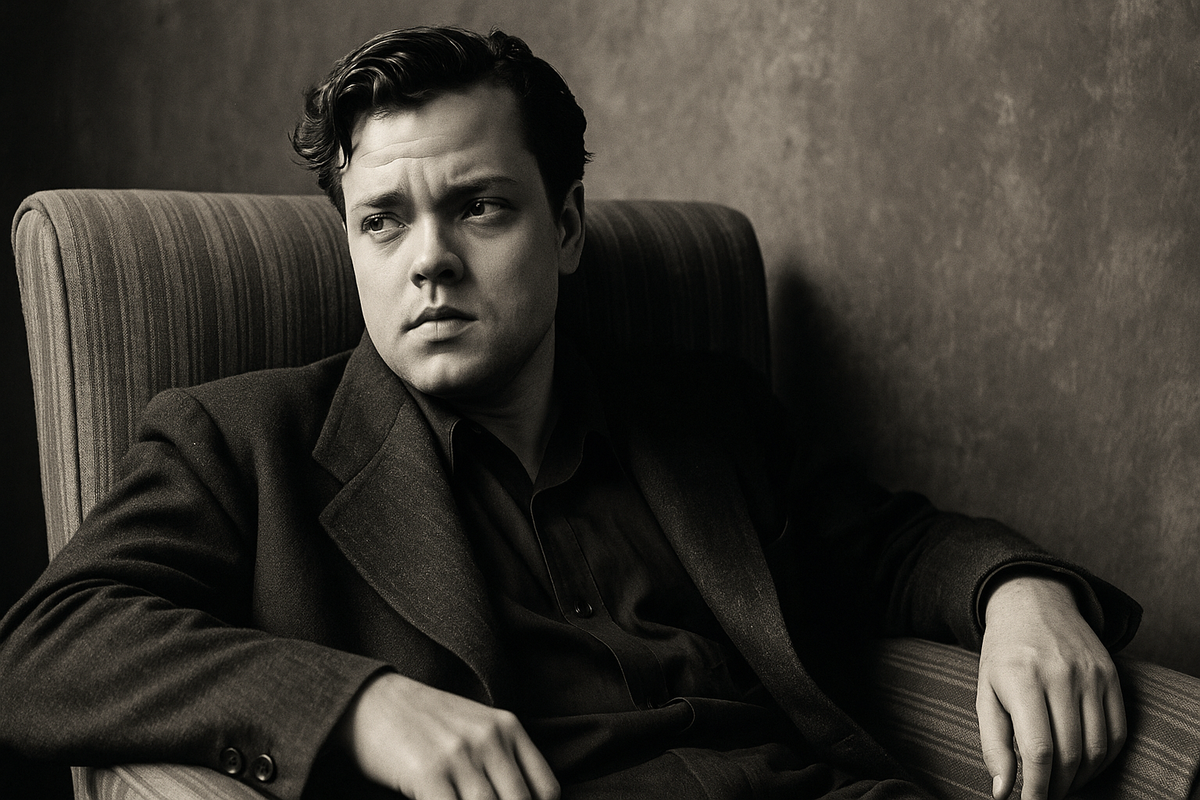
The Making of Orson Welles
A 1940 Portrait of Genius Before the Fall of Citizen Kane
When American readers opened the January 20, 1940 issue of The Saturday Evening Post, they had no idea they were looking at the future of cinema. The young man staring back from the pages—24 years old, theatrical, impossibly confident—had not yet directed a single Hollywood film. Citizen Kane was still months away from production. The legend had not yet calcified into myth.
What they saw instead was something rawer: a prodigy in real time, profiled under the provocative headline "How to Raise a Child: The Education of Orson Welles, Who Didn't Need It." Written by Alva Johnston and Fred Smith, the article offered not retrospective hagiography but a live-wire character study of an enfant terrible already notorious for terrifying half the country with a fake alien invasion.
This was Orson Welles before Hollywood tamed him, before the studios broke him, before history turned him into a cautionary tale. This was the moment of pure possibility.
Archive Details
Historical Figure: Orson Welles (1915–1985)
Issue Date: January 20, 1940
Publication: The Saturday Evening Post
Article: "How to Raise a Child: The Education of Orson Welles, Who Didn't Need It" by Alva Johnston and Fred Smith
Archive Source: Original Magazines Collection
A Nation on the Brink, A Medium in Ascendance
The America of January 1940 was a country holding its breath. The Great Depression still cast its shadow, even as New Deal programs reshaped the social contract. Across the Atlantic, Europe was three months into the Second World War—Poland had fallen, the Phony War was underway, and American neutrality felt increasingly fragile.
In this atmosphere of suspended catastrophe, Americans turned to their radios. The medium had become the central nervous system of the nation: Roosevelt's fireside chats, war dispatches from Edward R. Murrow, serialized dramas that millions followed religiously. And in October 1938, a 23-year-old radio producer named Orson Welles had hijacked that nervous system with his adaptation of H.G. Wells's "The War of the Worlds," convincing thousands that Martians had landed in New Jersey.
The panic made him famous. The backlash made him controversial. And by early 1940, as The Saturday Evening Post prepared its profile, Welles had become a cultural Rorschach test: genius or charlatan? Visionary or fraud?
The magazine's answer was characteristically American: maybe both.
The Post as Cultural Arbiter
The Saturday Evening Post was not just a magazine in 1940—it was an institution. With a circulation in the millions, it reached living rooms from Maine to California, offering a carefully curated blend of Norman Rockwell nostalgia, investigative journalism, serialized fiction, and cultural commentary. The Post was where middle America came to understand itself.
Yet the magazine was also capable of serious portraiture. Its long-form profiles were character studies that doubled as cultural diagnosis. To be profiled in the Post meant something: you had arrived, but your arrival would be examined, questioned, even gently mocked.
The Welles feature embodied this duality. It celebrated his brilliance while treating his rebelliousness with skepticism. It marveled at his precocity while questioning whether genius was an excuse for arrogance. Readers were invited not to worship, but to assess.
This was American journalism at its most sophisticated: entertaining enough for mass appeal, substantive enough to endure.
The Cover That Captured Lightning
Unlike the typical Post cover—a Rockwell painting of small-town warmth—the January 20, 1940 issue featured Welles himself, reclining in a pose of studied nonchalance. The choice was deliberate: this was not comfort food. This was a statement.
Inside, the article sprawled across multiple pages, dense with photographs and illustrations. One image showed Welles transformed into Quasimodo, the Hunchback of Notre Dame—proof of his chameleon talent for makeup and physical transformation. Another captured him among classmates at the Todd School for Boys in Woodstock, Illinois, the unorthodox institution that had nurtured his theatrical obsessions.
The narrative tone walked a tightrope. Johnston and Smith admired Welles but refused to genuflect. They catalogued his achievements—the all-Black Macbeth in Harlem, the anti-fascist Julius Caesar, the Mercury Theatre's experimental daring—while noting his impatience with authority, his contempt for convention, his sheer inability to be taught.
The subtext was unmistakable: here was a man who had educated himself by force of will, treating Shakespeare as syllabus and the stage as laboratory. The question the article asked, implicitly, was whether America could contain such a figure—or whether it would crush him.
Anatomy of a Self-Made Genius
The portrait that emerged from the Post's reporting was both illuminating and cautionary. Welles had been a prodigy from the start: at ten, a Madison, Wisconsin newspaper had profiled him as "Cartoonist, Actor, Poet, and only 10." He staged plays, drew cartoons, wrote poetry, memorized Shakespeare by the yard.
But precocity had come with a price. Welles rejected every conventional structure placed before him. He despised rote memorization, clashed with teachers, abandoned Boy Scouts. Traditional schooling bored him; he learned only what obsessed him.
His salvation was the Todd School for Boys, where a more flexible curriculum allowed him to flourish. There, he staged elaborate Shakespeare productions, experimented with lighting and sound, developed the directorial instincts that would later revolutionize film. Theater became his true education—not as a subject, but as a method of thinking.
His parents had set the template. Richard Welles, an inventor and bohemian, encouraged radical independence. Beatrice Ives Welles, a gifted pianist, nurtured his artistic sensibility before her early death. Between them, they had raised a child who believed rules were negotiable and genius was its own justification.
By 1940, the results were undeniable: Welles had reinvented American theater, terrified the nation with a radio broadcast, and stood on the verge of Hollywood. The question was no longer whether he was talented. The question was whether he could survive his own ambition.
Precocious Childhood
At just ten years old, Welles was profiled as "Cartoonist, Actor, Poet, and only 10" by a Madison newspaper—already staging plays and memorizing Shakespeare.
Rejection of Convention
Welles resisted traditional schooling, clashed with authority, and learned only what obsessed him—treating genius as license for rebellion.
Todd School Influence
The Todd School for Boys provided the flexible environment where Welles could experiment with theater, developing his revolutionary directorial instincts.
Theater as Laboratory
Shakespeare became Welles's true education—not a subject to study, but a method of thinking and creating that shaped his artistic vision.
Why This Issue Endures
For collectors, the January 20, 1940 Saturday Evening Post is more than memorabilia—it's a historical inflection point captured in newsprint. This issue documents Welles at the precise moment before transformation: after "War of the Worlds" notoriety, before Citizen Kane immortality.
The timing is everything. Published in early 1940, the profile freezes Welles at 24, still unproven in Hollywood, still hungry, still dangerous. Within months, he would begin shooting the film that Sight & Sound polls would repeatedly rank as the greatest ever made. But in January 1940, that future was unwritten.
The magazine itself is a cultural artifact beyond the Welles feature. The advertisements, fiction, and commentary create a time capsule of prewar American life—a nation prosperous enough to consume, anxious enough to wonder what came next.
For collectors of film history, vintage magazines, or American cultural ephemera, this issue represents a rare convergence: a major publication profiling a future legend at the exact moment of becoming. It is primary-source material for understanding how genius is recognized, questioned, and mythologized.
It is also, simply, a hell of a read.
Collector Significance
Historical Timing
Published in early 1940, this issue captures Welles at 24—just before Citizen Kane production began, making it one of the earliest major national profiles of his career.
Cultural Milestone
The profile reflects both Welles's fame and controversy following the 1938 "War of the Worlds" broadcast, documenting a cultural moment of fascination and skepticism.
Cover Rarity
Unlike typical Norman Rockwell illustrations, this issue features Welles himself on the cover—a striking choice that makes it especially prized among film history collectors.
Primary Source
The article offers unique contemporary insight into how Welles was perceived before legend overtook reality—rebellious, brilliant, and uncontainable.
Time Capsule
Beyond Welles, the magazine is filled with 1940 advertisements, fiction, and commentary that create a complete portrait of prewar American culture.
Investment Value
For collectors of vintage Saturday Evening Post magazines, Orson Welles memorabilia, or Hollywood history, this issue ranks among the most desirable.
Explore the Archive
Browse our complete collection of original Saturday Evening Post magazines—from Norman Rockwell covers to profiles of cultural icons. These are not reproductions. They are the original artifacts that once shaped how a nation saw itself.
Browse The Saturday Evening Post Magazine Collection