
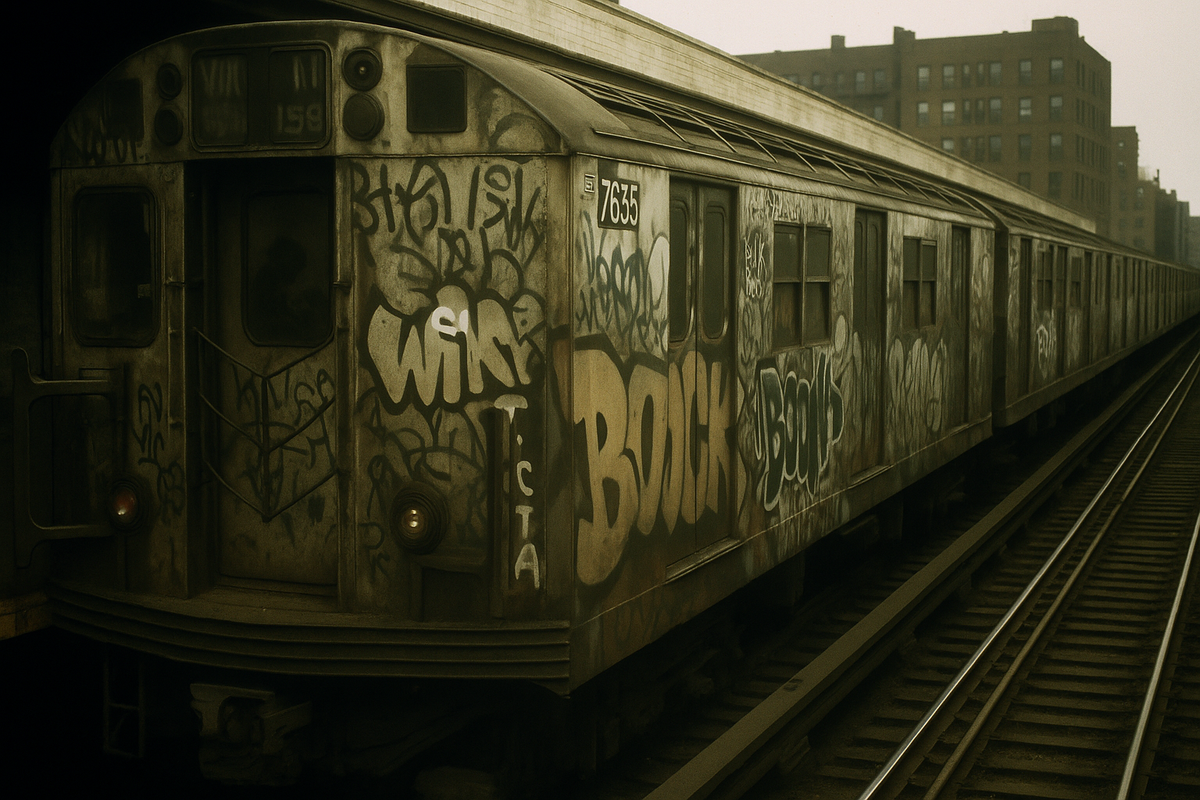
The Faith of Graffiti: When Esquire Canonized the Subway
Norman Mailer, Jon Naar, and the May 1974 issue that transformed vandalism into art
Before Basquiat. Before Banksy. Before street art commanded seven figures at auction, there was a Pulitzer Prize-winning novelist standing in a New York subway tunnel, squinting at spray paint, and asking whether God favored the vandals.
The year was 1974. The magazine was Esquire. And Norman Mailer was about to legitimize an art form that city officials wanted to pressure-wash into oblivion.
When readers opened the May 1974 issue, they discovered something heretical tucked between the cologne ads and political commentary: "The Faith of Graffiti," an essay arguing that the kids bombing subway cars might be creating the most vital art in America. Paired with Jon Naar's uncompromising black-and-white photography, the piece didn't just document graffiti culture—it baptized it.
This wasn't journalism. It was consecration.
Archive Details
Historical Figure: Norman Mailer (author), Jon Naar (photographer)
Issue Date: May 1974
Archive Source: Esquire Magazine
Cultural Context: First major publication to treat graffiti as legitimate art form
New York, Burning
To understand why this mattered, you need to picture the city Mailer was writing about. By 1974, New York was hemorrhaging money, jobs, and hope. Watergate dominated the news. Vietnam still bled. The optimism of the 1960s had curdled into something darker—cities felt dangerous, unmanageable, beyond repair.
Graffiti was the visible symptom. Entire subway cars rolled through stations covered in names written in wild, looping letters. To city officials, this was destruction. To the police, it was evidence of social collapse.
Mailer saw something else entirely.
By 1971, a teenager named TAKI 183 had already become infamous after the New York Times profiled his compulsive tagging. But by 1974, graffiti had evolved from simple signatures into something more ambitious—elaborate murals, color schemes, stylistic innovations. Poor kids, mostly Black and Latino, were turning public infrastructure into mobile galleries.
Mailer, ever the provocateur, recognized what others missed: this wasn't vandalism. It was a claim to existence in a city designed to erase you.
Esquire's Gamble
Esquire in the 1970s wasn't just a men's magazine—it was a cultural proving ground. Where Life went for mass appeal and The New Yorker cultivated highbrow intellectualism, Esquire carved out something rarer: a space where style, politics, and art criticism collided without apology.
The magazine had already published Gay Talese's "Frank Sinatra Has a Cold" and Tom Wolfe's experiments in New Journalism. It gave writers room to think, to sprawl, to argue. When Esquire ran something, it carried weight.
So when Mailer's essay appeared—comparing subway writers to Michelangelo, to Giotto, to Picasso—it wasn't just contrarian posturing. Esquire was making an institutional argument: graffiti belonged in the same conversation as Renaissance frescoes.
No other mainstream publication could have pulled this off. Newspapers buried graffiti in crime reports. Art magazines ignored it. But Esquire had the editorial audacity to ask whether something dismissed as urban blight might actually be the birth of a movement.
The answer, half a century later, is obvious. In 1974, it was radical.
Mailer as Aesthetic Investigator
Mailer positioned himself not as a critic but as a witness. He called himself an "Aesthetic Investigator"—his job wasn't to judge but to determine whether the Lord was "on the side of the artist."
His prose treated graffiti writers like mythic figures:
CAY 161 emerged as a martyr, his name hammered onto subway cars with brute force.
JUNIOR 161 created what Mailer deemed a masterpiece in the tunnels near 125th Street.
TOP CAT 126 imported Philadelphia's thin, angular handstyle—difficult to read but undeniably influential.
These weren't delinquents. They were authors of their own immortality.
Mailer understood what drove them: the need to be seen in a city that rendered poor people invisible. Each tag was an existential scream—I am. I exist. You cannot erase me. He framed graffiti as an act of faith, a belief that one's name might outlast the body that wrote it.
Where officials saw destruction, Mailer found spiritual yearning.
Naar's Gospel in Black and White
If Mailer supplied the theology, Jon Naar delivered the scripture.
Naar's photographs weren't illustrations—they were evidence. His camera captured subway cars transformed into rolling murals, walls swallowed by overlapping tags, young writers crouched over spray cans in near-darkness. Shot in stark black and white, the images elevated graffiti from background noise to visual symphony.
The photos revealed what the untrained eye missed: graffiti had structure. It followed rules. It had styles, hierarchies, territories, and rivalries. It was organized, evolving, self-aware.
Together, Mailer's prose and Naar's photography made the case that graffiti wasn't just expression—it was the earliest stirring of what would become hip-hop culture, a global force that would fuse graffiti, breakdancing, DJing, and MCing into a movement that reshaped cities worldwide.
Why Collectors Hunt This Issue
Historical Primacy
The first time a major American publication treated graffiti as art, not crime. It predates gallery exhibitions, museum retrospectives, and academic scholarship by years.
The Mailer Factor
A Pulitzer-winning novelist at the height of his powers, writing about an art form most critics refused to acknowledge.
Visual Archive
Naar's photography documents a moment that can never be repeated—graffiti in its rawest, pre-commercial form.
Hip-Hop Genesis
As scholars traced hip-hop's origins, this issue became essential reading. It's not an artifact about the culture—it's part of the culture's foundational text.
Scarcity: Mid-1970s magazines weren't built to last. Issues in good condition are increasingly rare, and those containing landmark essays command serious attention.
Owning this issue means possessing a primary source from the moment street art made its first argument for legitimacy.
The Afterlife of a Revolution
Nearly fifty years later, "The Faith of Graffiti" still reads like prophecy.
What Mailer and Naar captured in 1974 wasn't just kids with spray cans—it was the opening act of a cultural revolution. Graffiti has since infiltrated high fashion, contemporary art museums, and global design. Jean-Michel Basquiat started as a tagger. Shepard Fairey built an empire. Banksy became a household name without ever showing his face.
But in 1974, none of that was inevitable. Graffiti was still underground, still illegal, still dismissed as vandalism by nearly everyone who mattered.
Esquire gave it legitimacy. Mailer gave it language. Naar gave it proof.
For readers at the time, the essay was a revelation. For collectors now, it's a treasure. And for anyone interested in how subcultures become movements, how outsider art forces its way inside, how the margins rewrite the center—this issue remains essential.
For Collectors and Historians
Cultural Turning Point
The May 1974 Esquire sits alongside other landmarks: the first issue of Rolling Stone, the Whole Earth Catalog, early editions of Wired.
Primary Source Material
This is the magazine that asked whether vandalism might be prophecy—and time proved it right.
Investment Quality
As hip-hop culture expanded globally, this issue became a touchstone for scholars and collectors tracing its origins.
Explore the Archive
Whether you're a collector, a cultural historian, or someone who believes the most important art often begins as trespass—this issue offers something rare: a firsthand account of the moment the establishment stopped dismissing the streets and started listening.
Browse Esquire Magazine Collection