
The Man Who Refused His Place
Adam Clayton Powell Jr. and the Summer America Changed Forever
In June 1963, as Birmingham's streets ran with fire hoses and President Kennedy drafted legislation that would redefine the nation, Ebony magazine made a calculated gamble. Instead of putting Dr. King on the cover—the expected choice, the safe choice—they gave their readers something more dangerous: a close-up portrait of the most powerful Black politician in American history, a man whose enemies called him reckless and whose constituents called him prophet.
Adam Clayton Powell Jr. was, by every measure, an enigma wrapped in a tailored suit. Chairman of the House Education and Labor Committee. Harlem preacher. Legislative architect who raised the minimum wage and expanded school lunches. A man who spent weekdays forcing segregationists to vote on civil rights amendments and weekends playing badminton at his modernist Puerto Rican villa.
Ebony's June 1963 issue didn't try to resolve these contradictions. It amplified them.
Archive Details
Historical Figure: Adam Clayton Powell Jr., U.S. Congressman and Civil Rights Leader
Issue Date: June 1963
Archive Source: Ebony Magazine
Feature Article: "Adam Clayton Powell: Enigma on Capitol Hill" by Lerone Bennett Jr.
Historical Context: Published weeks before the March on Washington and Dr. King's "I Have a Dream" speech
Power in Black and White
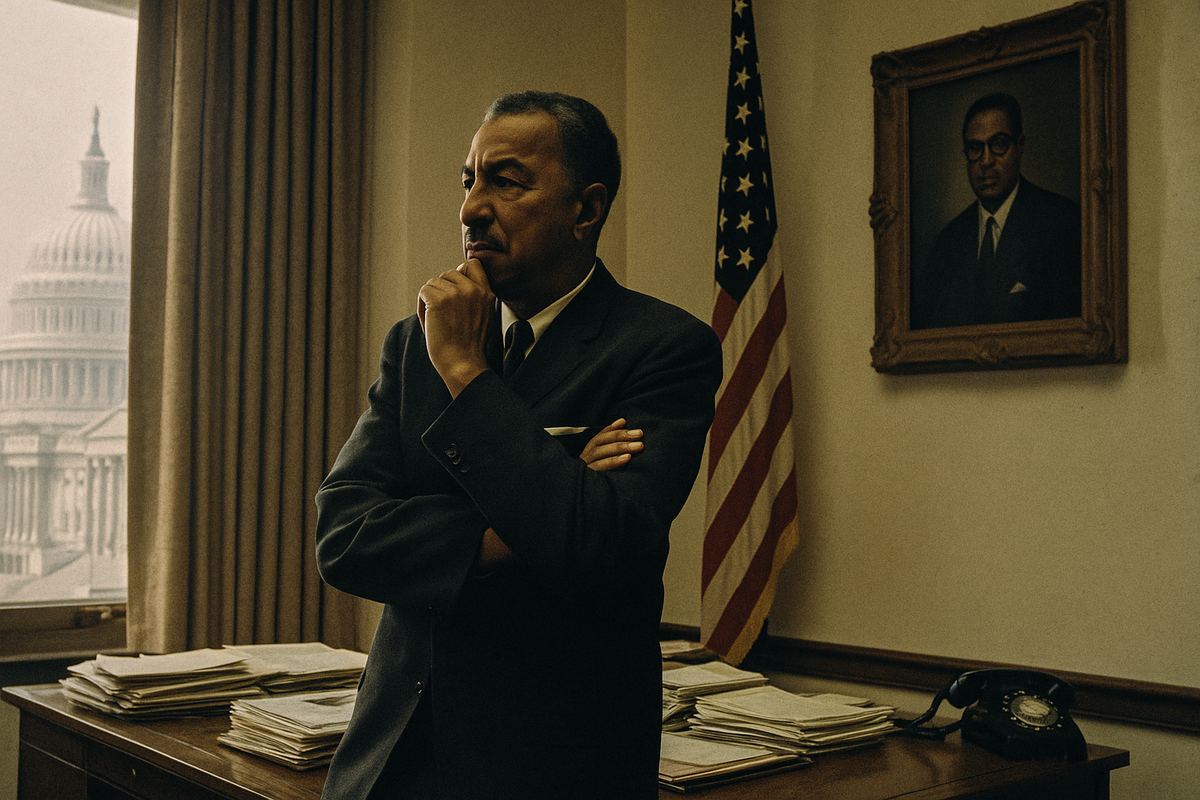
The cover photograph arrested the eye immediately: Powell in stark profile, half his face consumed by shadow, caught mid-conversation with an intensity that suggested both calculation and danger. This was not the airbrushed optimism of mainstream magazine covers. This was Ebony doing what it did best—refusing to simplify Black leadership for white comfort or Black consumption.
Journalist Lerone Bennett Jr.'s feature, "Adam Clayton Powell: Enigma on Capitol Hill," opened with a thesis that doubled as a warning: the most influential African American in government was also the most controversial, and America—Black and white—would have to reckon with that reality.
The photo essay that followed was a masterclass in visual biography. Powell presiding over committee hearings, his authority unmistakable. Powell on the Capitol steps, every inch the national lawmaker. Powell in Harlem, surrounded by the constituents who first elected him in 1945 and never stopped believing.
And then, the reveal: Powell at Villa Regoso, carving roast at dinner. Powell on a Puerto Rican beach with his glamorous third wife, Yvette. Powell cradling his infant son, Adam Diago. Powell living the life he insisted was his right to live, regardless of who thought a Black congressman should know his place.
The Legislator They Couldn't Ignore
By 1963, Powell had accumulated power that made him indispensable and infuriating in equal measure. As chairman of one of Congress's most influential committees, he controlled the legislative pipeline for education, labor, and social policy. The Manpower Development and Training Act. The Compromise Minimum Wage Bill. The Juvenile Delinquency and Youth Offenses Act. All passed under his gavel.
But Powell's most radical tactic predated his chairmanship. Since his earliest days in Congress, he had wielded what became known as the "Powell Amendment"—anti-segregation riders attached to legislation, forcing Democrats and Republicans alike to vote publicly on civil rights. Vote yes, and risk Southern fury. Vote no, and expose your hypocrisy. Either way, Powell won.
Bennett's article documented the legislative achievements with precision, but it was Powell's own words that revealed his philosophy: "I refuse to stay in 'my place.'" When critics attacked his absenteeism, his travel, his lifestyle, Powell deflected with characteristic defiance: "If it's not illegal, immoral, or fattening, Adam Powell is going to do it. I intend to live my life."
The white establishment heard arrogance. Black America heard something else: a man who refused to apologize for occupying space that had been denied to his people for centuries.
Ebony's Unflinching Mirror
What made this issue exceptional was Ebony's refusal to engage in hagiography or takedown. The magazine's editorial mission—launched by John H. Johnson in 1945, the same year Powell entered Congress—was to show Black life in its full complexity: achievement and controversy, dignity and contradiction, public triumph and private humanity.
Ebony did not exist to make Black leaders palatable to white audiences. It existed to reflect Black life back to Black readers with honesty and pride. The Powell profile embodied this philosophy perfectly. Yes, he was accused of misusing public funds. Yes, his critics had evidence. And yes, much of that criticism was racially motivated, rooted in the expectation that Black politicians should be twice as careful and half as ambitious as their white counterparts.
Bennett's article laid out both sides without flinching. Powell as civil rights champion. Powell as political showman. Powell as devoted father. Powell as target of both legitimate scrutiny and racist double standards.
For Ebony's readers, many of whom kept every issue as a treasured record of Black achievement, this was not cognitive dissonance. This was reality. Black leadership in 1963 America required navigating impossible contradictions—and Powell refused to navigate quietly.
Political Power
Powell wielded unprecedented influence as chairman of the House Education and Labor Committee, controlling landmark legislation on minimum wage, education funding, and social policy.
The Powell Amendment
His signature tactic of attaching anti-segregation riders to bills forced public votes on civil rights, angering both parties but advancing the cause.
Cultural Symbol
More than a politician, Powell was a Harlem institution—preacher at Abyssinian Baptist Church and embodiment of Black pride and defiance.
Media Representation
Ebony's coverage refused to simplify Powell's contradictions, showing him as both legislative champion and controversial figure—fully human, unapologetically complex.
The Summer That Defined a Decade
The timing of this issue magnifies its significance. Within weeks of publication, a quarter-million people would march on Washington. Dr. King would deliver the speech that became the moral soundtrack of a movement. Kennedy's civil rights bill would begin its tortuous journey through Congress—a journey Powell would help shepherd until his own political downfall in the late 1960s.
The June 1963 Ebony captured Powell at his apex: powerful enough to shape national policy, controversial enough to dominate headlines, defiant enough to live exactly as he pleased. It documented a moment when Black political power was both more visible and more vulnerable than ever before.
And it did so with a sophistication that mainstream publications could not match. While Life and Look were still framing civil rights as a problem to be solved, Ebony was chronicling it as a revolution to be lived.
Why This Issue Endures
For collectors of vintage African American periodicals, the June 1963 Ebony ranks among the most significant issues of the civil rights era. Its historical timing—published during the summer that reshaped America—makes it essential. Its subject matter—a profile of Black power at its most complex and unapologetic—makes it invaluable.
But the deeper value lies in what Ebony preserved: a record of how Black Americans saw themselves and their leaders in real time, unfiltered by white media gatekeepers. These pages contain arguments that mattered, controversies that shaped policy, and images of Black excellence that mainstream America rarely acknowledged.
Issues featuring Powell, King, Malcolm X, and other architects of Black political power are consistently among the most sought-after Ebony editions. They represent not just history, but a particular kind of history—one told by Black journalists, photographed by Black artists, and preserved in Black households as proof of what was possible.
Collector Significance
Historical Timing
Published during the pivotal summer of 1963, weeks before the March on Washington and Dr. King's "I Have a Dream" speech.
Iconic Subject
Adam Clayton Powell Jr. remains a towering figure in African American political history, making this among the most sought-after Ebony issues.
Cultural Documentation
Ebony's images of Powell in both public power and private leisure created a record of Black life rarely seen in mainstream publications.
Archival Value
Original issues serve as primary sources for historians, educators, and families preserving the authentic voice of Black journalism during the civil rights era.
The Archive as Inheritance
Vintage Ebony magazines function as more than collectibles. They are family heirlooms, classroom resources, and cultural touchstones. They documented Black life when most of American media pretended it didn't exist, or existed only as a problem to be debated by white experts.
The Powell issue exemplifies this documentary power. It shows us a man who broke barriers and courted scandal, who passed landmark legislation and lived lavishly, who was simultaneously champion and enigma. It refuses to simplify him. It refuses to apologize for him.
And in that refusal, it tells us something essential about Black leadership in 1963—and perhaps about American leadership in any era: power without contradiction is power without truth.
Preserve the Record. Honor the Archive.
For collectors, historians, educators, and families preserving cultural memory, these original issues offer direct access to the voices, images, and debates that shaped modern America. Each magazine is a portal—not to a sanitized past, but to the messy, magnificent reality of Black life as it was actually lived.
Browse Ebony Magazine Collection